In the 13th–14th centuries, the Byzantine Empire was going through a difficult period. In 1204, its capital was seized by crusaders: they founded the Latin Empire, which existed until 1261. By the end of the reign of Emperor Andronicus II, the peaceful relations between the Byzantine Empire and the Golden Horde ended; in 1341, already under Andronicus III, the Mongol invasion of Constantinople was suppressed with difficulty.
The weakening of the Byzantine Empire contributed to the strengthening of the economic activity of Venice and Genoa, which founded their factories on the coast of the Black and Azov seas and controlled transcontinental trade. The “in-line” import of tableware turned out to be profitable for merchants. The trade relations with Taurica, where grain that was necessary for the domestic market could be purchased, were especially valuable.
Thanks to its favorable geographical position, throughout the Middle Ages, Sudak remained a major trade center which acted as an intermediary between various regions of the Mediterranean region on the northern shores of the Black Sea. Therefore, many artifacts from this period could be attributed to Sudak by their location only.
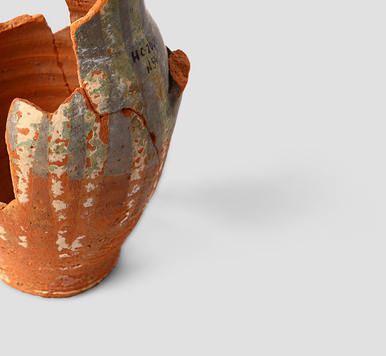
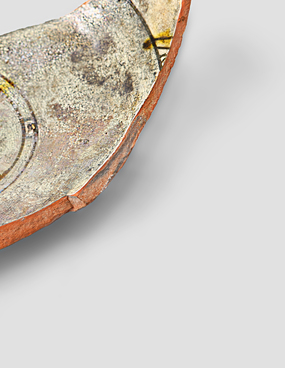
In the 13th–14th centuries, variants of sgraffito patterns in combination with other techniques, such as background removal and underglaze painting, became the defining features of different pottery schools. White clay pottery with brown-green glazing was gradually replaced by red clay pottery with sgraffito patterns on top of a white engobe.
Christian motifs abounded in the decoration of tableware when the population was not yet Islamized.
Natalia Vitaliyevna Ginkut notes that “glazed pottery… played an important role in the religious life of society, and in the Christian medieval world <…> simple glazed vessels with Christian symbols could become a relic” along with expensive icons, medallions and crosses.
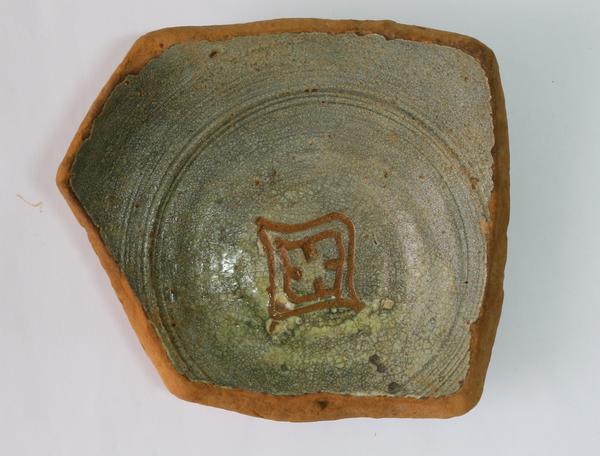
Researchers note frequent references to the warrior saints (Valentin Nikolayevich Danilenko, Alla Ilinichna Romanchuk and Stanislav Grigoryevich Ryzhov), birds (Svetlana Borisovna Adaksina and Natalya Vitaliyevna Ginkut) and ships (Irina Borisovna Teslenko). Natalya Ginkut also points to the presence of cross-shaped elements on the vessels.
According to Vera Nikolayevna Zalesskaya, vessels with crosses or monograms of saints could be eulogium bowls and were used in religious rituals.