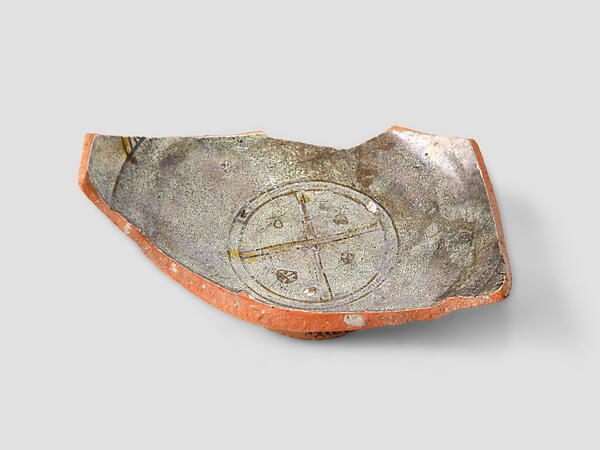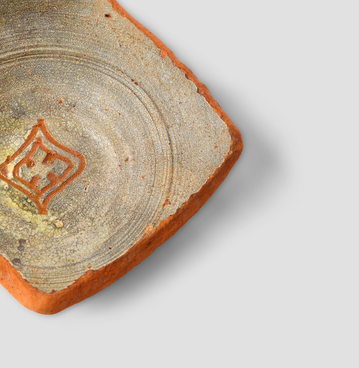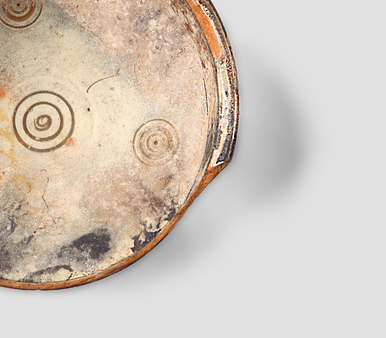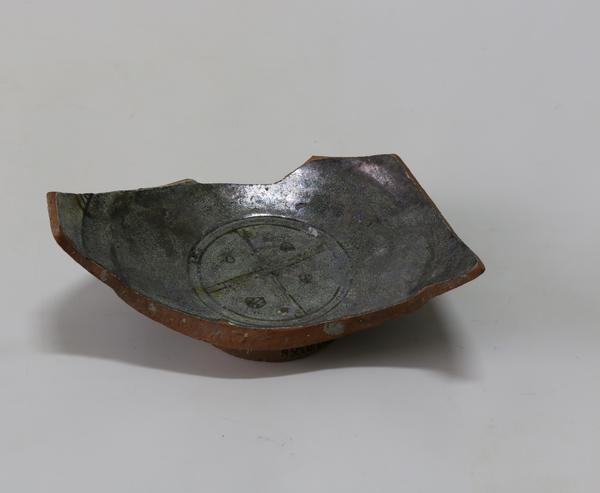
The earliest examples of painted ceramics date back to the 8th–9th centuries. They were made of white clay and decorated with one-colored, usually tear-shaped drawings.
In the 9th–10th centuries, there were middle-sized vessels “with a plain or oval body in profile, a round or loop-shaped handle and a short foot”, covered with three-color drawings of geometric figures, floral patterns and dots. Some of them bear the image of the so-called iconoclastic cross. Oftentimes the cross looked like a cross-shaped or rhomb-shaped figure. Vera Nikolayevna Zalesskaya defines such vessels as “ceremonial objects that were used for pouring milk into them, sometimes with honey <for> the noble newly-baptized barbarians”.
During this period, wares with relief stamped patterns and monochrome glazing of green or yellow-brown color were common. For stamping, designs carved on wooden or bone blanks, bird bones, jagged shells and other natural materials were used.
By the 13th century, whiteware had almost completely replaced redware. The exhibit belongs to the latter group of ceramics. The ware was painted with mineral dyes and covered with a glaze of multiple colors.
Painting was done directly on clay, and researchers distinguish two subtypes of such ceramics depending on the presence or absence of contour. The contour was more distinct and was applied in 1–2 mm thick lines of black and brown with a thin brush. The outlined details were filled with dyes — at the very least, there were three (yellow, pink and brown), and in more complex variations — five (the first three plus red and navy blue or green). Brown and yellow pigments were applied in a thin layer, blue (green) and red (pink) — in thick strokes to create relief.
Transparent or pale-yellow glazing was applied carefully so that the color of the painting was still seen through it. Because of that, the glaze layer was fragile and crumbled easily. Anatoly Leopoldovich Yakobson noted that many items lost their glazing almost completely and suggested that often it might not have been applied at all.