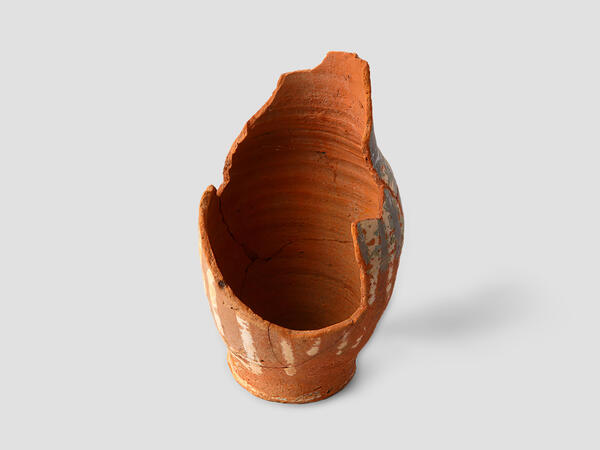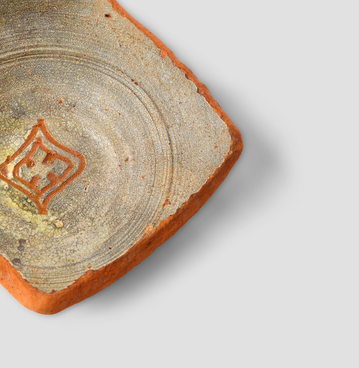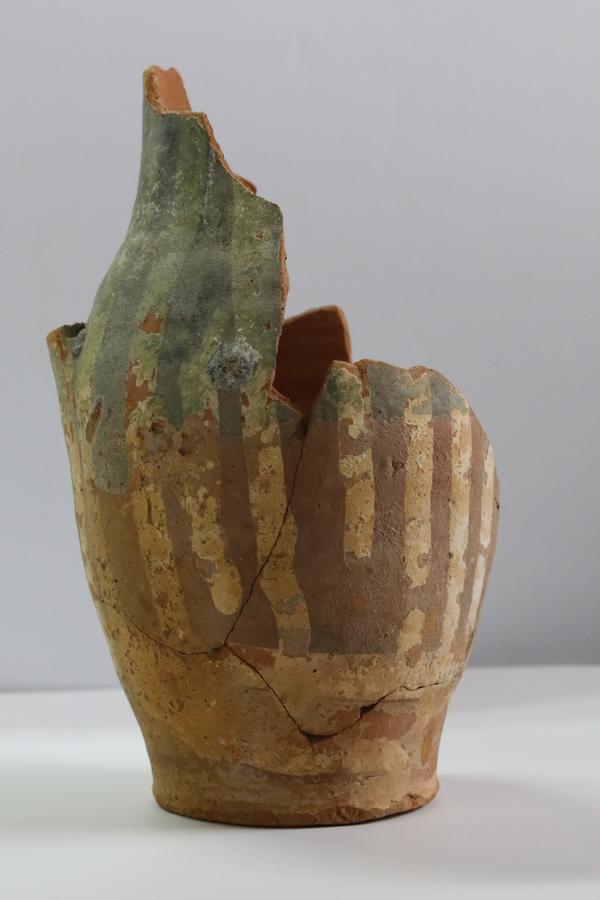
Four pottery fragments were raised from the bottom of Novy Svet Bay in 2000. They were then glued together to form the flat-bottomed jug on display. The find was identified as part of the cargo of the ship that sank in the 13th century.
The glazed redware on this ship was second in number only to the most widespread items — amphorae. Open-shaped dishware is represented by all kinds of serving dishes, plates and bowls, piala-shaped and shallow wide cups and bowls, and several types of goblets. Closed-shaped ones are less numerous and include only jugs.
The established sources, including lists of products exported by merchants from Italy, provide almost no information on whether pottery was sold. Nevertheless, archaeological finds made on the shore prove that artistic glazed pottery was actively imported to the Northern and Western Black Sea regions from Crimea, most likely by sea.
The centers of glazed pottery production were located in the territories that were rich in suitable raw materials and had the established traditions for this craft — the areas of Constantinople, Nicaea and Nicomedia (the northwestern part of Asia Minor).
The inner part of the jug shows some marks left by a potter’s wheel. This mechanism appeared in the 4th millennium BC in Mesopotamia, then came to Egypt and India. In 2,000 years, it was used in Greece, China, Iran and Central Asia, and by the 1st millennium BC became widespread in the countries of Western Europe. Thanks to this wheel, pottery evolved from an ordinary household chore (most likely done by women) into a special craft.
Pottery workshops could either be small, with only the potter and his apprentice working there, or include a whole staff of workers and craftsmen. Such artels could engage over ten employees.
The potter’s duties included extracting clay, cleaning it from impurities and mixing it, molding items on a potter’s wheel and turning them over, and joining the individual parts (the handle of the displayed jug was attached). The creative side of the craft (final finishing and decorating) was combined with the extraction of coal or firewood and heating the pottery kiln for firing. Oftentimes, the sale of finished products was also handled by the potter.