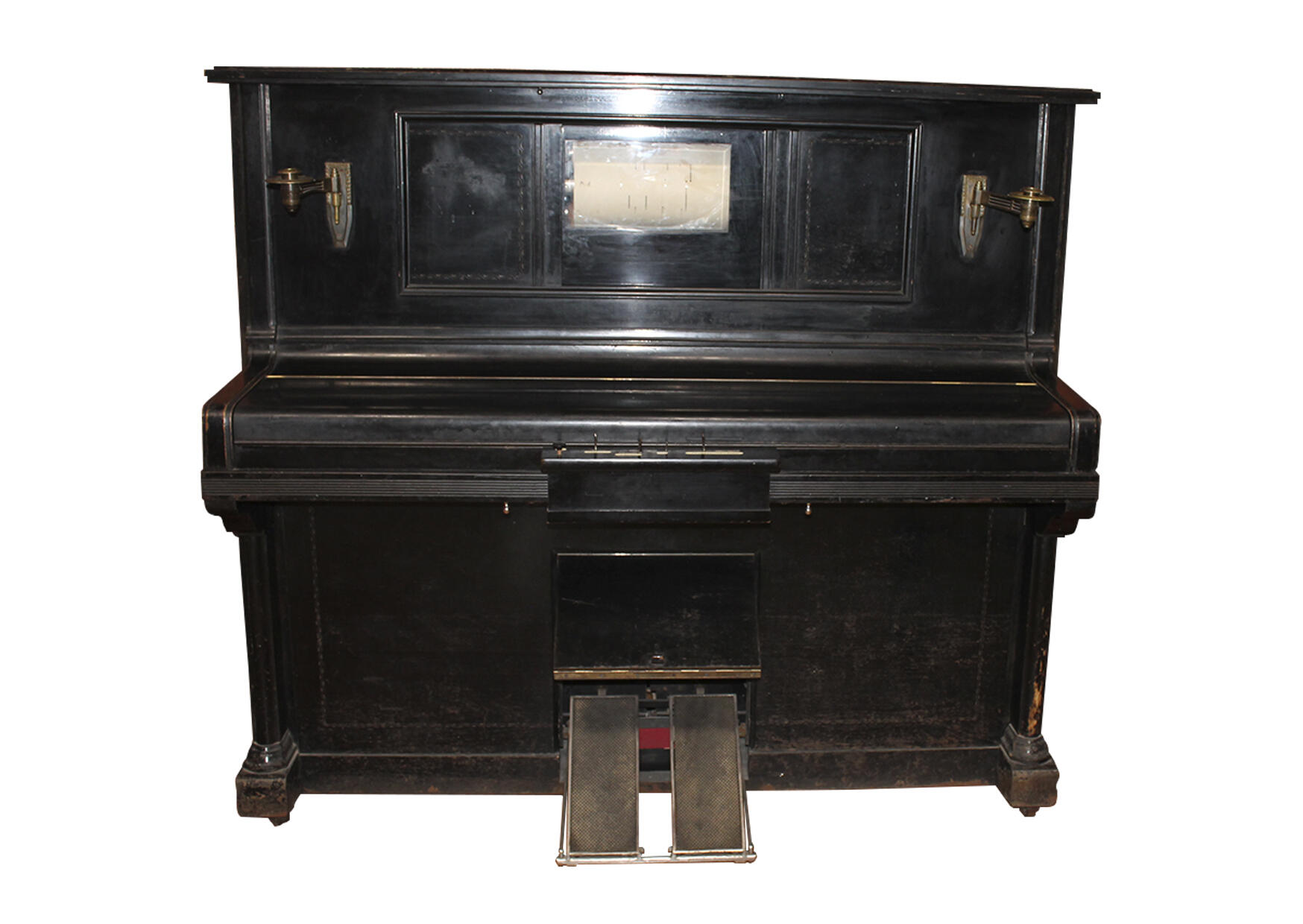
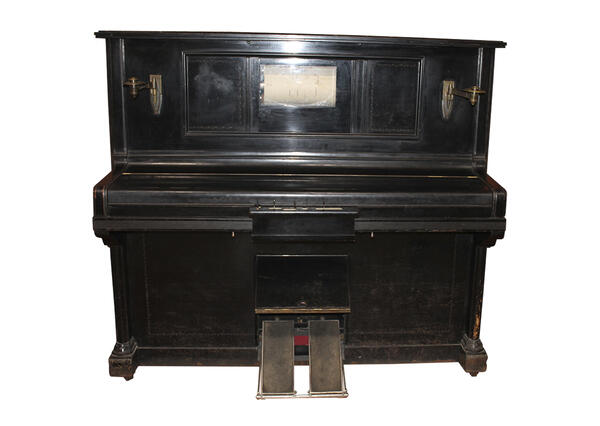
Collection of the Tomsk History Museum contains a pianola, a rather rare musical instrument for a city such as this that was produced in Germany in 1913. Pianola is a type of piano, a stringed and percussion keyboard instrument, that was invented in 1860. It is fitted with an electric motor that drives a perforated paper roll to reproduce music, with each hole on the tape corresponding to a note from the piece. Perforated paper programmed with recorded music is inserted into a device in the central section of the piano body. The volume and tempo of the piece can be adjusted using a panel found next to the keyboard. The keys of this musical instrument are made of bone, which is a valuable and expensive material.


Player piano
Creation period
1913
Place of сreation
Germany
Dimensions
130x144x86 cm
130 х 144 х 86 cm
130 х 144 х 86 cm
Technique
Industrial production
Collection
Exhibition
6
Open in app#1
Player piano
#3
#6
Pianolas can also be played the same way as a normal piano. To do this, all you need to do is close the instrument’s sliding doors and reset the settings.
#7
The pianola from our collection comes with punched rolls. We can find out what classical pieces the instrument could play from the list of contents featured on the box. Written in German, it tells us that the tapes contain the works of Franz Peter Schubert, Frederic Chopin, Ludwig van Beethoven, and Franz Liszt.
#5
This musical instrument was made at the Ibach factory, which specialized in the production of pianos and organs. The company was founded by Johann Adolf Ibach in the city of Barmen in 1794. In those years, pianos were becoming increasingly widespread in drawing rooms, thus replacing the harpsichord, a keyboard instrument that produces sound by plucking the strings. Between 1804 and 1863, the Ibach company was the leading piano manufacturer. The factory introduced a new design of the string-plate, a component that transmits vibrations from the strings into the air, making the sound much louder than if it was produced by the string alone. These new pianos were suitable for concert halls, rather than just playing at home.
#8
In 1869, the factory was inherited by Johann Adolf Ibach’s grandson, Rudolf. He renamed the company to Rud. Ibach Sohn. Seven generations of the Ibach family have been engaged in the production of musical instruments, and their pianos are still been manufactured to this day.
#9
Tomsk History Museum
read morehide
00:00
00:00
1x
Player piano
Creation period
1913
Place of сreation
Germany
Dimensions
130x144x86 cm
130 х 144 х 86 cm
130 х 144 х 86 cm
Technique
Industrial production
Collection
Exhibition
6
 Point your smartphone camera to open in the app
Open in app
Share