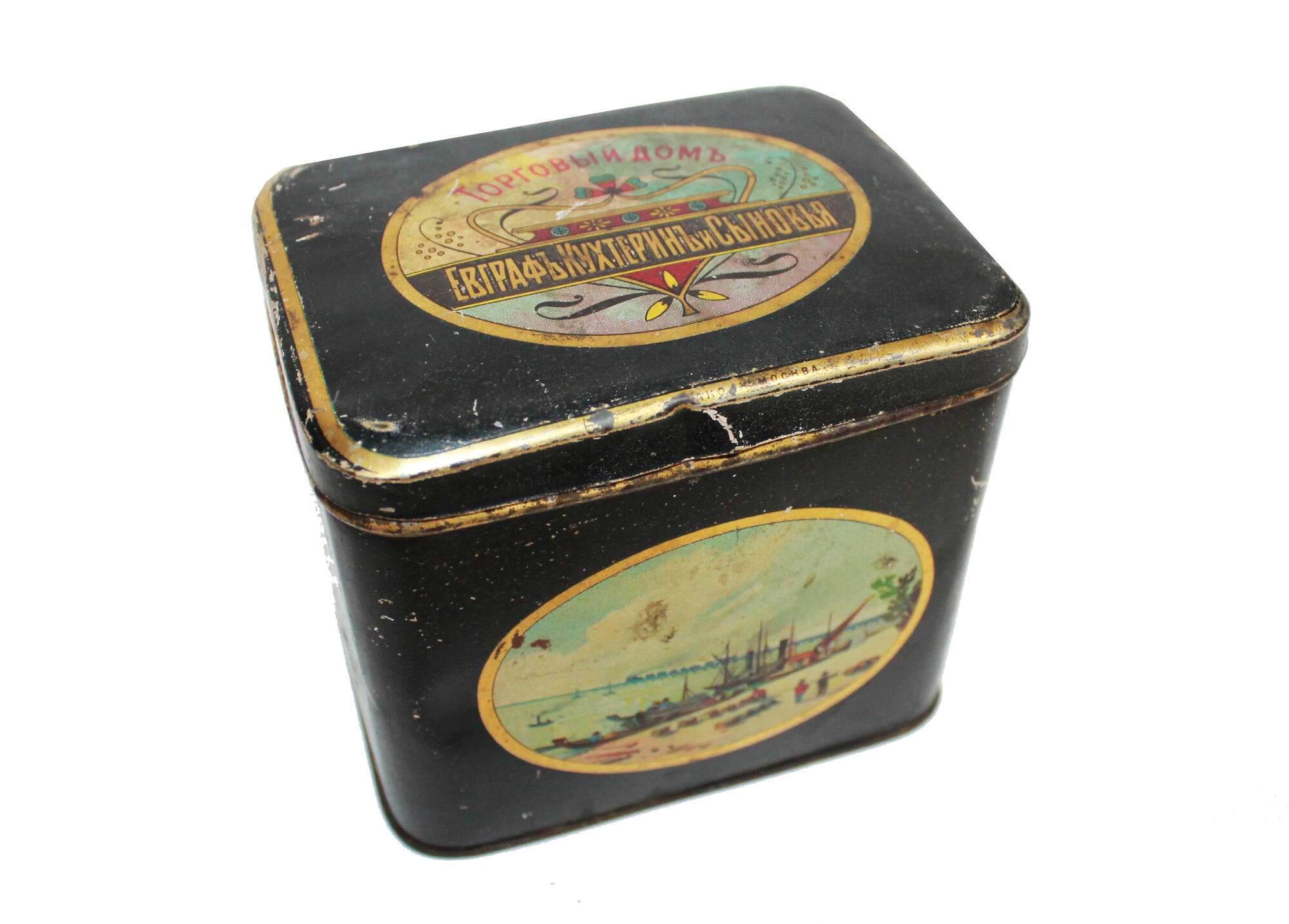
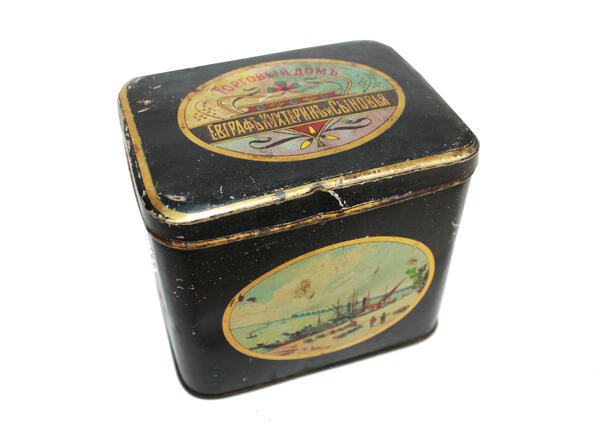
This tin can was intended for packing and storing tea sold by the Kukhterin merchant family, which was well known in Tomsk. In 1887, the merchant Yevgraf Ivanovich Kukhterin and his heirs Aleksey, Alexander, Innokenty, and Vladimir established the Yevgraf Kukhterin & Sons trading house. The company was involved in many fields. The family was engaged in carriage business throughout all of Siberia and part of European Russia. At its peak, the company employed 1,500 coachmen who drove about 30,000 carts. The merchants also owned a match factory and a large flour mill in Tomsk. They sold meat, flour, sugar, alcohol, matches, and kerosene. The business ties of the Kukhterins' trading house extended all the way to Moscow and St. Petersburg in the west and to the Chinese border in the east.


Tea box
Creation period
Late 19th–early 20th century
Place of сreation
A. Jaco & Co factory, Moscow, Russia
Dimensions
11,2 х 13 х 9 cm
Technique
Industrial production
Collection
Exhibition
1
Open in app#1
Tea Box
#3
#4
A significant portion of their profits came from Chinese tea, which they sold to merchants from Kyakhta, a Russian town on the Mongolian border. Our collection contains a box that was used for storing such tea. It is decorated with images of oriental scenes and jasmine flowers, which have been used in China since ancient times to give the tea a delicate aroma.
#5
In Tsarist-era Russia, compressed brick tea was considered to be cheap. It was made from small parts of tea leaves that remained as a byproduct of black pekoe and green tea processing. The drink was prepared by breaking off a piece from the brick and dropping it into boiling water. The more expensive tea varieties were sold in tin, wood, and glass packaging.
#6
According to an inscription on the edge of the lid, the tin can was manufactured at the A. Jaco and Co factory in Moscow. The factory was founded in Moscow by Frenchman A. Jaco in 1884. Eventually, it became one of the most well-known tin packaging producers in the Russian Empire. It manufactured containers for tea, coffee, candy, fruit and vegetable preserves, and canned fish, as well as cigarette cases, matchboxes, advertising signs, and many other products. At the customer’s request, the finished product could be decorated with an image from the factory’s catalog, as well as inscribed with the name of the company, and the item’s owner. In addition to its Moscow-based enterprise, the company also owned a factory in Odessa.
#7
Tomsk History Museum
read morehide
00:00
00:00
1x
Tea box
Creation period
Late 19th–early 20th century
Place of сreation
A. Jaco & Co factory, Moscow, Russia
Dimensions
11,2 х 13 х 9 cm
Technique
Industrial production
Collection
Exhibition
1
 Point your smartphone camera to open in the app
Open in app
Share