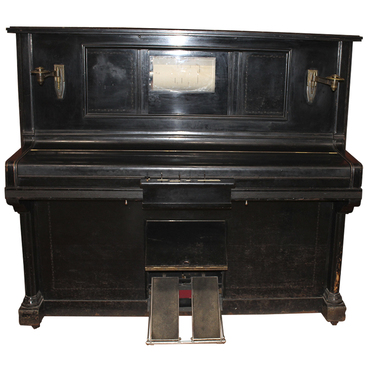
The merchant’s drawing room contains a tin box with the inscription “Vladimirovka Farm”s Comb Honey, 'Yevgraf Kukhterin & Family' Trading House in Tomsk.” Said Vladimirovka apiary farm was located on the outskirts of the city of Tomsk, between the Ushayka River and the Irkutsk highroad. It was named after Vladimir, one of the sons of Yevgraf Kukhterin, the founder of the merchant family.


Honey container
Creation period
Late 19th–early 20th century
Place of сreation
Russia
Dimensions
5,4x13,5x10,1 cm
5.4 х 13.5 х 10.1 cm
5.4 х 13.5 х 10.1 cm
Technique
Industrial production
Collection
Exhibition
2
Open in app#1
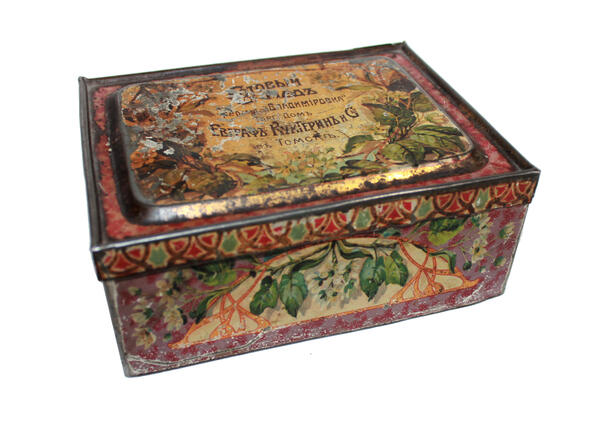
Honey Container
#3
#6
Siberia imported its honey up until the late 18th century. Same as other goods, it was brought here from the European part of Russia. Even honey hunting, the harvesting of wild honey, was not possible, as Siberia had no native bees. And those who came here from other regions could not survive the severe winter frosts.
#4
According to some records, the very first honey gathered in Siberia was produced near Ust-Kamenogorsk in the Tomsk Governorate. It was the place of duty for Colonel Nikolai Arshenevsky, who was missing the taste of honey from his home estate. Sometime between the 1780s and 1790s, he ordered bee logs from the Urals and hired an experienced beekeeper. In two years, the bee colony grew so much that the colonel began to sell bees to peasants, and in some cases even gave them away to the poor for free. In 1800, some of his bees were bought by Tomsk residents Stepan Duletov, Vasily Petrov, Andrey Antipin, and Dmitry Lozhnikov. Eventually, beekeeping spread to the Yenisey Governorate, and from there to Eastern Siberia. Thus, it was discovered that with proper care and attention bees can be bred even in an environment as challenging as this.
#5
The box from our collection was made at the A. Jaco & Co tin factory in Moscow. It was not easy to determine its origin, as the container has no surviving labels. However, researchers managed to find boxes of the same style, identical shape, and similar design. Their manufacturer was indicated as “A. Jaco & Co.” In tsarist-era Russia, many companies sent out packaging samples with price lists to various parts of the country, so that their customers could select a product from the available options and order a surprint with such information as the name of a confectionery factory, the name of a businessperson, or the type of a product. That is how tin containers with the labels “Ufa Linden Honey” and “Vladimirovka Farm”s Comb Honey” came to be produced at the same factory.
#7
Ministry of Culture of the Russian Federation
read morehide
00:00
00:00
1x
Honey container
Creation period
Late 19th–early 20th century
Place of сreation
Russia
Dimensions
5,4x13,5x10,1 cm
5.4 х 13.5 х 10.1 cm
5.4 х 13.5 х 10.1 cm
Technique
Industrial production
Collection
Exhibition
2
 Point your smartphone camera to open in the app
Open in app
Share