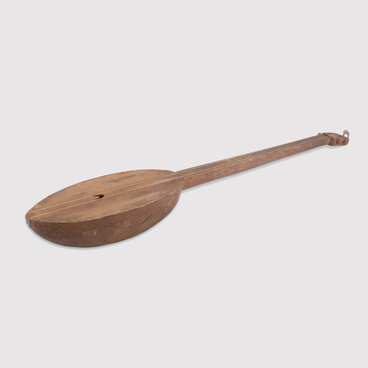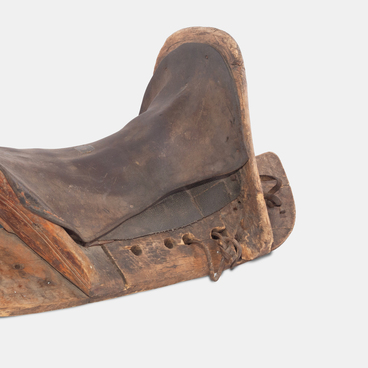
In ancient times, Shor women made dishes from clay. Over time, products made of wood and birch bark became very popular: men made elements of horse harness, smoking pipes, dishes, and other items of everyday use.
In the second half of the 19th— early 20thcenturies, the Shors used both wooden and birch bark, as well as metal, clay and, less often, leather or bone utensils.
Wooden utensils were divided into dugout, cooper (riveted from planks covered with hoops) and bent ones. For products of the first type, roots and burls (growths on tree trunks) were used, which were processed with special knives and tools for chiseling called “adylga”; bent ones were made from thin cedar shingles.
Cooperage utensils came into use at the beginning of the 20thcentury with the arrival of Russians in the regions of Gornaya Shoria. Probably, the first local coopers were Russian craftsmen, although over time, representatives of the indigenous population could also master the profession.
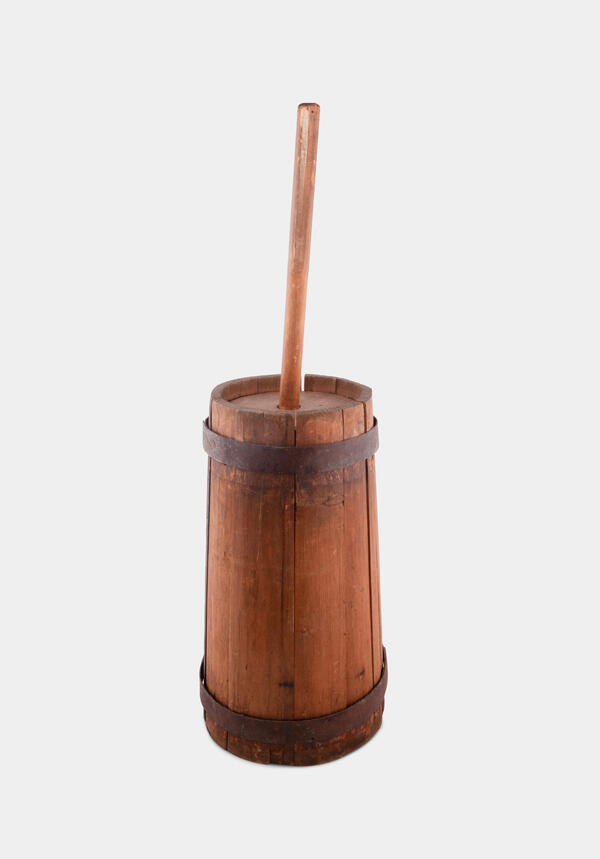
In everyday life, there were wooden containers of different sizes and purposes: larger barrels and tubs, medium-sized troughs and water buckets, smaller ones — butter churns. The kegs were used both for pickling vegetables and for storing flour, grain, and nuts. The barrels in which drinks were stored had bottoms on both sides, and the hole in the top was plugged with a wooden stopper.
The Shors who lived primarily in the steppe consumed dairy products such as kaymak sour cream, unleavened pyzhlak cheese, aarchy cottage cheese and sarmya butter.
Like the Russians, the Shors used cylindrical butter churns to beat butter in the first half of the 20thcentury. The devices looked like small barrels with two bottoms. A round hole was made in the center of the top one, through which the housewives put and rotated a beater — a round stick with a gear-shaped disk at the lower end.
Heavy cream was separated from the milk and placed in a churn. During churning, pieces of milk fat stuck into larger pieces and were separated. With continuous long-term work with a whorl, the butter became more and more dense and separated from the rest of the liquid.