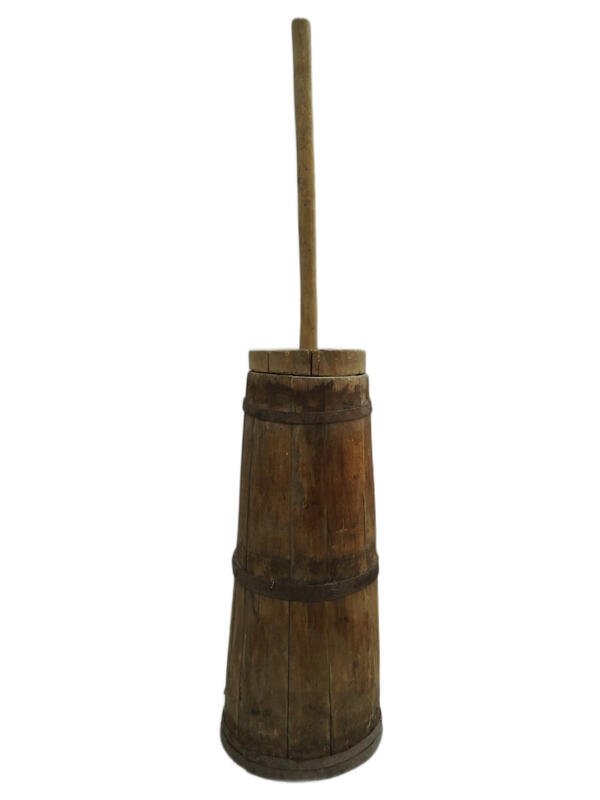
A butter churn from the collection of the Zheleznodorozhny Local Lore Museum was made in Russia in the mid-19th century.
A butter churn is a container in the shape of a truncated cone. It is assembled from rivets (narrow planks) held together by three metal hoops. It is closed with a lid with a hole for a staff equipped with a cross at the lower end. Such churns were called plunge churns and were used at small farms. They were made mostly of wood and had the shape of a barrel or a truncated cone; a staff with a cross or a perforated disk at the end was inserted through the lid. The churning was done in quick movements up and down, like in a piston. In Rus, it was believed that using linden barrels was a recipe for the most delicious butter; there were also experiments with cream — it was whipped and fermented to achieve different degrees of saltiness.
Churning butter was a long and leisurely process. Wooden churns were made by hand and came in different shapes: round, cylindrical, squared, polygonal or barrel-shaped. The most ancient type of churn was a tall, hollowed-out tub with a round of wood mounted at the end of a stick. In Rus, butter was also held in high esteem. In the agreement between Novgorod and the Germans from 1270, there is a mention of how much “a pot of butter” cost.
A churn was a source of pride because it spoke of
the prosperity of the household. They even had a saying about a good host — “he
has a buttery beard”. Women were always the ones to milk cows and process dairy
products. Butter was churned more often in spring and summer when milk yield
was increased. To make butter, milk was kept in a pot for the cream to rise to
the surface, then cream or sour cream (if the milk had turned sour) was skimmed
off with a spoon and put into a butter churn. Churning was usually entrusted to
children and teenagers: it was a simple task that did not require much physical
strength or special skills but was time-consuming.