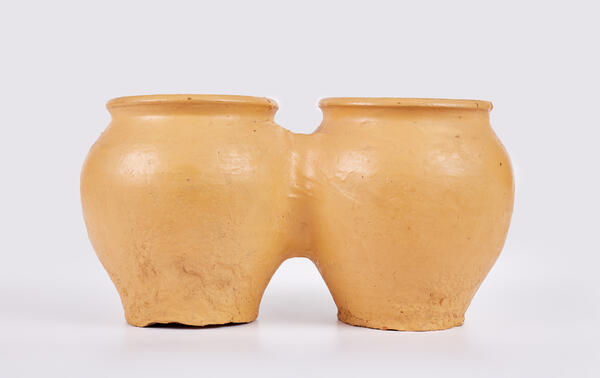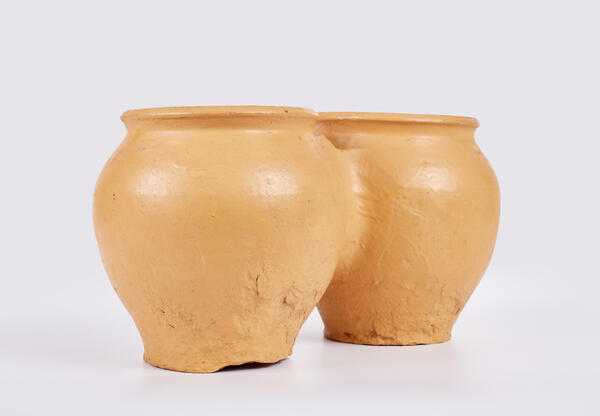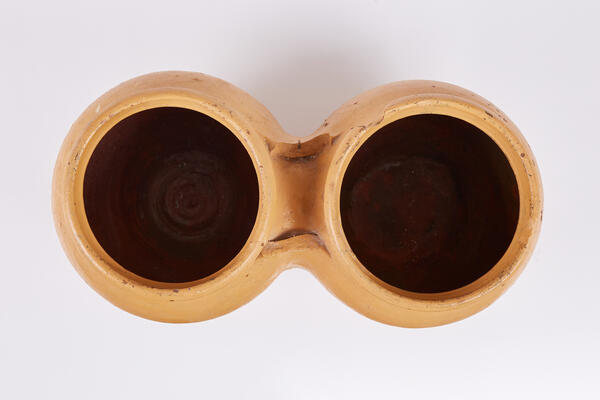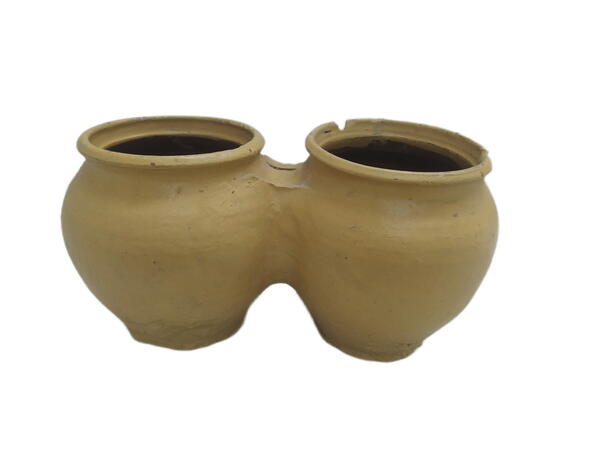
The collection of the Zheleznodorozhny Local Lore Museum contains a unique item — a double pot. This is a special type of cookware consisting of double pots with wooden lids that share a handle. This household item was called differently throughout Russian governorates: twins, twos, doubles, “shanki”, “parniky”, “sporyshi” and “polyatochki”.
Unfortunately, the two-piece pot presented in the exhibition did not withstand the test of time: the lid was lost, and a chip is now clearly visible where the handle used to be. This clay pot was made in Russia at the beginning of the 20th century using a potter’s wheel. Making such an item required great skill and patience from the craftsman: after the vessel dried, one of the pots could end up slightly lower or higher than the other. The thickness of the walls is also important, as it affects both the durability and the weight of the object. As a rule, the pots were not heavy and could be handled by a child.
In olden times, pots were the most common and most necessary utensils. Clay wares gradually heat up over a long period of time; food cooked in a pot is more nutritious and, if stored in a pot, does not get cold for a long time or heat up even in the sun. Even though there are many varieties of pots in Russia, they are only divided into two groups: those for cooking and those for storing food. Each peasant household had about 30–40 of them. This was mainly because there was a designated pot for each dish: there was a porridge pot, an onion pot, a company pot, a large earthenware pot, etc. This helped to avoid mixing smells when cooking, and the dish retained its unique taste. In the old days, pots were not yet glazed, and therefore each pot was permeated with the smell of the product for which it was intended. Once a year, for disinfection purposes, pots were placed upside down right into a heated Russian stove.
A double pot is a very practical thing; it was
created so that two types of food could be carried at the same time from home
to the field during haymaking and harvest, for example, one pot could have
cabbage soup, and the other — porridge.