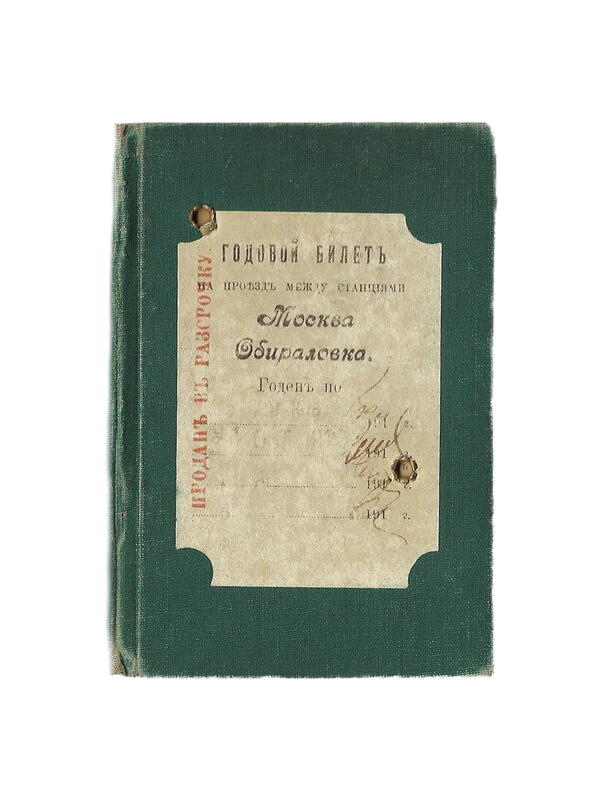
The Zheleznodorozhny Local Lore Museum presents a unique exhibit — annual train pass N0693 “Moscow — Obiralovka”. The city of Zheleznodorozhny used to be called Obiralovka until 1939. The ticket is dated August 1, 1916. The pass looks like a small book bound in green. It has a clear mark which reads “Sold in installments” and also indicates the price — 46 rubles. For reference, the average salary of a worker in Russia at that time was 37.5 rubles, a paramedic — 40 rubles, a gymnasium teacher — 85 rubles, and a Privy Councillor (high-class official) — 500 rubles.
In the middle of the booklet are special stubs marked “For pasting fee receipts.” Annual passes purchased in installments would be invalid without such receipts. The back of the pass cover always indicated the owner’s first, middle and last names. There was also a space for a photograph. So, by law, such passes were non-transferable to another person.
The first railway in the Russian Empire was opened under Nicholas I in 1837 and connected Saint Petersburg and Tsarskoye Selo. It was at this time that the first train tickets appeared in Russia. They were made of brass, had a rectangular shape with rounded corners and were reusable. The brass tickets were stamped with the carriage number, the place and time of departure and the destination station. Passengers bought the tickets at the ticket office and, upon arriving at their destination and exiting the carriage, handed them over to the train conductor, who returned them to the ticket office. Conductors got a fine in case of any missing tickets. Brass tickets were in use until the 1860s when they were replaced by paper ones.
Later, cardboard tickets were invented by Thomas Edmondson.
He also invented a ticket printing machine. Thanks to him, cardboard passes
began to spread from England throughout the world. A ticket was considered
valid if it had marks left by a ticket stamper. The stamper punched the
departure date and train number on the ticket. Therefore, tickets bought
elsewhere went through a sight check. The ticket itself indicated the departure
and destination stations (typographically printed), the train number and the
class of the carriage.