

Kamus skis. Tunguses are the indigenous inhabitants of the Angara region. Their main trade was hunting in the winter season. When there is a lot of thick snow, it is better for the hunter to follow the trail of the beast on kamus skis — this is a unique device of northern hunters: they not only allow relatively free movement through heavily snow-covered territory, but also to fish in conditions of deep snow cover, sneak up on the beast unnoticed, as the kamus extinguishes the crunch of snow.
Kamus skis are the ancient hunting equipment of the Evenks, which has survived to the present day. The use of skis made it possible to hunt in winter conditions, and contributed to an increase in the productivity of the hunter. Skiing was hunted not only by men, but also by women.
To create skis, the efforts of both the male (making a wooden base) and the female group (making a camus cover) are needed. Girls learned to sew from childhood, but only adult women who had strength in their hands were engaged in the manufacture of skins.
Kamus skis were passed down from grandfathers and fathers to the younger generation.
For the manufacture of skis, straight-layered spruce or cedar wood was used. The best skis are spruce, they are lighter. The wood for making skis is harvested in winter until the juices in the trunk move.
The length and width of hunting skis depends on the physical parameters of their owner, traditions and technology features, snow looseness, terrain roughness, etc. In the taiga, skis up to 1.5 meters long are used, the width of such skis is up to 23-25 cm, in the middle part their thickness is up to 2.5 cm and at the ends — 0.6–1.0 cm.
The prepared and bent ski was dried and, after carefully measuring, four holes were planned and drilled almost in the middle of the ski for (straps for fastening.
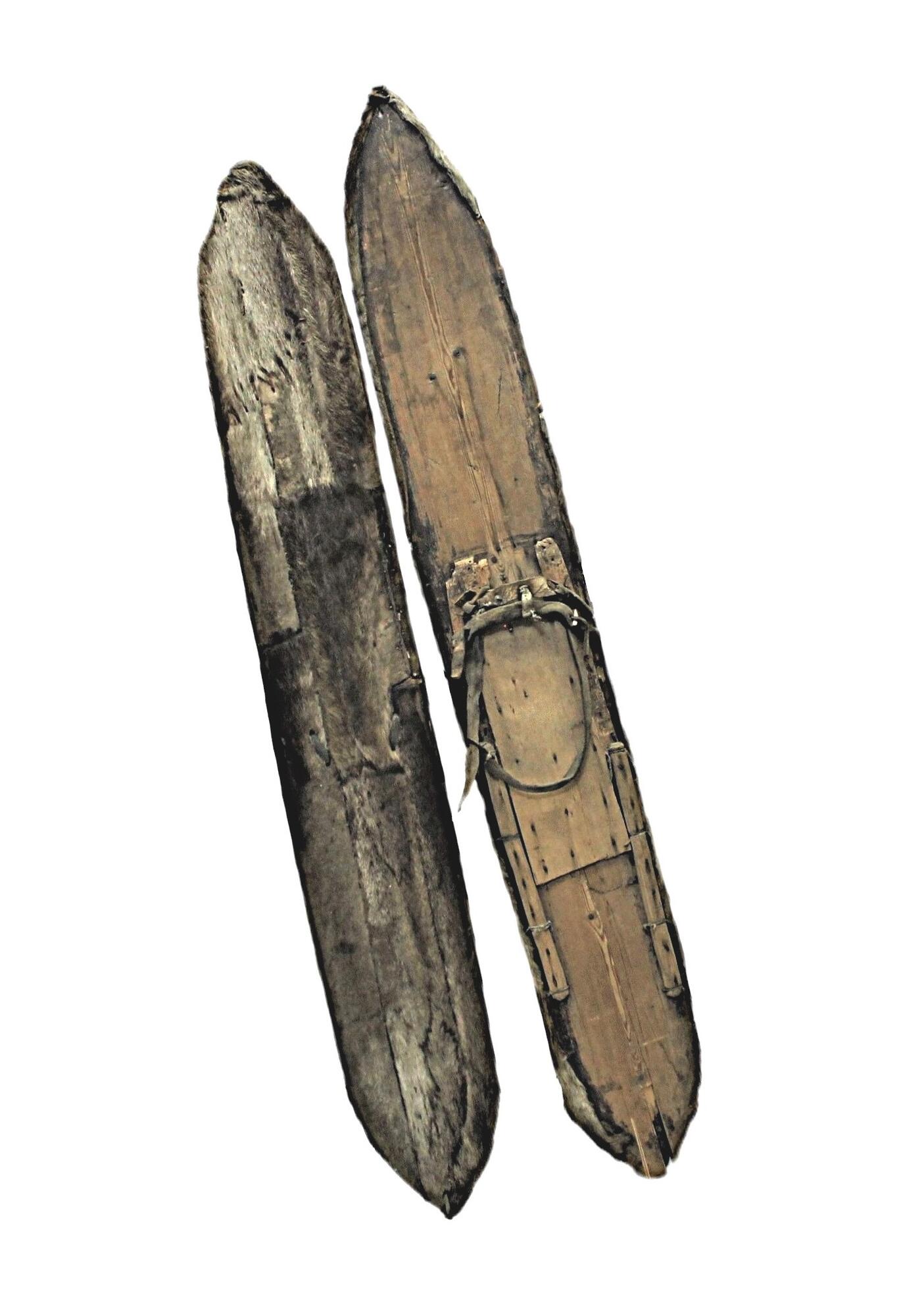
From the outside, the skis were pasted with a cover sewn from several kamuses in the shape of skis. Camus was taken from the deer’s feet, where the pile is small.
Kamuses took two or five pieces per ski. They were sewn in strips, pile in one direction. The sewn strip was wound with a pile top on a thick stick, sewing one end. The sewn end of the strip was put on the toe of the ski, covered with an even layer of thick fish glue, and unwound from the stick to the rear end of the ski, on which it was sewn, and the pile should go from the toe back. Pulling on the cover, they put ready-made skis to dry. For ease of climbing Kamus mountain, they glued the pile from the toe to the heel, then the skis did not slide back. After gluing, the skis were clamped with planks, dried, and after that they were inserted into the rules a second time and allowed to settle.
To prevent the foot from freezing and slipping, birch bark was glued to the upper surface of the skis under the foot in a shape resembling a shoe insole, that is, it was possible to distinguish the right from the left. Such a sticker (hargan’s followers) was glued with fish glue. Birch bark is an indispensable thermal insulator: the feet on it do not freeze, despite long walking. Snow does not stick to it and does not press under the heel in warm weather, the sole of fur shoes does not slip on it. Such skis have never broken down thanks to the glued camus and birch bark.
Then the fastenings of rawhide straps were attached to the loops for attaching the leg. Rawhide was made from deer or elk skin, removing the wool.Kamus skis. Tunguses are the indigenous inhabitants of the Angara region. Their main trade was hunting in the winter season. When there is a lot of thick snow, it is better for the hunter to follow the trail of the beast on kamus skis — this is a unique device of northern hunters: they not only allow relatively free movement through heavily snow-covered territory, but also to fish in conditions of deep snow cover, sneak up on the beast unnoticed, as the kamus extinguishes the crunch of snow.
Kamus skis are the ancient hunting equipment of the Evenks, which has survived to the present day. The use of skis made it possible to hunt in winter conditions, and contributed to an increase in the productivity of the hunter. Skiing was hunted not only by men, but also by women.
To create skis, the efforts of both the male (making a wooden base) and the female group (making a camus cover) are needed. Girls learned to sew from childhood, but only adult women who had strength in their hands were engaged in the manufacture of skins.
Kamus skis were passed down from grandfathers and fathers to the younger generation.
For the manufacture of skis, straight-layered spruce or cedar wood was used. The best skis are spruce, they are lighter. The wood for making skis is harvested in winter until the juices in the trunk move.
The length and width of hunting skis depends on the physical parameters of their owner, traditions and technology features, snow looseness, terrain roughness, etc. In the taiga, skis up to 1.5 meters long are used, the width of such skis is up to 23-25 cm, in the middle part their thickness is up to 2.5 cm and at the ends — 0.6–1.0 cm.
The prepared and bent ski was dried and, after carefully measuring, four holes were planned and drilled almost in the middle of the ski for (straps for fastening.
From the outside, the skis were pasted with a cover sewn from several kamuses in the shape of skis. Camus was taken from the deer’s feet, where the pile is small.
Kamuses took two or five pieces per ski. They were sewn in strips, pile in one direction. The sewn strip was wound with a pile top on a thick stick, sewing one end. The sewn end of the strip was put on the toe of the ski, covered with an even layer of thick fish glue, and unwound from the stick to the rear end of the ski, on which it was sewn, and the pile should go from the toe back. Pulling on the cover, they put ready-made skis to dry. For ease of climbing Kamus mountain, they glued the pile from the toe to the heel, then the skis did not slide back. After gluing, the skis were clamped with planks, dried, and after that they were inserted into the rules a second time and allowed to settle.
To prevent the foot from freezing and slipping, birch bark was glued to the upper surface of the skis under the foot in a shape resembling a shoe insole, that is, it was possible to distinguish the right from the left. Such a sticker (hargan’s followers) was glued with fish glue. Birch bark is an indispensable thermal insulator: the feet on it do not freeze, despite long walking. Snow does not stick to it and does not press under the heel in warm weather, the sole of fur shoes does not slip on it. Such skis have never broken down thanks to the glued camus and birch bark.
Then the fastenings of rawhide straps were attached to the loops for attaching the leg. Rawhide was made from deer or elk skin, removing the wool.