

Lottery tickets fall into the category of bearer securities. This kind of document is claimed to have been introduced in Belgium in 1466 when the first lottery was held. It was organized by the widow of the renowned painter Jan van Eyck to commemorate the 25th death anniversary of her famous husband. All proceeds went to help those in need.
In the 16th century, lotteries started appearing in other European countries, and 200 years later, they came to Russia. A Russian lottery was first mentioned during the reign of Peter I when a watchmaker named Jacob Gassenus was selling tickets with an instant result. In 1760, the state held the first official lottery, which proved to be unprofitable as the tickets were too expensive and no one bought them.
The popularization of charity in Russia in the second half of the 19th century led to lotteries becoming more ubiquitous. During this period, the country welcomed a great number of new public organizations and various funds that aimed at helping those in need. They were largely supported by members of the imperial family, nobles, prosperous industrialists, merchants, and ordinary people who were wealthy. One of the forms of raising money for charity was holding raffles: they were used for fundraising for the construction of hospitals, helping the wounded and sick soldiers, poor widows and orphans, and other purposes.
After the Russian Revolution, the Soviet authorities outlawed lotteries. However, three years later, the Council of People’s Commissars issued a decree “On the organization of lotteries by state institutions”. Lotteries were allowed as long as the proceeds were allocated for charitable purposes, such as advancing social welfare, healthcare, culture, and education.
Over time, the number of different lotteries kept increasing significantly. They were held by regional authorities, city, public and sports organizations, enterprises, collective farms, and factories. The tickets were printed at the Goznak factory. The greatest variety of topics in lotteries is found in the 1920s and 1930s.
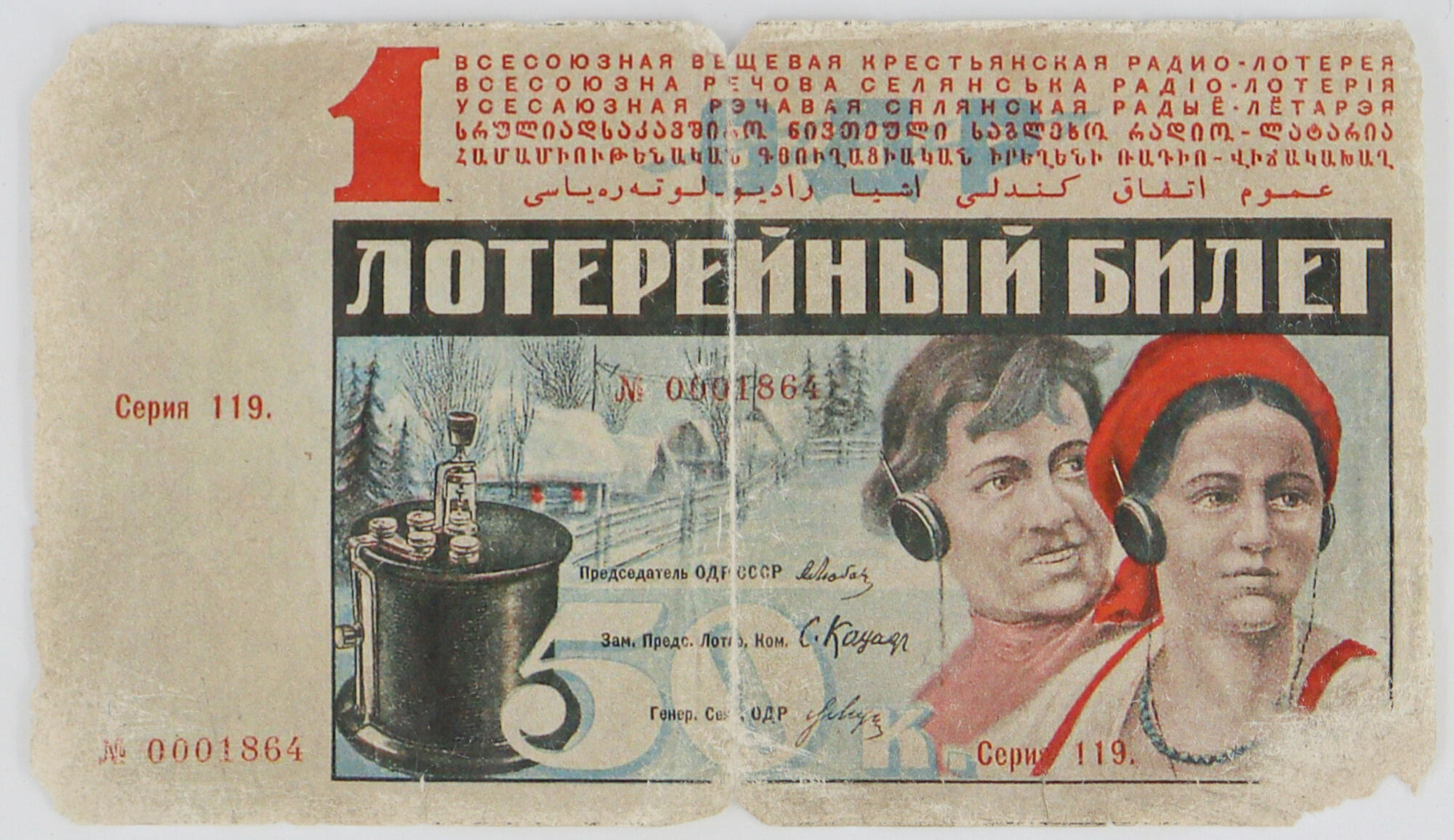
The First All-Union Peasant Radio Raffle, organized by the Radio Friendship Society in March 1929, had prizes totaling 750,000 rubles. The main prize was a full set of a broadcasting station for 50 receivers. The goal was to advance radio technology in rural areas. However, the tickets were not selling well: in a year, only 25 percent of 2,000,000 copies were sold.
In the 16th century, lotteries started appearing in other European countries, and 200 years later, they came to Russia. A Russian lottery was first mentioned during the reign of Peter I when a watchmaker named Jacob Gassenus was selling tickets with an instant result. In 1760, the state held the first official lottery, which proved to be unprofitable as the tickets were too expensive and no one bought them.
The popularization of charity in Russia in the second half of the 19th century led to lotteries becoming more ubiquitous. During this period, the country welcomed a great number of new public organizations and various funds that aimed at helping those in need. They were largely supported by members of the imperial family, nobles, prosperous industrialists, merchants, and ordinary people who were wealthy. One of the forms of raising money for charity was holding raffles: they were used for fundraising for the construction of hospitals, helping the wounded and sick soldiers, poor widows and orphans, and other purposes.
After the Russian Revolution, the Soviet authorities outlawed lotteries. However, three years later, the Council of People’s Commissars issued a decree “On the organization of lotteries by state institutions”. Lotteries were allowed as long as the proceeds were allocated for charitable purposes, such as advancing social welfare, healthcare, culture, and education.
Over time, the number of different lotteries kept increasing significantly. They were held by regional authorities, city, public and sports organizations, enterprises, collective farms, and factories. The tickets were printed at the Goznak factory. The greatest variety of topics in lotteries is found in the 1920s and 1930s.
The First All-Union Peasant Radio Raffle, organized by the Radio Friendship Society in March 1929, had prizes totaling 750,000 rubles. The main prize was a full set of a broadcasting station for 50 receivers. The goal was to advance radio technology in rural areas. However, the tickets were not selling well: in a year, only 25 percent of 2,000,000 copies were sold.