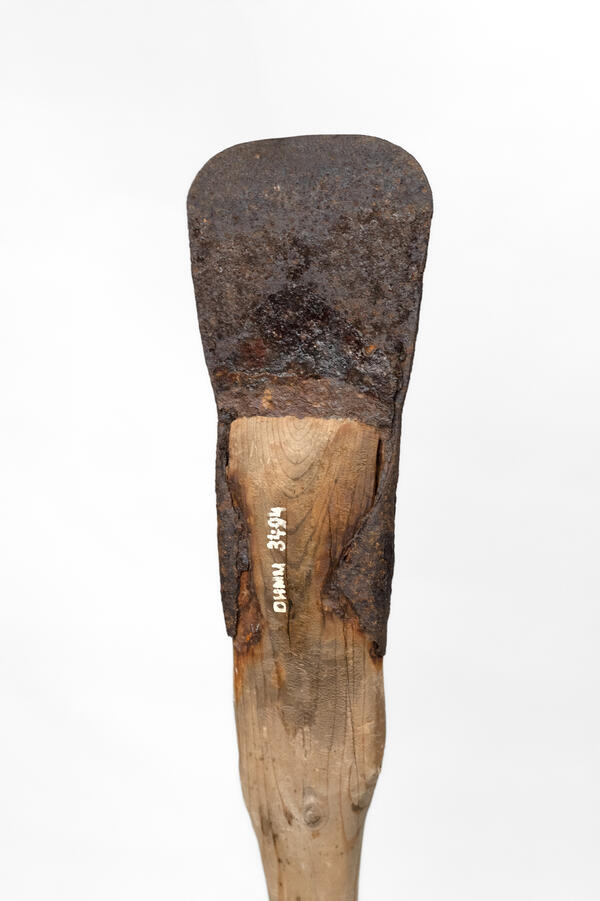
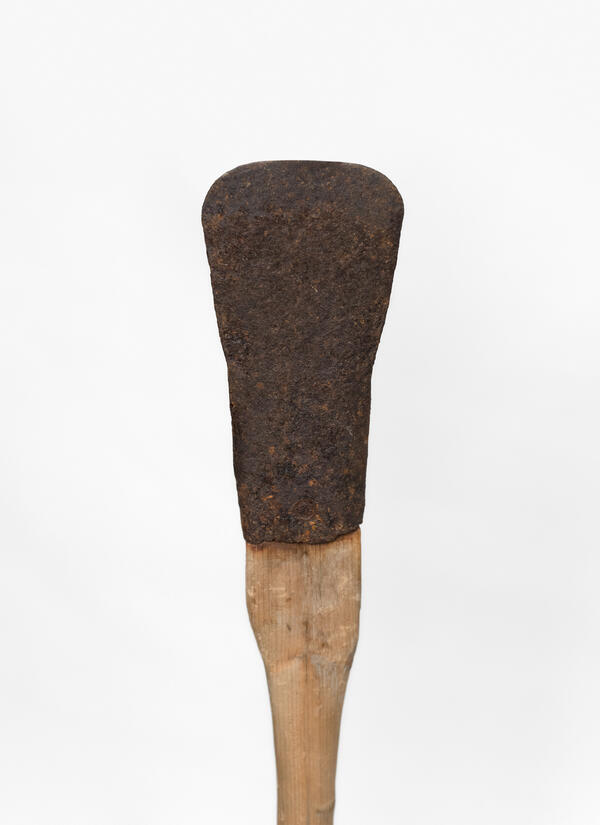
This shovel for digging marine worms was made in the early 20th century. The iron blade was given rounded edges. It turns it into a semicircular socket connecting with the shaft. The length of the blade is 20 centimeters. A wooden shaft flaring at the bottom was made of spruce. It has a length of 72 centimeters. The shovel comes from the Unezhma village in the Onega Uyezd, Arkhangelsk Governorate.
Usually, at the village blacksmith’s shop, shovels were forged from broken iron objects. These could include old scythes, axes, or cutting parts of plows. Charcoal for the blacksmith’s forge was prepared on site by burning wood without air inflow.
Locals noticed that the seabed consisted of silt and small pebbles. The oblong shape of the shovel best corresponded to the natural conditions in the village of Unezhma. The sandworm got its name due to its habitat. This is the closest relative to the earthworm. These worms attracted fishermen because they were effective bait for catching a wide variety of marine fish.
The sandworm, also known as the marine worm (Arenicola marina), is a polychaete worm. It can grow up to 20 centimeters long and one centimeter in diameter. Its maximum lifespan is 6 years. Its body is segmented. Its head end is blackish red. The middle part is red and has bristles that help the worm breathe. The tail has a brownish tint. Sandworms feed on organic matter found in the sand.
Locals have long known how to identify the hiding places of worms. These are funnel-shaped burrows, next to which is a mound with rings. Pomors have learned that if a worm is grabbed by the tail when digging and pulled out, the tail may break off. However, the tail of the sandworm can regenerate. Fishermen knew to look for sandworms between the funnel, or the entrance to the hiding place, and the mound.
At low tide, sandworms are found in large numbers on the sand banks near the village of Unezhma. In the past, they were harvested in large quantities. To catch fish, fishermen used various methods, such as with a fishing rod or a paternoster line, which was a rope with hooks (ganglions) attached to it and placed on the seabed at low tide. The fish that were caught most often included herring, flounder, navaga, and smelt.