Salmon has always been a great source of income for the Pomors. Merchants and traders were more eager to purchase it at higher prices than any other type of fish, so it was primarily sold, rather than consumed. The main types of salmon, according to their habitat areas, as well as the differences between them, were described by the ethnographer of the Russian North and writer Sergey Vasilyevich Maximov. According to his descriptions, in the mid-19th century, a salmon variety known as “porog” was caught in the Onega River in Podporozhsky District. This was a relatively lean salmon with dense flesh. Due to the proximity of this area to St. Petersburg and the quality of salmon salting, this variety was highly valued.
Umba was similar to porog, but it was inferior in terms of cooking quality. Varzuga was noticeably more tender, and its autumn variety was considered the best in the Pomor area. Ponoy and mezen were quite dry, fat-free varieties of salmon. Pechora and Kola salmon, with layers of fat between each layer of meat, could potentially surpass varzuga in terms of taste but were often poorly salted. Kandalaksha and pongama were considered the least favorable varieties in terms of flavor. Porog, umba, and varzuga were noted for their ability to retain their flavor qualities for an extended period when salted.
The salmon also varied depending on the running time. The tastiest, fattiest, largest, and most expensive variety was the “autumn salmon”, which refers to fish whose migration from the sea into the rivers began in early August. These fish had a distinctive mirror-silver color, which is why they were called “silver salmon”. Post-spawn fish that returned to the sea after spending time in fresh water and not eating the usual food acquired a dark brown, almost blackish color, and thicker scales.
In late winter and early spring, when rivers would become free of ice, fishermen would catch migratory fish which was significantly inferior in taste and size to the autumn salmon but was usually rich in large caviar. The summer run from May to August was called the mezhen or mezhonka by the Pomors. During this period, fish were smaller than in the autumn.
There were two main methods of salmon fishing: by blocking the river with logs and poles, and fishing with various types of nets. In addition, a dragnet was utilized in the autumn, which was pulled against the current by multiple boats.
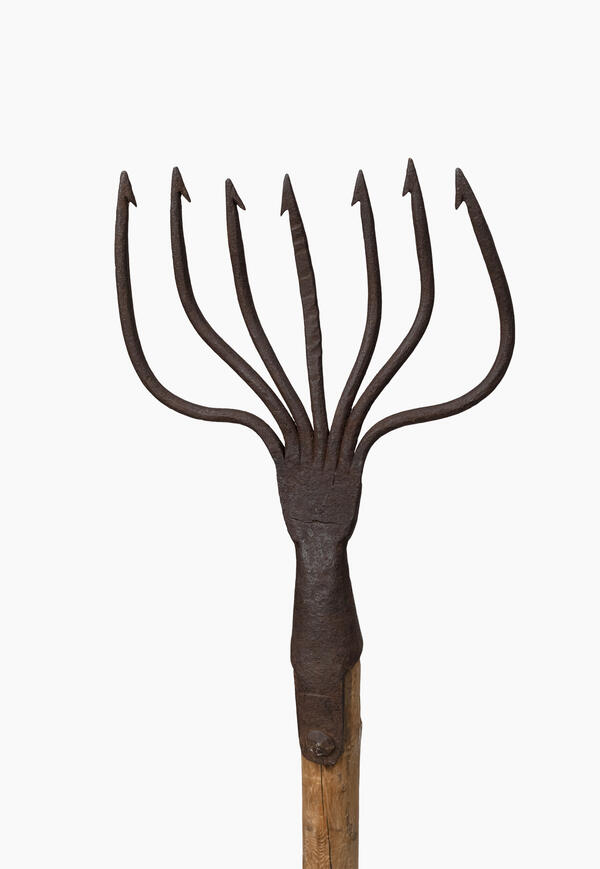
Using a leister to catch salmon was considered the most primitive method. Such fish were not caught for commercial purposes. The prongs were usually made of metal, although some people used wood or bone. The iron leister with a wooden handle from the museum collection dates back to the late 19th or early 20th century. The exhibit originated from the Vorzogory village in the Onega Uyezd, Arkhangelsk Governorate.