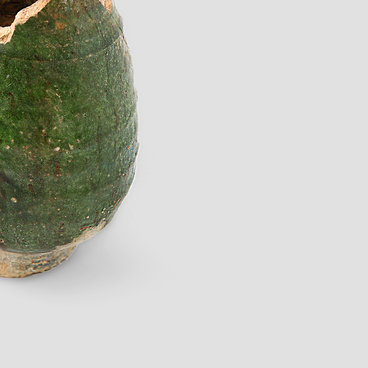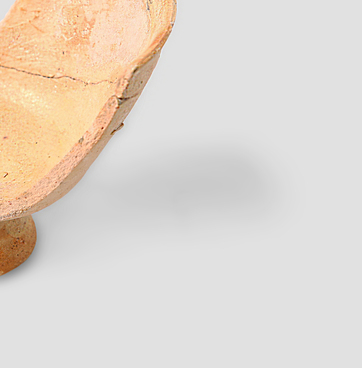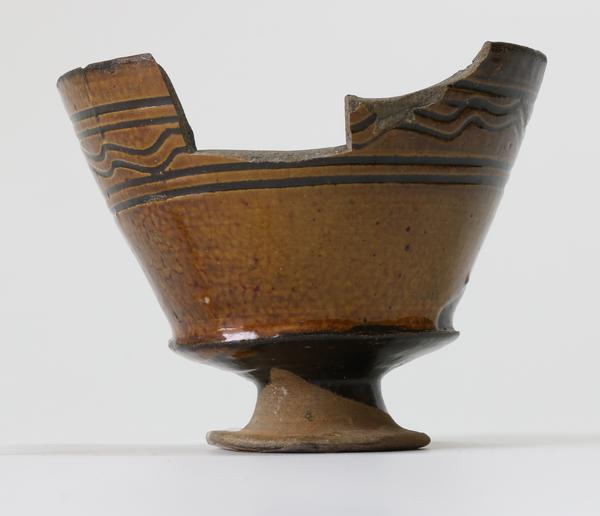
Since 2000, systematic exploration has been carried out between Cape Meganom and Cape Ai-Foka on the shelf of Sudak Bay; by now, a part of Kutlak Bay (Vesyoloye) and the shelf on the western side of Cape Meganom have been explored. In 2015, the staff of the joint underwater archaeological expedition organized by the State Budgetary Institution of the Republic of Crimea “Museum-Reserve ‘Sudak Fortress’” and the Institute of Oriental Studies of the Russian Academy of Sciences raised a number of items, including the goblet on display, from the bottom of Novy Svet Bay.
In the 13th century, workshops specializing in glazed pottery appeared in many centers of the Byzantine Empire, which were supervised by Italian merchants. The production spread throughout the Mediterranean Sea and Black Sea regions and began to develop actively on the Crimean Peninsula in the 14th–15th centuries.
This one-color item is covered with a layer of light brown coating and decorated on the outside with a sgraffito pattern in the form of straight and wavy concentrics.
The sgraffito (“scratching”) technique originated in Ancient Egypt over 4,000 years ago, from there it was borrowed by the Greeks and Romans. However, officially, the sgraffito technique, as well as the term itself, is dated to the 14th–16th centuries and is thought to have come from Italy. The modern craftsmen still use this ancient technique to create drawings or patterns.
To decorate a ceramic product in this way, a molded blank was dried and covered with a layer of engobe in a shade contrasting with the color of the clay. Although it is possible to work with both wet and completely dried engobe, it is still considered best to wait until it undergoes a short drying and loses some of the moisture. Once the surface becomes matt, the drawing is applied and scratched with a sharp object, reaching the surface of the vessel itself and forming an image within the glaze layer. When the drawing is ready, the vessel is fired, coated and, if necessary, fired once more.
Goblets were part of the most well-represented group of ceramics — tableware. The area where such items were found is very wide. They have been discovered during excavations in various places — throughout Turkey and, in particular, Asia Minor (Gulpinar, Iznik); along the Black Sea coast — from the Azov region (Azov/Azak) and Taman to Romania and Bulgaria; at the mouth of the Dniester and on the Crimean Peninsula; in Greece and Italy; in Serbia, Croatia, Macedonia and other countries of the former Yugoslavia.