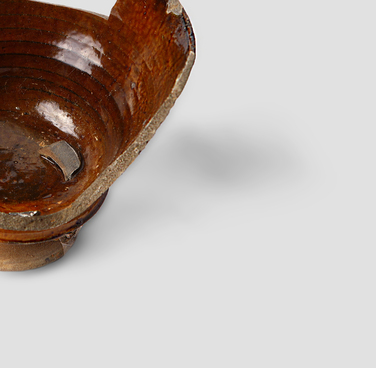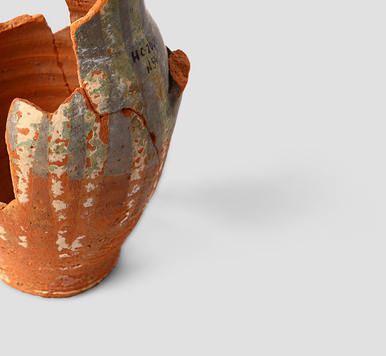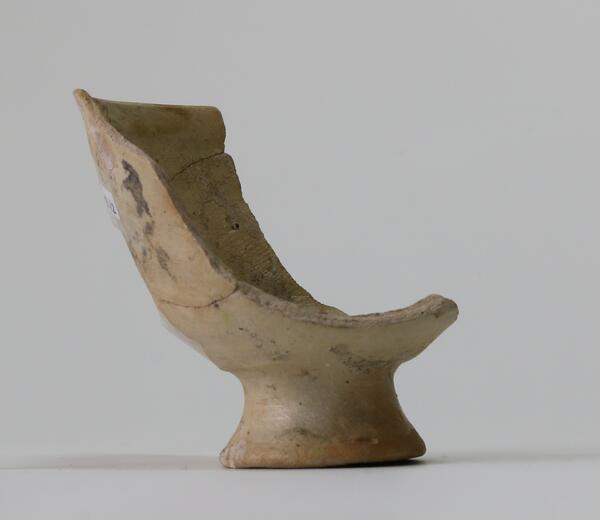
The exhibit was discovered as two separate fragments by the participants of an underwater archaeological expedition. They were processed and then glued together. The resulting large fragment, which paints a clear picture of what the whole object (in this case, a vessel) looked like, is recognized as an archaeologically complete profile, or an archaeologically complete form.
The white clay from which the goblet is made of indicates that it was most likely imported, as no such material was found on the territory of Crimea. So, this type of whiteware could have come from the Byzantine Empire or Italy, and only wealthy people could afford it.
The vessel was polished without the use of glazes. The essence of the technique is that the product or its separate parts are carefully polished with a smooth object like a pebble. The craftsman could make the object’s surface smooth and shiny, as well as add some wavy, straight or intersecting patterns to it.
Before polishing, the item was dried but not completely. The material had to lose its plasticity but retain its pliability so that a characteristic shine was left on its surface after polishing. The work of the polisher required speed and confidence, as it was important to finish the process before the clay dried completely. To enhance the effect, the shiny surface was fired and then covered with a layer of oil or glaze, as is in this case.
This processing was both decorative and practical: the treated products were characterized by greater water resistance.
Goblets that were used for drinking belonged to the most diverse group of crockery — tableware.
The collection of whiteware objects is the second largest group of tableware found at the shipwreck site. Most of the finds were probably intended for sale, but some may have belonged to the passengers or crew members. These personal items are distinguished by a graffiti mark on the exterior.