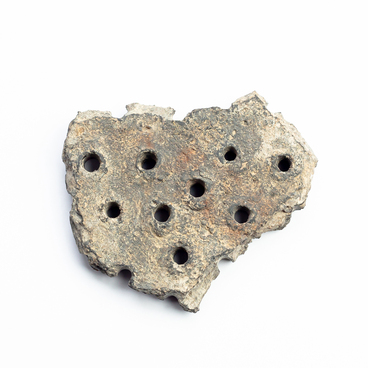
During the study of the Jurchen monuments in Primorye, one of the most common finds was ceramic roofing tiles.
Tiles were both a building material and an architectural detail. After studying them, scientists could make architectural reconstructions.
The finds of roofing tiles are an important indicator of the level of urban culture development.
The main building material for Jurchen dwellings was wood. Ordinary houses were thatched and had several rooms. Wooden walls were coated with clay. The buildings were heated by a kang — a clay bed, which also served as a chimney.
Wealthy houses were large and had tiled roofs. The walls were painted from the inside, and some houses might have featured paintings. The tiles, which were located on the eaves of the roofs, had a traditional zoomorphic and anthropomorphic decor, combining features of animals and people. There were several dozen types of decorative patterns, varied in their content and technique, but generally quite simple. As a rule, these were geometric designs.
The manufacture of building ceramics occupied a significant place in Jurchen craft production. In addition to tiles, bricks were also produced in large quantities.
A distinctive feature of the tiles was the imprint of coarse fabric on the concave side. Fabric was used in the technological process of shaping the tiles.
Thanks to archaeological research, the construction of the Jurchen tile kilns is now well known. Kilns were located outside the city or settlement, near clay deposits and water sources. They were highly productive: the volume of the firing chamber was about 5 cubic meters, allowing for about 2000 units of tiles to be fired at the same time.
Tile production took place seasonally during the relatively warm months of the year. Due to the complex and labor-intensive technique of producing this roofing material, the work was done by men. The craftsmen who manufactured tiles formed special groups, where professional skills and secrets were passed from father to son.
Most likely, such workshops and their products were
owned not by private individuals, but by the state, since only administrative
buildings, palace structures and ceremonial arches, as well as houses of the
Jurchen nobility, had tiled roofs.