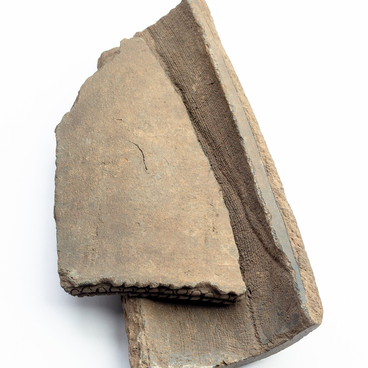
Chopping tools are among the oldest types of tools of the Paleolithic era. They belong to the category known as pebble tools.
A chopping tool was extremely easy to make and consisted of a pointed pebble. The working edge was formed by several flakes struck from both sides. The tool had an irregular shape. The rest of the chopping tool remained unprocessed and served as a handle for gripping.
Experiments by scientists have shown that creating such a tool required 10–15 strikes of one stone against another.
The tools could be used for butchering animal carcasses and processing plant materials.
People of the Early or Lower Paleolithic did not know how to grind or process materials in any other way. They used primitive methods — splitting a stone and then using its parts.
It has been established that already during the Paleolithic, there were special workshops for the production of stone tools. At these sites, researchers find a large number of artifacts: raw blanks and characteristically shaped flakes.
Humans appeared in the historical territory of Primorsky Krai more than 30 thousand years ago. The oldest and most well-known sites have been discovered by archaeologists near the village of Osinovka and in the cave of the Geographical Society.
The primary methods of obtaining food were hunting wild bulls and horses, reindeer, mammoths, and wooly Siberian rhinoceroses. The diet was supplemented by foraging. In those days, people did not stockpile provisions because they constantly followed animal herds. The most successful hunting occurred in places where the main routes of seasonal migrations of hoofed animals passed and where herds crossed rivers. These locations became long-term winter settlements and hunting camps of Upper Paleolithic people.
The chopping tool from the collection was donated to the museum by Fyodor Pavlovich Trigub, an archaeologist and local historian from the village of Chernigovka. Fyodor Pavlovich discovered over 350 archaeological sites in the Primorsky Krai and took part in many archaeological expeditions. In the 1990s, he donated a large collection of artifacts from various periods to the Spassk Museum of Local Lore.