An altar cross is an obligatory object in the altar of an Orthodox church. This cross entered the collection of the Radishchev Art Museum in 1930. When the relic was transferred from the Church and Art Department of the Regional Governorate Museum, a note was made in the inventory book indicating the original location of the cross. It was part of a collection from the village of Zubrilovka, Balashovsky District, Saratov Governorate, now Tamalinsky District, Penza Oblast.
The Golitsyn-Prozorovskys, the representatives of the most numerous princely family in Russia, used to live there. They purchased highly artistic liturgical objects to decorate the Church of the Transfiguration of the Savior, located in the territory of the estate. Some of these items are now kept in the collection of the Radishchev Art Museum.
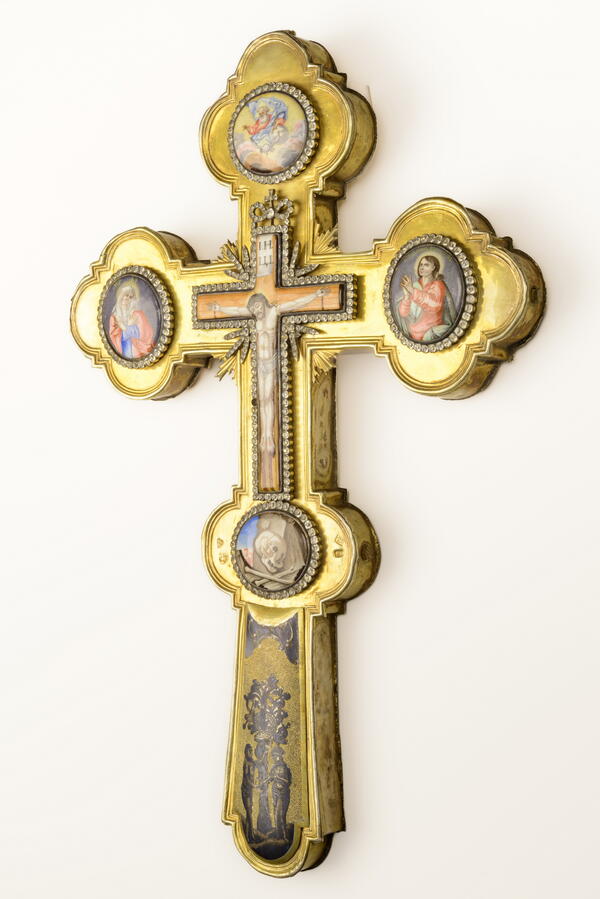
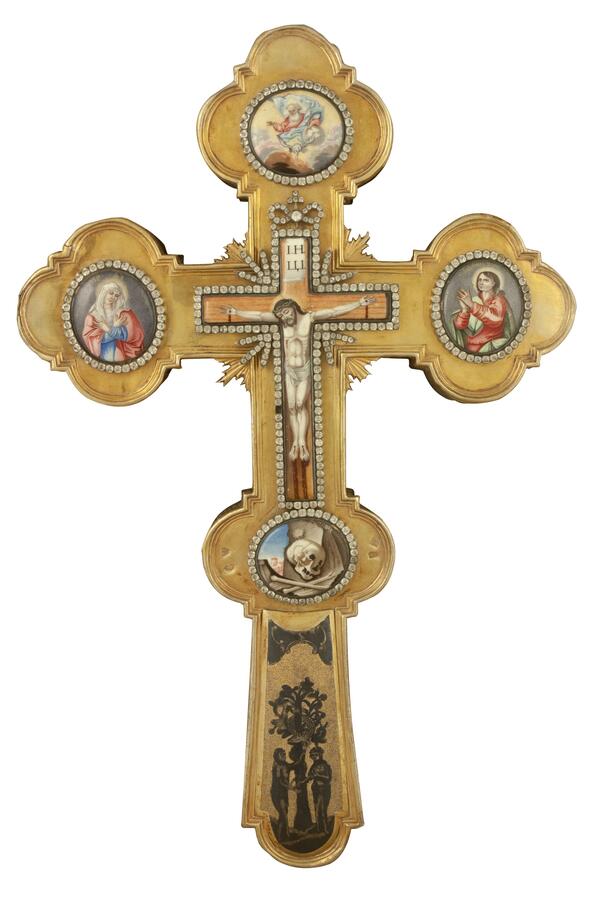
The silver cross is a brilliant example of gilding, chasing and niello techniques. Its front side is decorated with splendid inlays — painted enamel — and small faceted pieces of glass.
The enamels feature the images of saints. In the central part of the cross there is a fragment depicting the Crucifixion, at the top is the image of the God of Sabaoth in the clouds, at the bottom is Adam’s skull, on the left and right are half-length images of the Mother of God and the Apostle John the Theologian.
At the base of the cross, on a silver overlay made using the most complex niello technique, there is a fragment of the Old Testament story: Adam and Eve are depicted naked in the Garden of Eden near the Tree of Knowledge with a serpent.
The reverse of the altar cross is just as carefully designed as the front side. There are intricate relief images: an equal-armed ray-shaped cross in the center and garlands on short crossbars. The embossed background around the images is matte, the rest is polished, smooth, and shiny.
It is likely that this work of art and crafts was made by the famous Moscow silversmith Alexander Bogdanovich Hildebrandt, who was born in the middle of the 18th century. The cross was made in a workshop in Moscow, since there is a maker’s mark featuring the coat of arms of Moscow — St. George on horseback.
The Golitsyn-Prozorovskys, the representatives of the most numerous princely family in Russia, used to live there. They purchased highly artistic liturgical objects to decorate the Church of the Transfiguration of the Savior, located in the territory of the estate. Some of these items are now kept in the collection of the Radishchev Art Museum.
The silver cross is a brilliant example of gilding, chasing and niello techniques. Its front side is decorated with splendid inlays — painted enamel — and small faceted pieces of glass.
The enamels feature the images of saints. In the central part of the cross there is a fragment depicting the Crucifixion, at the top is the image of the God of Sabaoth in the clouds, at the bottom is Adam’s skull, on the left and right are half-length images of the Mother of God and the Apostle John the Theologian.
At the base of the cross, on a silver overlay made using the most complex niello technique, there is a fragment of the Old Testament story: Adam and Eve are depicted naked in the Garden of Eden near the Tree of Knowledge with a serpent.
The reverse of the altar cross is just as carefully designed as the front side. There are intricate relief images: an equal-armed ray-shaped cross in the center and garlands on short crossbars. The embossed background around the images is matte, the rest is polished, smooth, and shiny.
It is likely that this work of art and crafts was made by the famous Moscow silversmith Alexander Bogdanovich Hildebrandt, who was born in the middle of the 18th century. The cross was made in a workshop in Moscow, since there is a maker’s mark featuring the coat of arms of Moscow — St. George on horseback.