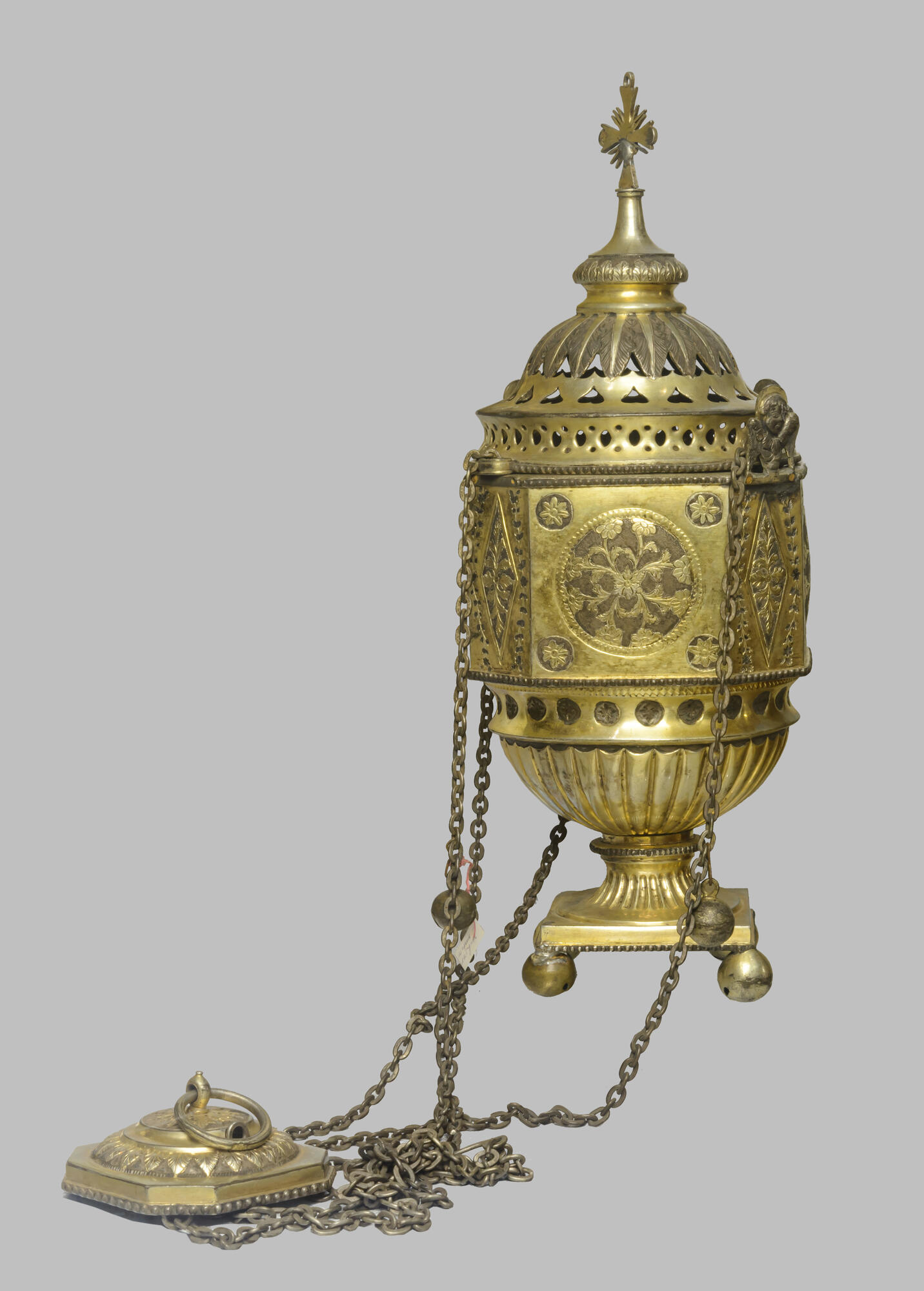


A censer is a special metal vessel on a chain, a bowl with incense lying on hot coals. Coal in this case symbolizes the earthly nature of Jesus Christ, and fire — the divine. There is a version that the censer also symbolizes the Virgin’s womb, and burning coals — Jesus Christ. During the service, the priest sways the censer, spreading incense. This burning of incense is called censing. It can be full (when the clergyman walks around the entire church) or partial (only near the altar and iconostasis).
In the Christian tradition, the censer appeared no earlier than the 4th century. It first came to Rus from Byzantium along with other liturgical utensils. Until the 17th century, hand-held censers (“katsei”) and censers on chains with an open top were widely used in Rus. These items, forged from silver or cast from bronze, were especially common in Veliky Novgorod and the Russian North.
Such vessels are mentioned in written sources, and their images are often found in murals, icons, miniatures and in the decoration of church utensils. However, censing with an open bowl could be dangerous: particles of hot coal could fall out and start a fire. Thus, open censers were often altered or an upper part, a lid, was added to them.
In 1930, this silver censer entered the collection of the Radishchev Museum among almost a hundred religious items. It was made at the end of the 18th century. The shape of the church utensil is quite complex: it is octagonal at the top, round at the bottom, with a low leg, a smooth square base, and it rests on ball-shaped legs.
The body — the main part of the censer — is richly decorated with chased and carved patterns: it is carved along the edges with an alternating ornament of round rosettes and rhombuses with floral designs on the sides. The lid is decorated with openwork floral and geometric patterns. The top is a four-pointed cross.
The censer was made in Moscow, as evidenced by the city brand featuring Saint George on horseback and the stamp of the famous artisan Aleksey Ivanovich Vikhlyaev: “A•B”, “1796/A•B”, “1781–1804”.
In the Christian tradition, the censer appeared no earlier than the 4th century. It first came to Rus from Byzantium along with other liturgical utensils. Until the 17th century, hand-held censers (“katsei”) and censers on chains with an open top were widely used in Rus. These items, forged from silver or cast from bronze, were especially common in Veliky Novgorod and the Russian North.
Such vessels are mentioned in written sources, and their images are often found in murals, icons, miniatures and in the decoration of church utensils. However, censing with an open bowl could be dangerous: particles of hot coal could fall out and start a fire. Thus, open censers were often altered or an upper part, a lid, was added to them.
In 1930, this silver censer entered the collection of the Radishchev Museum among almost a hundred religious items. It was made at the end of the 18th century. The shape of the church utensil is quite complex: it is octagonal at the top, round at the bottom, with a low leg, a smooth square base, and it rests on ball-shaped legs.
The body — the main part of the censer — is richly decorated with chased and carved patterns: it is carved along the edges with an alternating ornament of round rosettes and rhombuses with floral designs on the sides. The lid is decorated with openwork floral and geometric patterns. The top is a four-pointed cross.
The censer was made in Moscow, as evidenced by the city brand featuring Saint George on horseback and the stamp of the famous artisan Aleksey Ivanovich Vikhlyaev: “A•B”, “1796/A•B”, “1781–1804”.


