

The eight-pointed cross has been known since the 6th century and is the most common in Russia. It is believed that the Son of Man was executed on such a cross.
Above the crucifix itself, the soldiers nailed a sign with a mocking inscription “Jesus of Nazareth, King of the Jews.” It is symbolized by the upper short crossbar of the cross, which usually featured the initial letters of this inscription.
The lower slanting board is a support for the feet of Jesus Christ — the “righteous scales”, weighing the sins and virtues of all people. Legend has it that it is tilted to the left, because the thief who was crucified to the right of Christ repented and went to heaven with the Lord. And the second thief, who was executed on the left, challenged Jesus and His teachings, so that he aggravated his posthumous fate and went to hell.
For religious purposes, the eight-pointed Russian cross also features the letters ІС ХС — the so-called Christogram, the designation of the name of Jesus Christ. The Latin word NIKA, which means “winner”, is often printed or engraved nearby. This word symbolizes the resurrection of the Son of God, and His victory over death.
Some Christian crosses include an image of a skull and bones at the bottom. Legend has it that the remains of Adam and Eve were buried under the place of the crucifixion — at the foot of Golgotha. It turns out that the blood of Christ, as it were, washed away the original sin from the forefathers and their descendants.
The altar Orthodox cross from the collection of the Radishchev Art Museum is hollow inside and is designed to store the relics of revered saints. Various crosses and icons with a secret recess for relics were widespread in Old Rus.
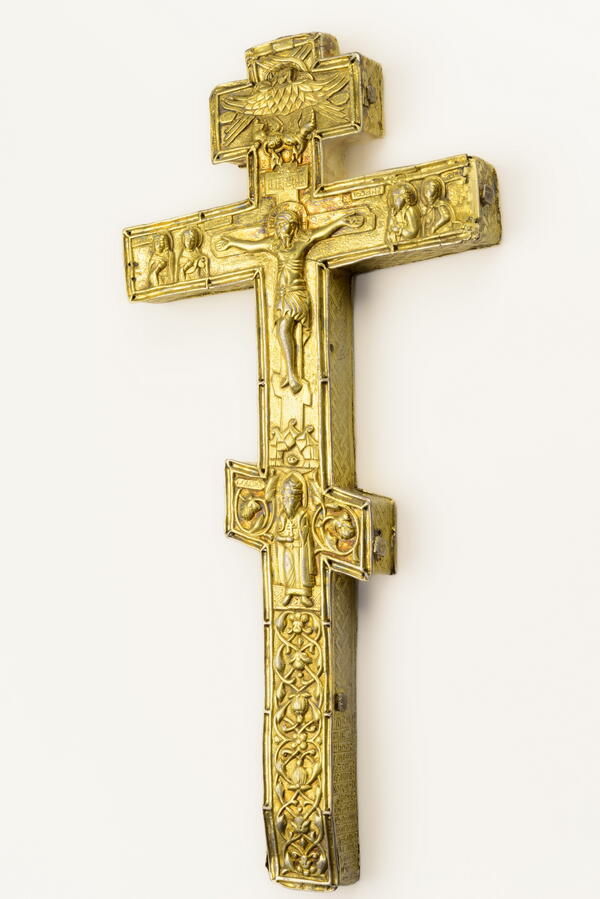
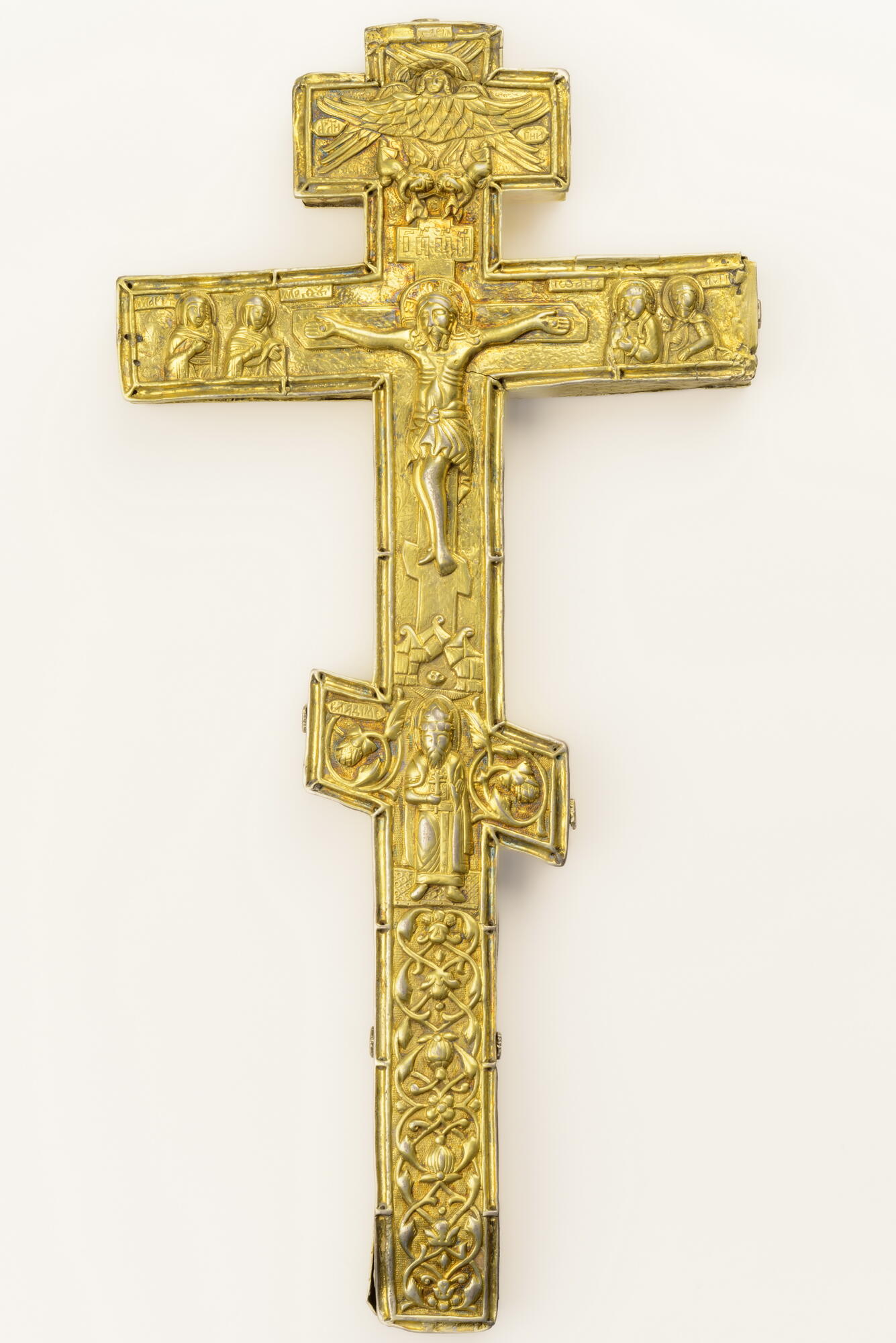
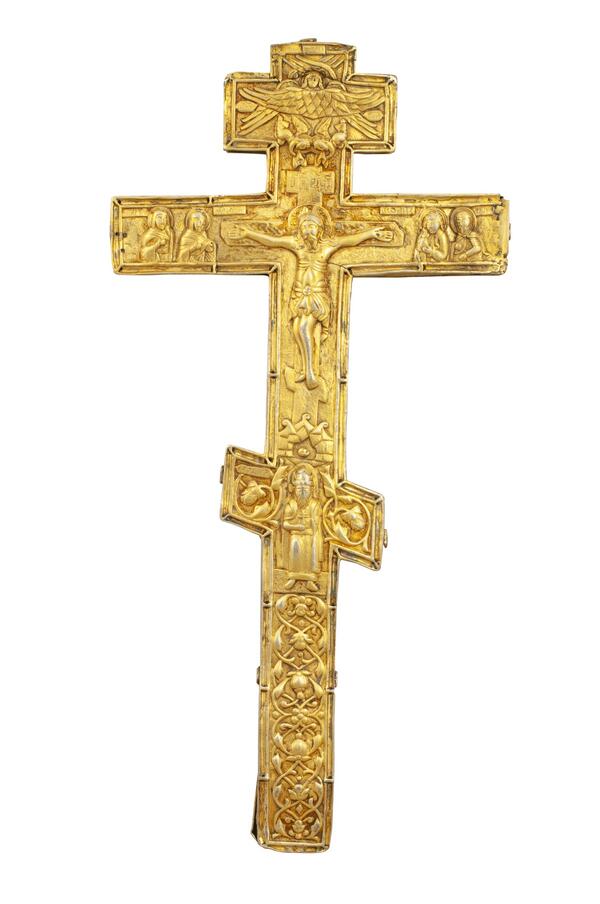
The silver cross is made using complex gilding and embossing techniques. It consists of thin sheets of precious metal with an embossed floral pattern on the surface. In the center of the cross, according to tradition, there is the Crucifixion, at the ends of the middle crosshairs there are two half-length figures of saints: the Mother of God, Mary, the Apostle John, and Joseph of Arimathea. Above the head of Jesus Christ in the upper crosshairs are the figures of a six-winged seraph and two angels. At the feet of the Savior is the skull of Adam and the city. In the middle of the lower crossbar is the image of St. Vladimir with a cross in his right hand.
At the base of the cross are stylized leaves and fruits. The reverse side is completely covered with a chased pattern of scrolls of plants, rosettes and shells. The sides are trimmed with an ornamental carved “pigtail”. The inscription on the right side of the lower end of the cross says that the relic was made for the Saratov Monastery.
Above the crucifix itself, the soldiers nailed a sign with a mocking inscription “Jesus of Nazareth, King of the Jews.” It is symbolized by the upper short crossbar of the cross, which usually featured the initial letters of this inscription.
The lower slanting board is a support for the feet of Jesus Christ — the “righteous scales”, weighing the sins and virtues of all people. Legend has it that it is tilted to the left, because the thief who was crucified to the right of Christ repented and went to heaven with the Lord. And the second thief, who was executed on the left, challenged Jesus and His teachings, so that he aggravated his posthumous fate and went to hell.
For religious purposes, the eight-pointed Russian cross also features the letters ІС ХС — the so-called Christogram, the designation of the name of Jesus Christ. The Latin word NIKA, which means “winner”, is often printed or engraved nearby. This word symbolizes the resurrection of the Son of God, and His victory over death.
Some Christian crosses include an image of a skull and bones at the bottom. Legend has it that the remains of Adam and Eve were buried under the place of the crucifixion — at the foot of Golgotha. It turns out that the blood of Christ, as it were, washed away the original sin from the forefathers and their descendants.
The altar Orthodox cross from the collection of the Radishchev Art Museum is hollow inside and is designed to store the relics of revered saints. Various crosses and icons with a secret recess for relics were widespread in Old Rus.
The silver cross is made using complex gilding and embossing techniques. It consists of thin sheets of precious metal with an embossed floral pattern on the surface. In the center of the cross, according to tradition, there is the Crucifixion, at the ends of the middle crosshairs there are two half-length figures of saints: the Mother of God, Mary, the Apostle John, and Joseph of Arimathea. Above the head of Jesus Christ in the upper crosshairs are the figures of a six-winged seraph and two angels. At the feet of the Savior is the skull of Adam and the city. In the middle of the lower crossbar is the image of St. Vladimir with a cross in his right hand.
At the base of the cross are stylized leaves and fruits. The reverse side is completely covered with a chased pattern of scrolls of plants, rosettes and shells. The sides are trimmed with an ornamental carved “pigtail”. The inscription on the right side of the lower end of the cross says that the relic was made for the Saratov Monastery.