

A pectoral cross symbolizes the Cross, on which the Savior was crucified by Roman soldiers. Orthodox Christians wear such items as a sign of their faith and loyalty to Christ. The symbol refers to the words from the Holy Scriptures, “Whoever wants to be my disciple must deny themselves and take up their cross daily and follow me.”
Often people wear small pectoral crosses without taking them off. This custom did not appear immediately: in the first centuries of Christianity, believers used medallions with the image of the Slain Lamb (sacrificial lamb) or the Crucifixion instead of crosses. And the so-called encolpions were the closest predecessors of the familiar pectoral crosses.
Encolpions looked like rectangular, rounded, or cruciform hollow boxes. At first, the outside of these boxes used to be decorated with a Christogram. Later they were decorated with crosses of various shapes. In this box, Christians kept the relics of saints and other small holy objects.
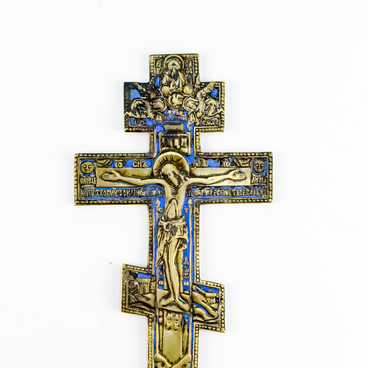
Today believers put on the cross after being baptized and wear it in the most important place — close to the heart There are different variants of crosses: with four, six, and eight points, with a semicircle at the bottom, and others. In Russia, eight-pointed pectoral crosses were more common. According to tradition, there was an inscription “Save and preserve” made on the reverse side of the Orthodox cross.
There are no rules as far as materials for pectoral crosses are concerned — it is possible to use any kind of metal and even wood. There is also no fundamental difference between a chain and a braided rope: the only important condition is that the cross should be safe and would not be lost.
Russian people pledged allegiance on the crosses. When building churches, houses, bridges and other important structures, they set a cross in the construction of a foundation. There was a custom to cast large numbers of crosses from a broken church bell. These crosses were particularly venerated.
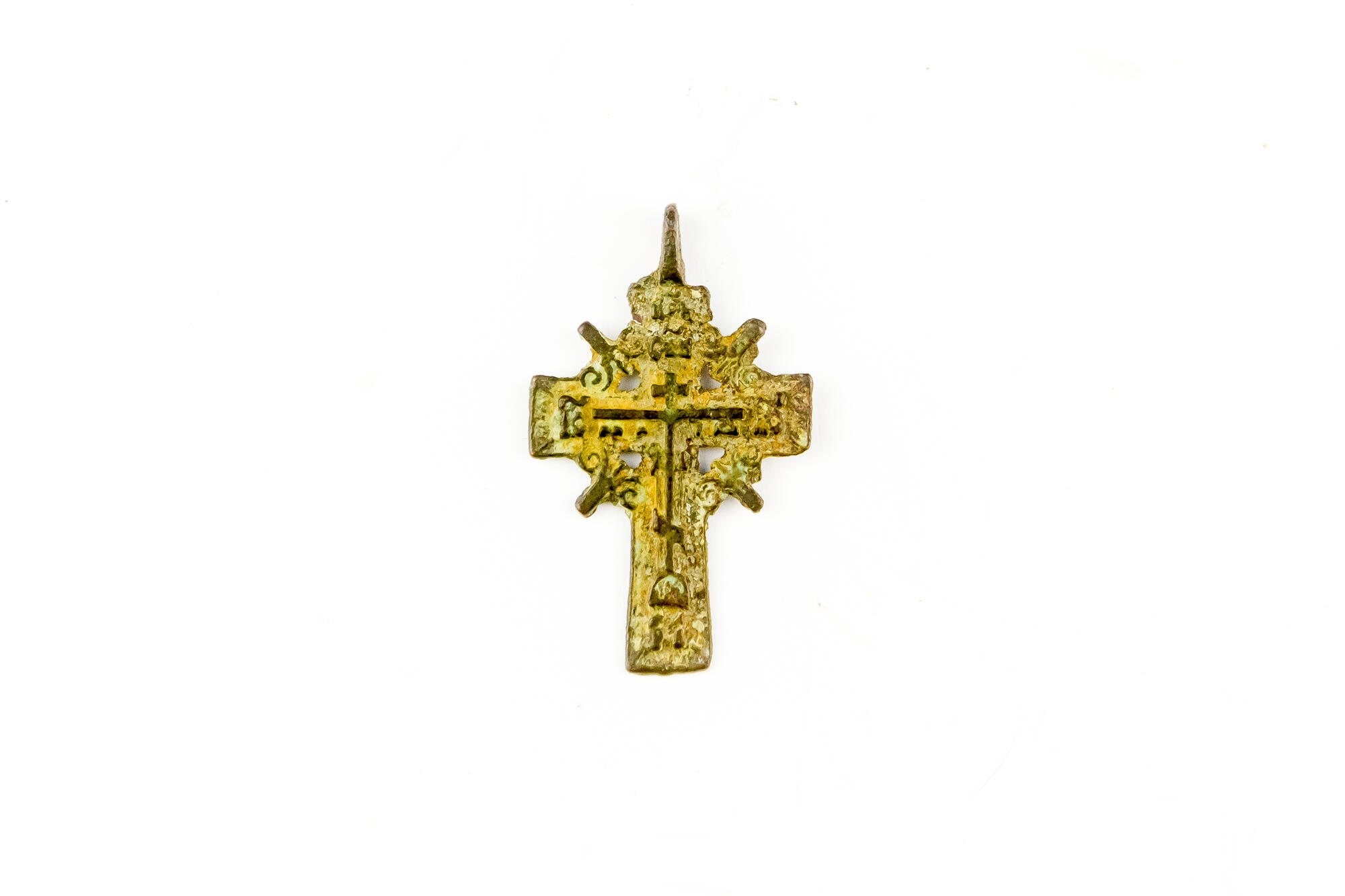
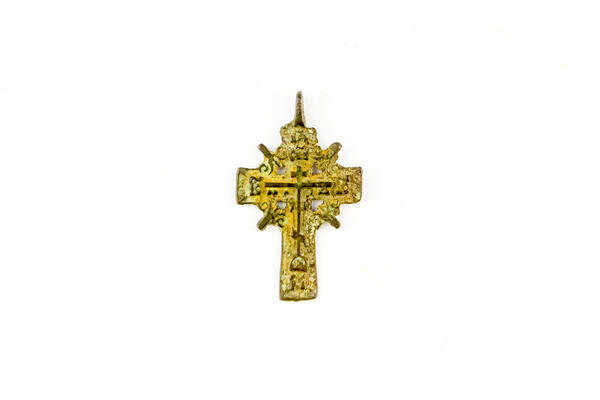
The cross from the museum collection was made in the late 19th — early 20th centuries. It is a four-pointed cross, but in the middle, there is an image of an eight-pointed cross with a slanting bottom crossbar. The eight-pointed variant was usually considered most familiar to Orthodox Christians.
The name “Jesus Christ” flanks the large crossbar. “The Son of God” is the likely inscription under the crossbar. To the right and left of the cross are the Instruments of the Passion. At the top, there is a loop for the braided rope left.
Often people wear small pectoral crosses without taking them off. This custom did not appear immediately: in the first centuries of Christianity, believers used medallions with the image of the Slain Lamb (sacrificial lamb) or the Crucifixion instead of crosses. And the so-called encolpions were the closest predecessors of the familiar pectoral crosses.
Encolpions looked like rectangular, rounded, or cruciform hollow boxes. At first, the outside of these boxes used to be decorated with a Christogram. Later they were decorated with crosses of various shapes. In this box, Christians kept the relics of saints and other small holy objects.
Today believers put on the cross after being baptized and wear it in the most important place — close to the heart There are different variants of crosses: with four, six, and eight points, with a semicircle at the bottom, and others. In Russia, eight-pointed pectoral crosses were more common. According to tradition, there was an inscription “Save and preserve” made on the reverse side of the Orthodox cross.
There are no rules as far as materials for pectoral crosses are concerned — it is possible to use any kind of metal and even wood. There is also no fundamental difference between a chain and a braided rope: the only important condition is that the cross should be safe and would not be lost.
Russian people pledged allegiance on the crosses. When building churches, houses, bridges and other important structures, they set a cross in the construction of a foundation. There was a custom to cast large numbers of crosses from a broken church bell. These crosses were particularly venerated.
The cross from the museum collection was made in the late 19th — early 20th centuries. It is a four-pointed cross, but in the middle, there is an image of an eight-pointed cross with a slanting bottom crossbar. The eight-pointed variant was usually considered most familiar to Orthodox Christians.
The name “Jesus Christ” flanks the large crossbar. “The Son of God” is the likely inscription under the crossbar. To the right and left of the cross are the Instruments of the Passion. At the top, there is a loop for the braided rope left.