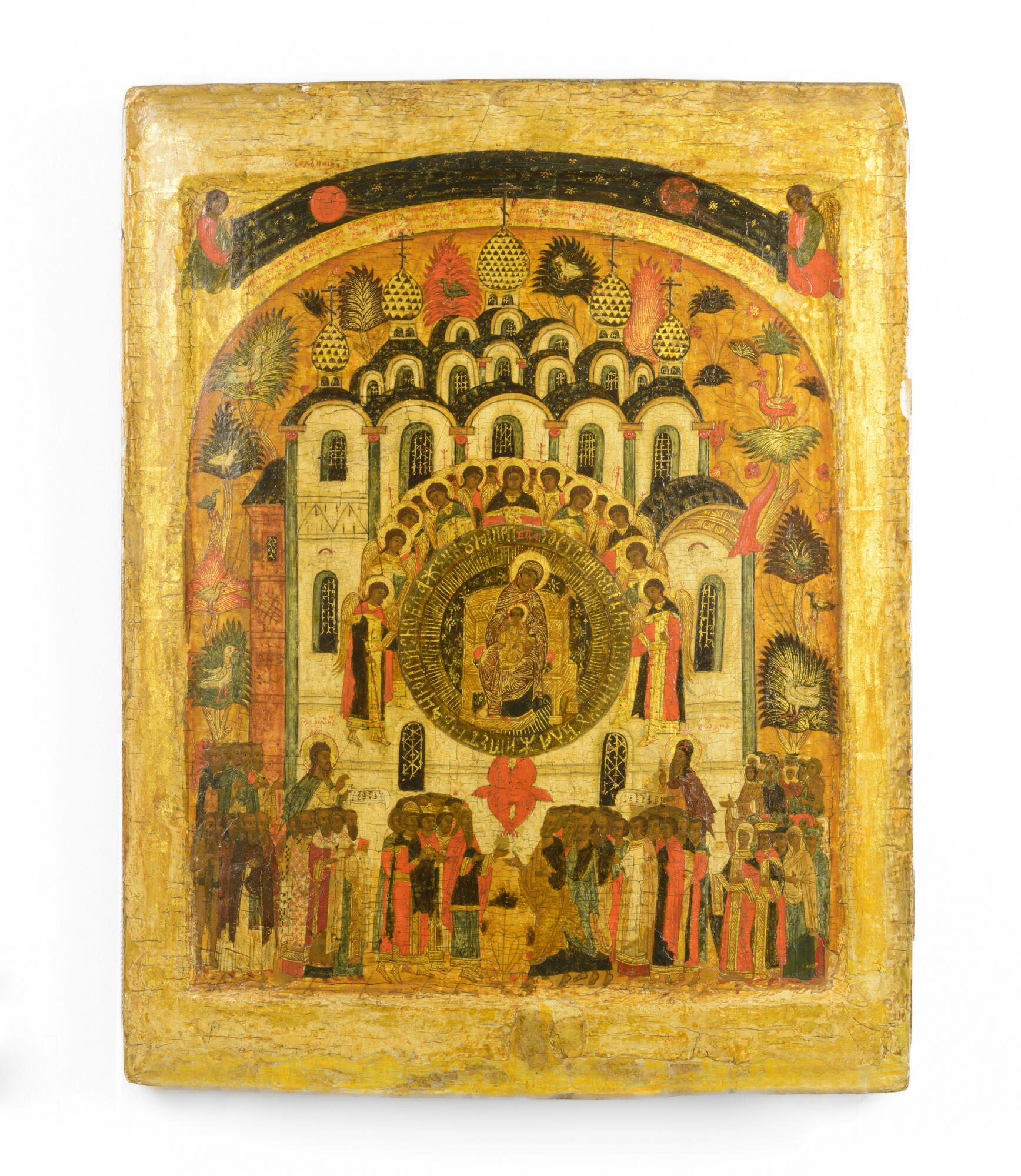


The history of the icon “All Creatures Rejoice in You” dates back to the events of the 8th century, when the Byzantine emperor Leo III forbade the worship of images. This was opposed by John Mansur (in Orthodoxy — Damascene) — a Christian saint, philosopher, theologian and hymnographer — the author of liturgical works. Forging a letter, the emperor convinced the Syrian caliph, whom John served, that he was starting a rebellion. The caliph ordered that the right hand of the saint be cut off. Having asked the executioner for his hand, John put it in place and prayed all night to the image of the Most Holy Theotokos. In the morning, it turned out that his hand was miraculously restored.
John was grateful and expressed his admiration in a prayer beginning with the words “All of creation rejoices in you, O full of grace, the ranks of Angels and the human race; hallowed Temple and spiritual Paradise, glory of Virgins.”
Icons based on this hymn began to appear in the late 15th century as a result of the independent work of Russian icon painters. The iconography of this image gravitates towards the Moscow school. It is enriched with additional original details, referring to other famous icons of the Theotokos — “The Burning Bush” and “Axion Estin”.
In the center is the Mother of God with a baby on her lap in a halo of Divine glory, against a background of the Garden of Eden and the five-domed temple. Around the Mother of God there are angels, below is the human race, represented by all the ranks of holiness. The nature of the wonderful Garden of Eden is fantastic, and the icon painter depicts bizarre trees with green and red crowns and birds. The stylistic features of the icon speak of its northern origin.
This icon comes from the collection of a well-known Moscow collector, Pavel Petrovich Shibanov. He was born into an Old Believer family in Samara, and began his career in the Moscow shop of his father, a well-known antiquarian, a specialist in early printed books. After the nationalization of the book trade in 1918, Pavel Petrovich became an expert in applied and Old Russian art at the People’s Commissariat of Education of the RSFSR. His tasks included recording and describing the private collections confiscated by the Bolsheviks. This image could be one of the family icons for personal Old Believer prayer rooms (a room for worship, a home church).
John was grateful and expressed his admiration in a prayer beginning with the words “All of creation rejoices in you, O full of grace, the ranks of Angels and the human race; hallowed Temple and spiritual Paradise, glory of Virgins.”
Icons based on this hymn began to appear in the late 15th century as a result of the independent work of Russian icon painters. The iconography of this image gravitates towards the Moscow school. It is enriched with additional original details, referring to other famous icons of the Theotokos — “The Burning Bush” and “Axion Estin”.
In the center is the Mother of God with a baby on her lap in a halo of Divine glory, against a background of the Garden of Eden and the five-domed temple. Around the Mother of God there are angels, below is the human race, represented by all the ranks of holiness. The nature of the wonderful Garden of Eden is fantastic, and the icon painter depicts bizarre trees with green and red crowns and birds. The stylistic features of the icon speak of its northern origin.
This icon comes from the collection of a well-known Moscow collector, Pavel Petrovich Shibanov. He was born into an Old Believer family in Samara, and began his career in the Moscow shop of his father, a well-known antiquarian, a specialist in early printed books. After the nationalization of the book trade in 1918, Pavel Petrovich became an expert in applied and Old Russian art at the People’s Commissariat of Education of the RSFSR. His tasks included recording and describing the private collections confiscated by the Bolsheviks. This image could be one of the family icons for personal Old Believer prayer rooms (a room for worship, a home church).


