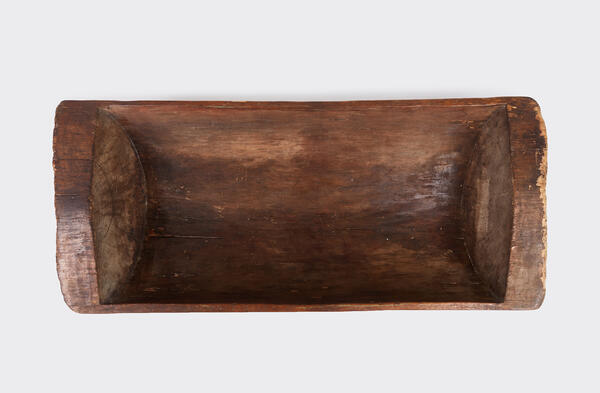
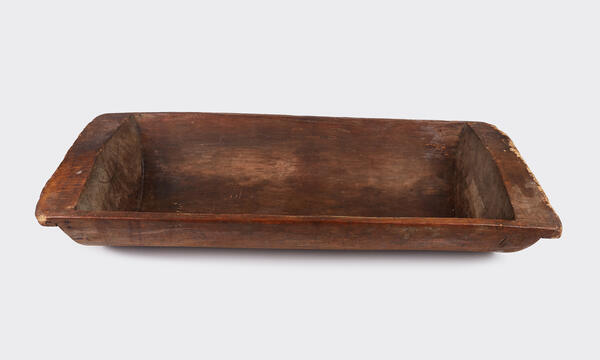
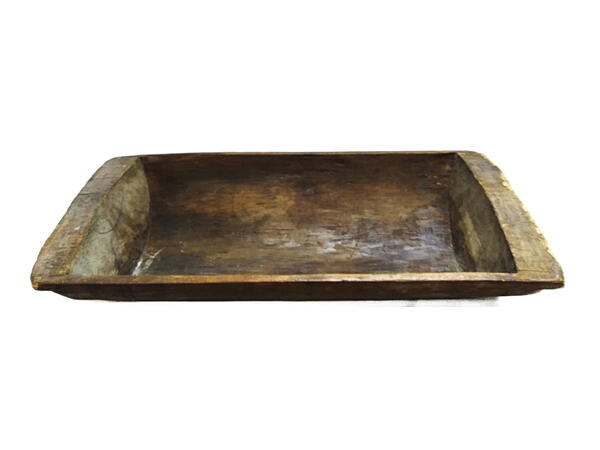
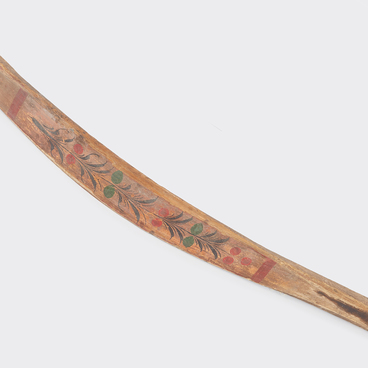
The exhibition of the Zheleznodorozhny Local Lore Museum presents a traditional household item of the Slavic peoples — a trough.
Every household chore — cooking, washing, storing supplies — required containers. Clay vessels were expensive and fragile, so craftsmen hollowed out a pine or birch trunk. Tree bark often remained on the back of the resulting container. The museum houses a trough chiseled out of birch. Unfortunately, it is unknown who made the exhibit.
The Russian term for trough — “koryto” — is found in almost all Slavic languages: Polish, Serbian, Bulgarian and others. Archaeologists claim that in Rus, troughs became ubiquitous in Veliky Novgorod and Staraya Ladoga and probably in other areas in the 10th century. A wooden trough was a very practical thing to have in the everyday life of the Slavic people. It was used for washing clothes, bathing babies, chopping cabbage and meat, cooking, cooling beer, brewing wort, and feeding livestock. In winter, the trough was sometimes used for sliding downhill.
The development of metallurgy led to the replacement of wooden containers by iron ones. Their wide use, however, was hampered by corrosion and the high cost. But in 1742, the French chemist Paul Jacques Malouin first used the method of hot-dip galvanizing. Galvanized steel, albeit expensive, was resistant to corrosion. Due to the high cost, zinc troughs were rarely found in villages even in the first half of the 20th century.
But after the Great Patriotic War, there were so many iron troughs that they were used everywhere — both the countryside and the city. Even today they can be found in public baths. In the 1970s, plastic troughs were introduced for household use. They were bright-colored and light, which was important.
The trough is often found in fiction. For example,
Korney Chukovsky in his fairy tale “Moydodyr” highlighted the importance of the
trough and urged children to maintain personal hygiene: “Let us bathe, splash,
Let us swim, dive, Let us tumble in the tub, In the current, in the stream, In
the basin, in the bath, In the river, in the ocean…”