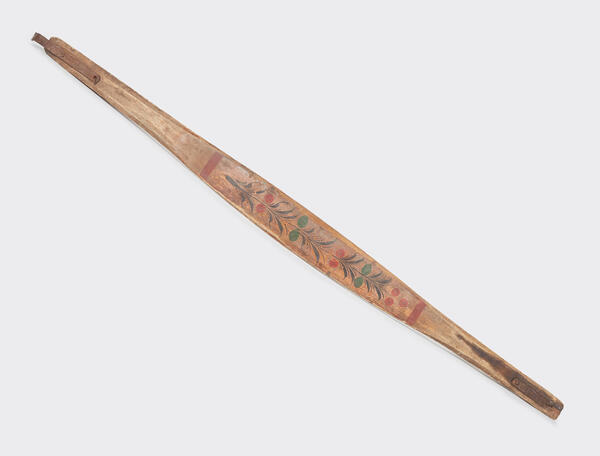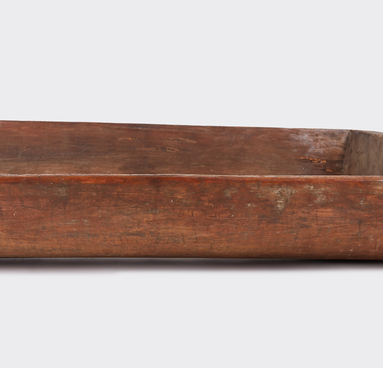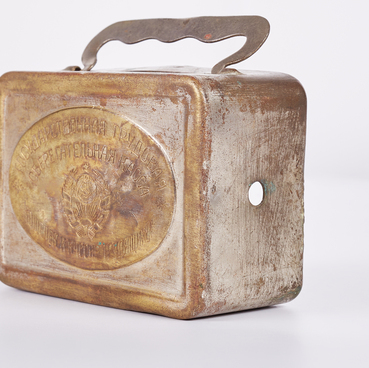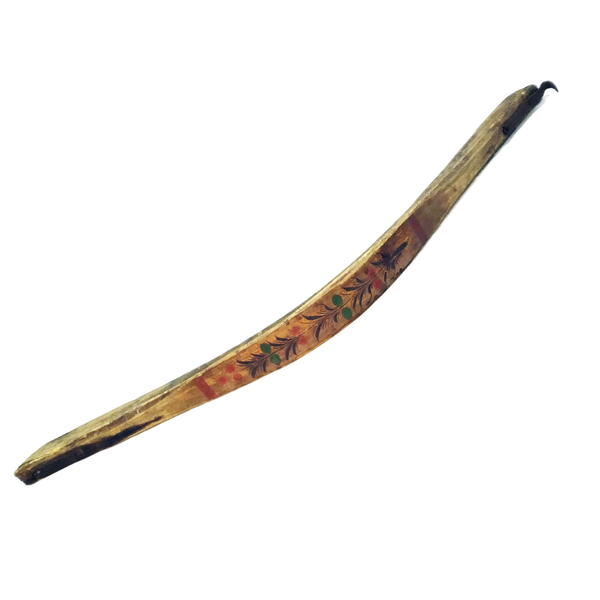
The Zheleznodorozhny Local Lore Museum presents an indispensable item of peasant life — a shoulder yoke.
The shoulder yoke was first mentioned in Russian literature of the 16th century. “A single yoke, a bow-shaped beam, which is used to carry a pair of buckets on the shoulder” soon spread throughout Russia. It was deservedly appreciated in the urban environment, but especially so in the villages.
Three types of yokes were known in Rus: straight, bent and carved. The first, well known in Western Europe, was rare. It was a straight round stick with small hooks at the ends. Sometimes not only buckets, but also laundry was carried on such yokes. The yoke was carried by two women: one end was on the shoulder of a peasant woman walking in front, the other — on the shoulder of the second one. At home, the yoke was stored in the corner of the hallway either vertically on the floor or on two pegs or thick nails in the wall.
In the
olden days, every area had its own craftsmen who knew how to make light,
convenient and beautiful yokes. Every talented craftsman had his own style, and
the products were easily distinguished by their shape and decorative finish.
Sometimes the cooper himself made sets of yokes and buckets. In late autumn or
early spring, when wood is especially flexible, the craftsman went into the
forest to get raw materials. The wood for yokes must be light, strong and
flexible, as well as homogeneous and crack-resistant. Depending on the
thickness of the tree trunk, the log was split into two or four parts.
Rectangular blanks were cut out of each of them. Every piece was processed to a
certain thickness in the middle and then steamed. Birch was the most common
material for making yokes, while pine and spruce were used less often. Blanks
required a tree 5–7 centimeters thick and 190–210 centimeters long. An ax and a
plane were used to make a finished product out of such a trunk. In some cases,
yokes could be used for 50 years or more.