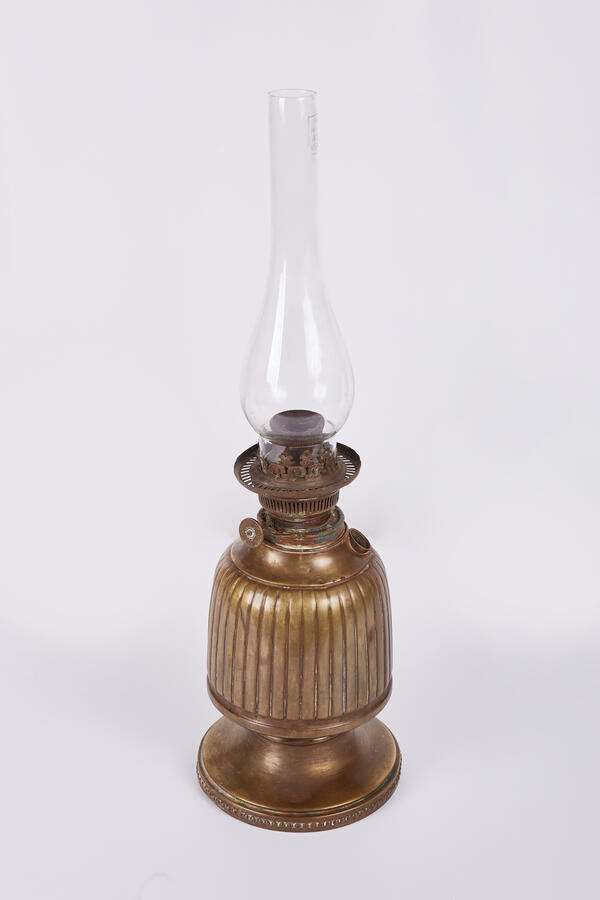
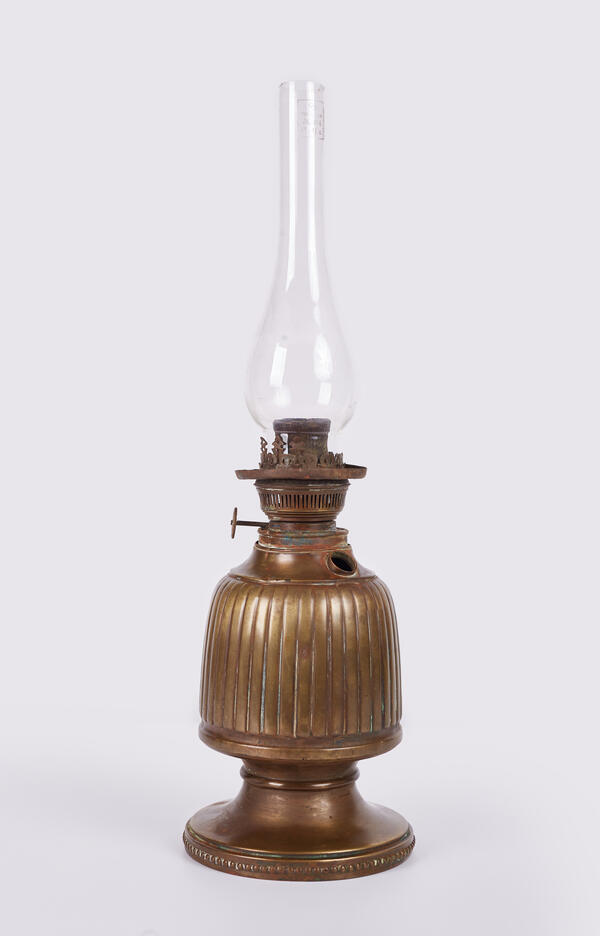
The Zheleznodorozhny Local Lore Museum presents a kerosene lamp. The lamp has a gold vase-shaped metal base with vertically oriented, equally wide relief strips across the diameter on a massive round base. The manufacturer’s mark “Carl Holy. Berlin” (inscriptions in Russian and German) is clearly visible on the brightness control wheel. The lamp dates to the second half of the 19th — first half of the 20th centuries.
It is impossible to name just one inventor of the kerosene lamp, and the exact year of its invention is unknown. Its prototypes — oil lamps — are first mentioned in the works of the Baghdad scientist, doctor and alchemist Abu Bakr al-Razi in the 9th century. However, the technical innovation is considered to have been invented by the employees of the Lviv pharmacy — masters of pharmacy Jan Zeh (1817–1897) and Jan Józef Ignacy Łukasiewicz (1822–1882), as well as the tinsmith Adam Bratkowski.
Ignacy Łukasiewicz was one of the pioneers in petroleum extraction, and this was an important step towards the creation of the kerosene lamp. While researching crude oil distillation, the initial goal of which was to create new medicine, pharmacists obtained a yellowish oily liquid that gave a clear and bright flame. This was kerosene. On March 30, 1853, there was a public “burning” of the resulting oil product in a tin lamp in the Golden Star pharmacy in Lviv. This large lamp looked like a cylinder made of thick metal. At the bottom there was a container into which kerosene was poured, and above it there was glass that protected the wick from the wind.
On July 31, a surgery took place in a Lviv hospital using
the light from Łukasiewicz’s lamp. After successfully removing the appendix
from patient Vladislav Kholetski, Dr. Zaorski noted that it was much easier to
operate when there was a lamp rather than candles. When the fame of the
kerosene lamp spread throughout the neighboring states, the Austrians took a
great interest in this type of lighting. Without hesitation, they began to
produce such lamps themselves. The production was carried out by a Viennese
company called Ditmar. This factory began to produce about 1000 models of
kerosene lamps. The company’s warehouses were located not only in Vienna, but
also in Trieste, Milan, Prague, Lyon, Krakow and even Bombay. Unfortunately,
Lviv innovators were unable to patent their invention in a timely manner. It is
curious that when Austrian analogs began to be sold in Lviv, they were called
exclusively “Viennese”.