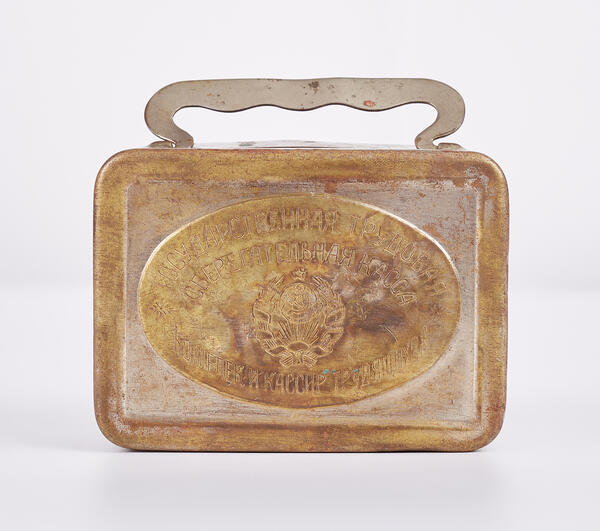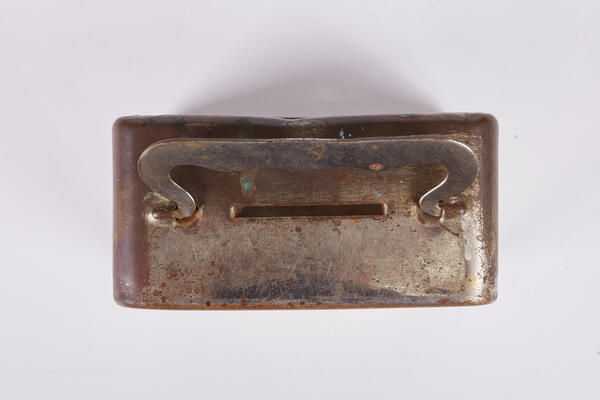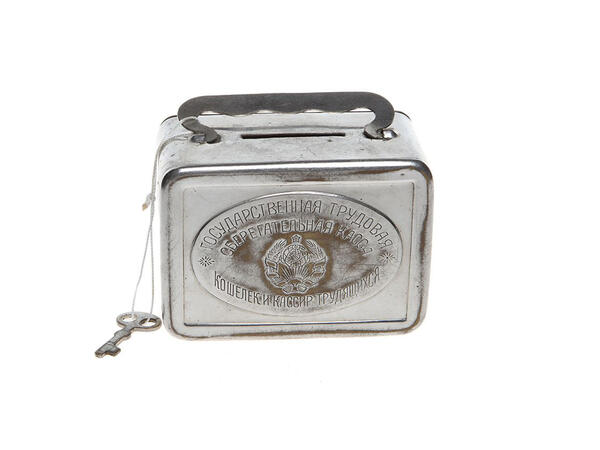
The exhibition of the Zheleznodorozhny Local Lore Museum presents a money box in the shape of a suitcase with a folding handle. Engraved on the side are the words “State Labor Savings Bank” and “Wallet and Cashier of the Workers” with the coat of arms of the USSR in the center.
Before the completion of the monetary reform in 1924, the Soviet people had no spare money. In fact, the authorities began to revive the savings business only in the mid-1920s. The decree of the Council of People’s Commissars of the RSFSR “On the establishment of state savings banks” was adopted in December 1922, and the first savings bank in the RSFSR opened its doors on February 11, 1923, on Krasnaya Presnya in Moscow. According to other sources, the first savings bank was opened in Petrograd on February 1, 1923. Savings banks became widespread only two years later, after the Central Executive Committee of the USSR adopted the decree “On State Labor Savings Banks” on November 27, 1925. At this time, the Narkomfin began actively producing special money boxes: in the 1920–1930s, they became the important tools of propaganda.
The demand for money boxes in the USSR remained
steady through the early 1930s. Thus, the Voskresenye (Sunday) weekly newspaper
for 1931 printed an article on how convenient and profitable it was to use
money boxes along with bankbooks. As a rule, such money boxes were given to
each depositor along with a savings book for a nominal fee or free of charge. A
Sberkassa employee closed the bottom lid of the money box in the presence of
the client with a key that had an individual number. After this, the client
went home to put “every spare penny” into the money box, and the key was kept
in the savings bank. As the money box was filled, the client brought it to the
savings bank, where it was opened, and all the money saved was credited to the
savings book. The key to the money box was deliberately kept at the bank so
that the clients would not be tempted to spend the money they saved. For the
same purpose, the hole into which the coins were dropped was lined with teeth
from the inside, which prevented the coins from spilling out.