Font
Color
Graphics
Изображение точки

To see AR mode in action:

1. Install ARTEFACT app for iOS or Android;

2. Find the exhibition «The Indigenous People: Lifeways and Trades»

3. Push the «Augmented reality» button and point your phone's camera at the exhibit;

Скрыть точки интересаПоказать точки интереса
Показать в высоком качестве

Tobacco cutter, Box, Shears, Scythe, Steelyard

0
Open in app
#1

Tobacco cutter

#4

Tobacco played an important role in the life of the Shors: not only men but also women and teenagers were smokers. Since the 18thcentury, growing tobacco has been one of the sources of income for Kuznetsk townspeople. At the end of the 19thand beginning of the 20thcenturies, smoking was considered a fashionable phenomenon in Kuznetsk, especially among women.

The 19th-century traveler and ethnographer Alexander Vasilyevich Adrianov wrote that wealthy Shors“lend money to their… relatives for the future nut harvest at 60-80 kopecks per pood <…> most often and most willingly they lend not money, but a commodity popular with foreigners like vodka, tobacco, gunpowder, etc.”Tobacco is also mentioned among the goods a hunter needs, along with bread, horse meat, salt, firearms supplies, materials for clothing and shoes, and tea.

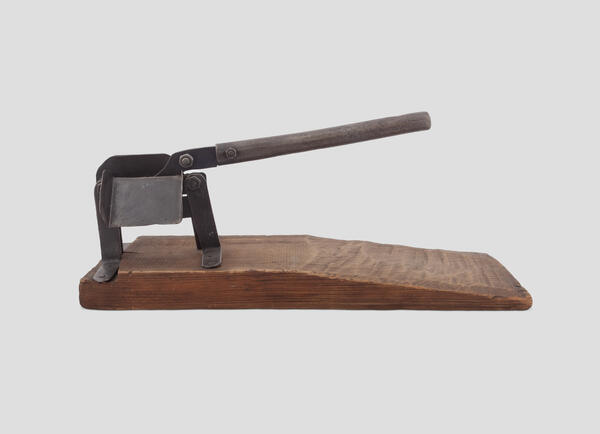
To grind tobacco leaves for smoking, there were special devices called tobacco cutters.

The exhibited device has several blades. It is mounted on four corner legs. Bolts, nuts, and nails fasten the corners respectively to the blades and the wooden base board. The five lower knives are immovable and have a serrated edge along their upper surface. There is a protective plate on one side of the blades, on the other there is a groove along which tobacco is placed under the cutting surfaces with the edges raised by three centimeters. Four arched movable upper blades are fixed between the lower blades, equipped with a serrated edge at the bottom. Attached to these movable knives is a handle through which the tobacco cutter is operated.

Tobacco cutters were commissioned in small private forges. In the 1920s, even factory production of tobacco (the Shors considered it too strong) appeared in Kuznetsk, however, most of the work in such factories was carried out manually.

The Shors smoked wooden pipes with crooked mouthpieces, which were stored along with tobacco in fabric or leather pouches. Green tobacco leaves were dried and mixed with birch bark to reduce the bitterness when smoking. In the summer, when tobacco supplies were depleted, the Shors used dry grass or smoked old pipes themselves, having previously crushed them into powder.
#2
Name: Tobacco cutter
Date of creation: the mid-20th century
Place of creation: the USSR
Technique: metal, wood
Dimensions: 55×17,8×25 cm

№: 25458751

#5
Box
#7

Historically, the Shors settled along the banks of the Mrassu, Kondoma and Tom Rivers, rich in fish. Fishing was seasonal and mostly intended for local consumption, although residents of the lower reaches of Mrassu exported grayling, pike, taimen and burbot and sold them in Kuznetsk.

Depending on the size of the fish and the fishing method, different equipment was required.

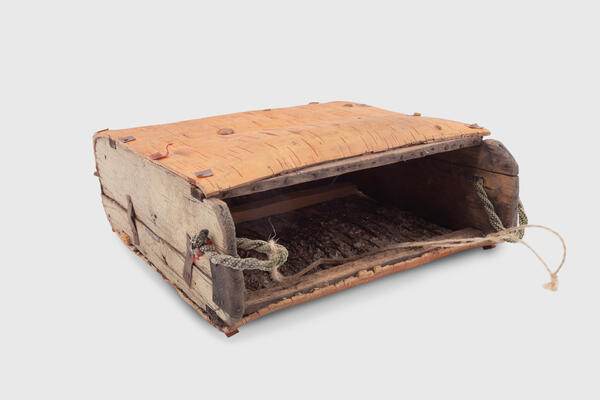
Catching small fish, three to four centimeters long, was like gathering, and was carried out by women and children. Wandering through shallow waters, they explored the holes under the stones and extracted fish by hand. They also used nets woven from kendyr: the net was lowered under the water, and when a school of fish gathered above it, it was raised sharply. Women used ropes to tie birch bark boxes to their belts: the boxes floated nearby, and the fish from the nets were put in those boxes.

In the autumn, men went fishing in a more serious way. Large fish were pierced with a harpoon with one, four or five prongs. For such fishing, they chose quiet, deep waters and went there at night in boats. A fire lit at the bow of the boat illuminated the fish deep in the water, allowing the fisherman to take aim. This method required a lot of experience and precision.

In addition to the harpoon, fish were hit with wooden arrows, nets were used, and fishing rods were made from hooked tools. The hooks were bought or commissioned from local blacksmiths.

Men set up “engme” nets with floats made of wood or birch bark and weights made of ground pebbles tied to the upper edge. They surrounded a section of the river, sailed inside the circle, and drove the fish into the net with poles. Gill nets and seines were also used quite often.

In smaller places, the river flow was blocked with fences made of twigs, leaving holes for “sugen” and “ashpar” traps. “Ashpar” were boxes like troughs, “sugen” were nets in the form of wicker cones inserted into each other. Other devices included fishing rods, hooks, “agashsugen” pins, and “uske” screens.

The fishing process was associated with several prohibitions: fishermen were forbidden to laugh, swear, or shout. Before fishing, the elders sprinkled wine.

#6
Name: Box
Date of creation: the 1950s
Place of creation: Gornaya Shoria, the USSR
Technique: wood, birch bark
Dimensions: 28×26×24,5 cm

№: 36867037

#8
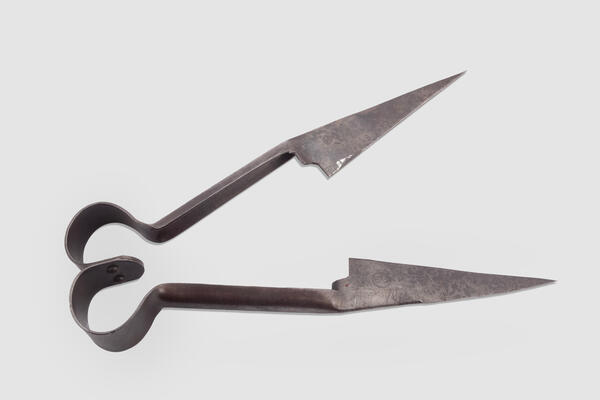
Sheep shears
#10

Back in the 17thcentury, livestock was used in exchange between the Shors and neighboring peoples. In her research, the linguist and Turkologist Nadezhda Petrovna Dyrenkova cites excerpts from the order to the Kuznetsk governor Yevdokim Baskakov: the author describes blacksmithing practiced by the Shors and then clarifies that“those armors… are sold to the Kolmatian people for horses and for cows and for sheep…”

The Shors started their own cattle breeding under the influence of the Russians. At the same time, the Soviet ethnographer Leonid Pavlovich Potapov emphasized that we are talking here specifically about the breeding of cows, sheep, and horses, but it is possible that “in times long before Russian colonization, some clans… had domesticated deer.”

In the early 1860s, the missionary and ethnographer Vasily Ivanovich Verbitsky noted in the north of Altai “cattle breeding and poultry farming [is] in a pitiful state” and is limited to the breeding of a few horses.

The Siberian educator and ethnographer of the 19thand early 20thcenturies Alexander Vasilyevich Adrianov recalled that“he met large uluses along the Kondoma and in the Mrassu system, in which there was not a single cow, and children grew up without ever seeing milk.”A similar situation was described by the Russian ethnographer of German origin Vasily Vasilyevich (Friedrich Wilhelm) Radlov, who did not find a single cow in the Shor villages.

Among the skills the Shors borrowed from the Russians was poultry farming (breeding chicken and geese), as well as sheep breeding. There were no more than two or three of the latter on the farm. In the winter, open pens or simply sheds were set up for animals, and part of the hay was thrown onto the roof to keep them warm.

Twice a year, in spring and autumn, the sheep were sheared, and all the wool was left for internal use: the Shors made “pimy” (felt boots), mittens, and “shabur” outerwear. Only the wealthiest cattle owners could sometimes set aside surplus for sale. They also bred “fat-tailed” sheep, bred from long-tailed and curly-tailed sheep, whose coarse wool was only suitable for making felt carpets called “koshma” (“kochma”).

Sheep shears resemble two knives with a spring that enables them to be opened and closed during the cutting process.

#9
Name: Sheep shears
Date of creation: the mid-20th century
Place of creation: Gornaya Shoria, Kemerovo Oblast, the USSR
Technique: metal, forging

№: 36727999

#12
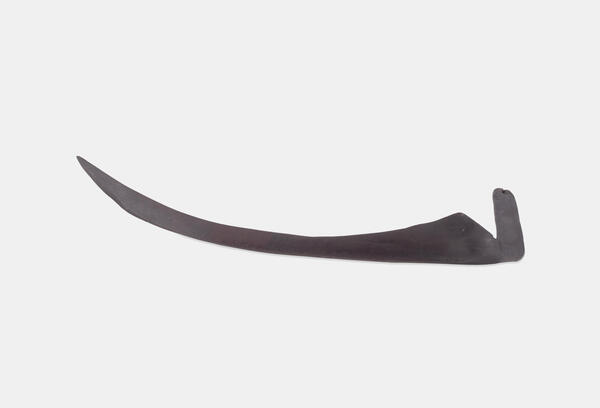
Scythe
#13

The scythe is used in agriculture for mowing grass, making hay, and preparing feed for livestock, as well as for harvesting crops. Before the scythe with a long straight handle people used a sickle and a short scythe, that required bending over while mowing. In Russian, the scythe with a long handle is called “litovka” or a “stand-up” scythe, which indicates that the mower does not have to bend down when working with it.

All these cutting tools came into use only with the development of metallurgy, at the end of the Neolithic era (6th–4thBC), since pointed stones were not suitable for such work.

The chine is made of high-quality steel: the blade is slightly bent inward, the stiffening rib along the outer edge is thickened near the base — the “heel”. A ring or a tang are used to mount the blade on the shaft. The grips were usually made of bird cherry or willow, the snaith was made of spruce or, less commonly, of birch or pine.

As an individual tool, the scythe requires adjustment to the height and style of mowing of a particular person, as well as to the height and hardness of the grass. The scythe allows the mower to change the inclination of the blade relative to the shaft. The correct setting is determined by the characteristic clear ringing sound of the tool cutting grass and the ease of movement. With sufficient skills, even long-term work does not cause excessive fatigue.

Traditionally, people went scything in the morning, before the heat of the day set in and, preferably, before the dew disappeared. The dew makes the grass and stems heavier, causing them to have greater inertial resistance, and the blade cuts rather than bends them to the ground. In addition, regular cooling with dew has a good effect on the cutting ability of the knife.

Places in river valleys are considered optimal for haymaking. But, since they are occupied by Russian villages, the Shors have to put up with average and even worse conditions. Shor cattle graze in forest clearings and by mid-August almost completely trample down the pasture. For this reason, the Shors are forced to drive animals out onto fresh grass in haymaking areas. It is always delayed, just as the haymaking season is delayed due to frequent rains. Almost every year it ends only at the end of autumn, often coinciding with the grain harvest.

#11
Name: Scythe
Date of creation: 1934
Place of creation: Sverdlovsk Oblast, the USSR
Technique: iron, forging
Dimensions: 58×6,5×0,5 cm

№: 25458826

#14
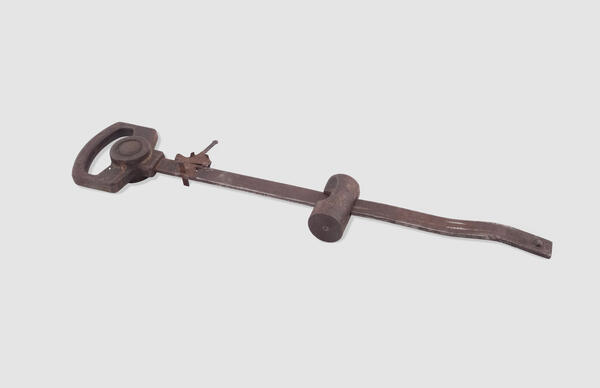
Steelyard
#16

The first simplest scales with a counterweight appeared in Russia back in the 14thcentury and were widely used by merchants, farmers, hunters, and housewives. The merchandise to be weighed was hung on a hook, and then the device was balanced by moving the suspension cord along the beam.

Given how often cunning merchants defrauded their customers, the use of steelyards was banned in the 18thcentury. They were still readily available unofficially, but with the steelyards made before the 19thcentury determining the place and date of their manufacture can pose a problem.

The steelyard presented in the exhibition is also known as a Roman steelyard or Roman balance. The suspension cord and the plate with the object to be weighed remain immovable, while the counterweight is slid along the length of the beam until it and the object in the plate balance perfectly. The weight of the load is indicated by the position of the counterweight on the scaled beam.

In the first half of the 20thcentury, steelyards were furnished with scale marks displaying the weight in kilograms. There was a sliding weight to counterbalance the load and indicate its weight, as well as an immovable cylindrical cast-iron weight. The plate with the load was hung from a hook that was suspended from a rigidly fiхed loop. It was suspended four centimeters from the zero-reference point in the direction of the cast-iron weight.

In the USSR, the use of steelyards was banned again since even the properly made ones were prone to inaccuracy. Nevertheless, they were sold in hardware stores as household scales of the Tulinovsky plant.

In June 1941, an instrument engineering plant was evacuated from Vitebsk to the village of Tulinovka, Tambov Region, with the workers and engineers arriving as well. The former cloth factory buildings that were partially restored after a fire in 1933 housed the plant’s facilities, which began to supply the active army.

After the war, the Metal Products Plant enterprise began to produce loudspeakers, accessories for suitcases and other consumer products. In 1952, the plant started making weighing scales, primarily steelyards reading 10 and 20 kilograms. Over time, the range was expanded to include the pan balance, dial scales, medical scales, and others. In 1976, a new particularly precise instrument was introduced. At that time, the plant received its official name — the Tulinovsky Instrument Engineering Plant.

Equipment and materials were delivered to the plant from Lipetsk, Khabarovsk, Tyumen, Saratov, Belarus and Ukraine, and the product range was popular both in the Soviet Union and abroad: in Bulgaria, Mongolia, and Vietnam.

#15
Name: Steelyard
Date of creation: 1950
Place of creation: Tambov Region, the USSR
Technique: metal
Dimensions: 51×10×0,5 cm, weight — 7×3.7×3.7 cm, counterweight — 10×10 cm
#3
read morehide

Tobacco cutter, Box, Shears, Scythe, Steelyard

0
Point your smartphone camera to open in the app
Share
VkontakteOdnoklassnikiTelegram
Share on my website
Copy linkCopied
Copy
Open in app
To see AR mode in action:
  1. Install ARTEFACT app for 
  2. iOS or Android;
  3. Find and download the «Paintings in Details» exhibition
  4. Push the «Augmented reality» button and point your phone's camera at the painting;
  5. Watch what happens on your phone screen whilst you flip through the pictures.
 
We use Cookies
Cookies on the Artefact Website. We use cookies to ensure that we give you the best experience on our website. If you continue without changing your settings, we'll assume that you are happy to receive all cookies on the Artefact website. However, if you would like to, you can change your cookie settings at any time.
Learn more about useHide
Content is available only in Russian

X

Нашли опечатку?...

%title%%type%