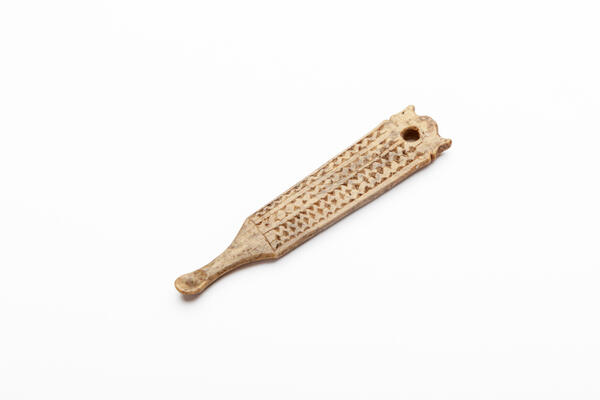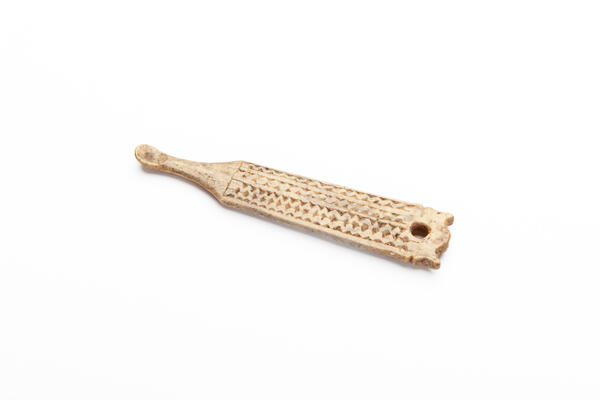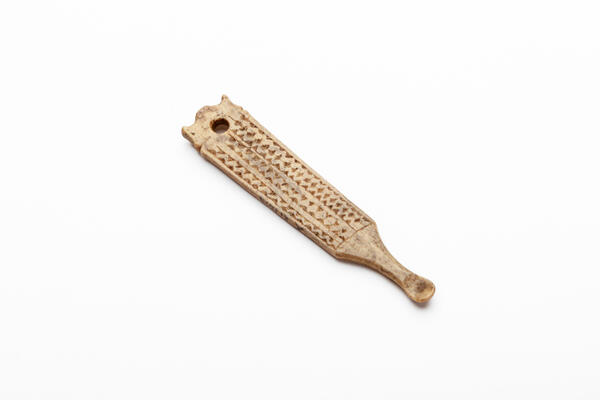
An ear pick, or an ear spoon, appeared in the Middle Ages and was used to clean out earwax. It was also perceived as a talisman and jewelry. Ear picks were carefully carved, polished and covered with an elegant pattern. The ear pick from the museum’s collection was found at the site of the Idnakar hillfort in Soldyr during archaeological excavations in 1992.
This product has a hexagonal handle, gradually transitioning into a rounded leg. The top of the ear pick has the symbolic shape of a horse head and features a hanging hole. The ear pick was made of antler and decorated with a simple geometric pattern.
In total, several hundred bone ear picks were found at the Idnakar site. These products are known all over the world; the oldest pieces are about 5,000 years old. Ear picks were common in Ethiopia, Japan, Austria and China. Eastern ear spoons could reach 15 centimeters in length. However, Eastern Europeans preferred more compact versions.
All over the world, ear picks were made from wood, glass, bamboo, iron, tortoise shell, whalebone, gold and silver. They were worn on chains or leather cords or stored in special cases. The tip of the ear pick could resemble a miniature ladle or be covered with down, like a brush.
Ear picks were also sometimes referred to as ear scoops. Those that were especially elegant were used not only as a means for cleaning ears but also as an adornment. Each product was unique; it could be a useful and nice gift for a woman.
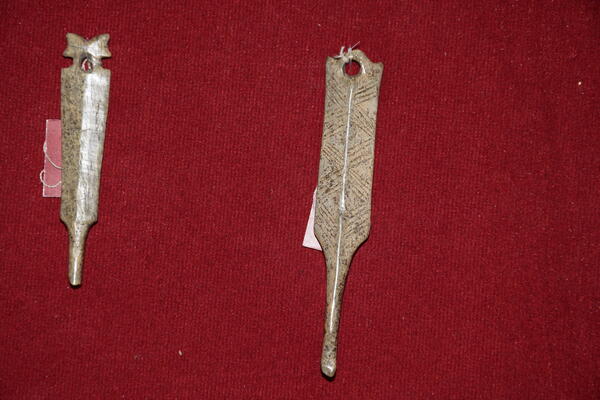
The ear picks found on the territory of the Idnakar hillfort are very diverse. Chepetsk products are distinguished by a characteristic pattern and the shape of the top tip, reminiscent of ears or horse heads. In Udmurt mythology, the horse was a sacred animal, thus a product shaped like one could become a talisman and amulet for its owner.
Some peoples of the USSR — the Turkmens, Buryats, Khanty and Mansi — used ear spoons until the 1980s. Modern manicure kits feature ear picks as well, however, doctors disagree on the subject of the need to clean out earwax: some say that this can damage the ear canal and cause infection. Today, ear picks have been successfully replaced by disposable cotton swabs.