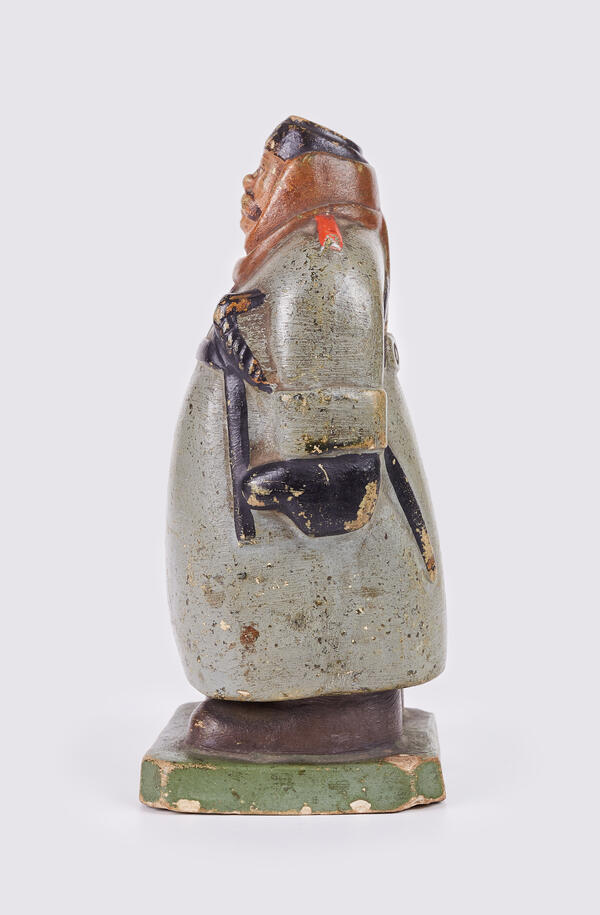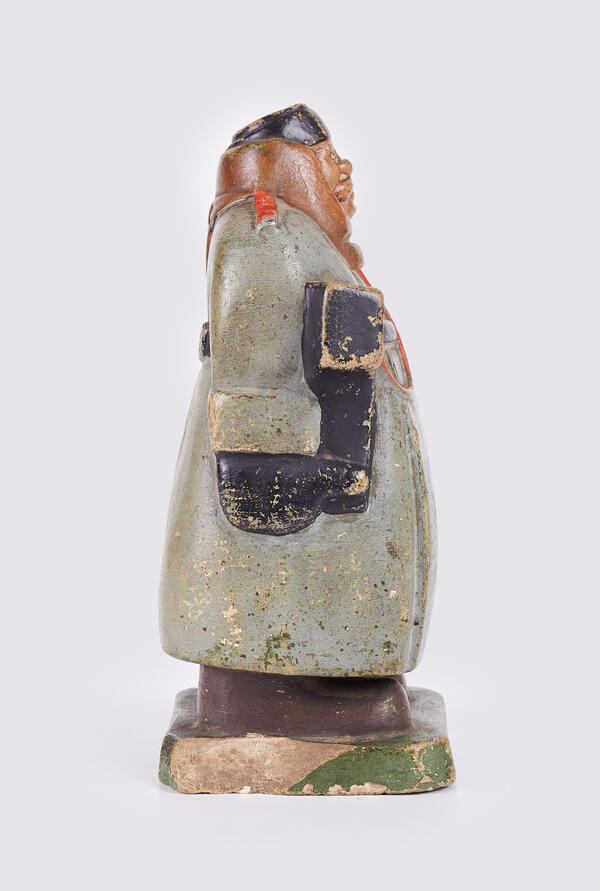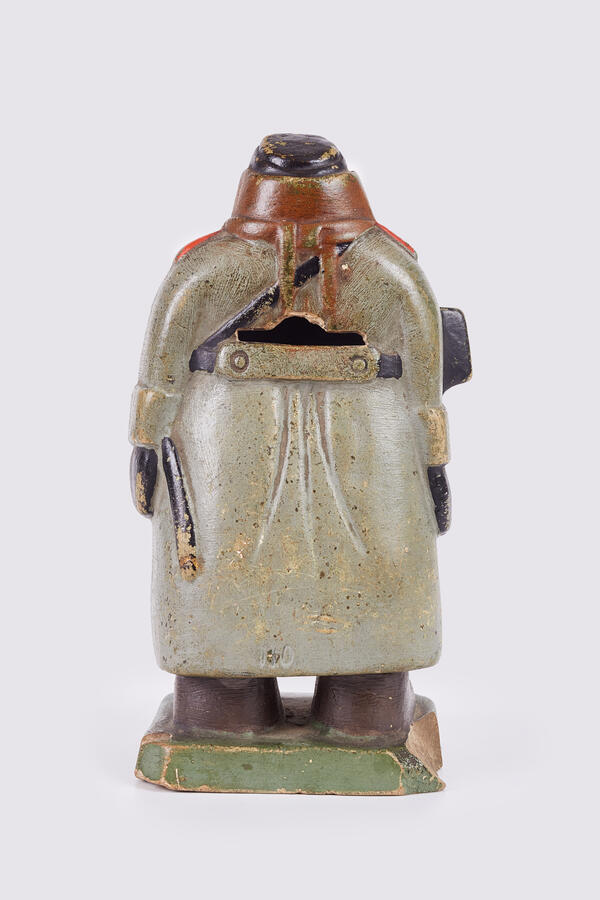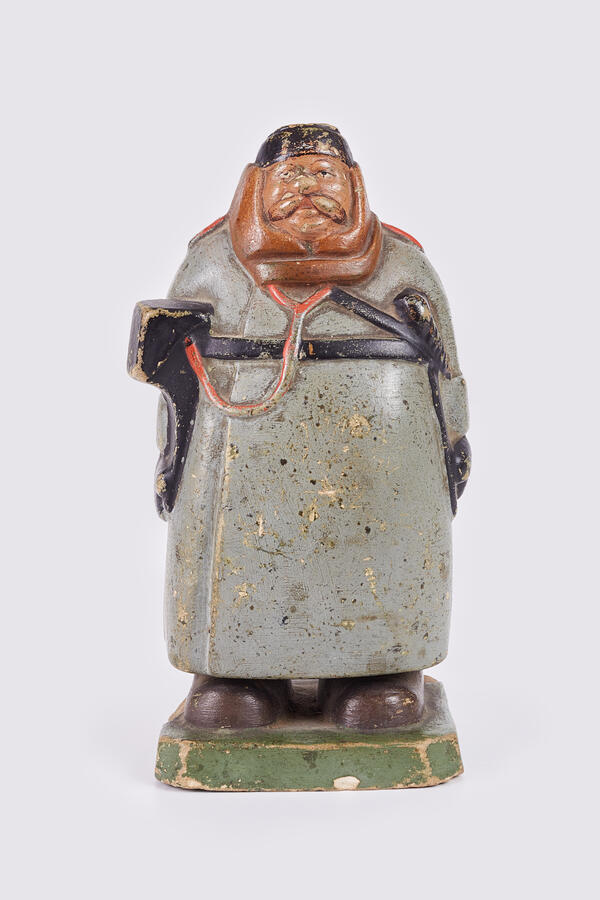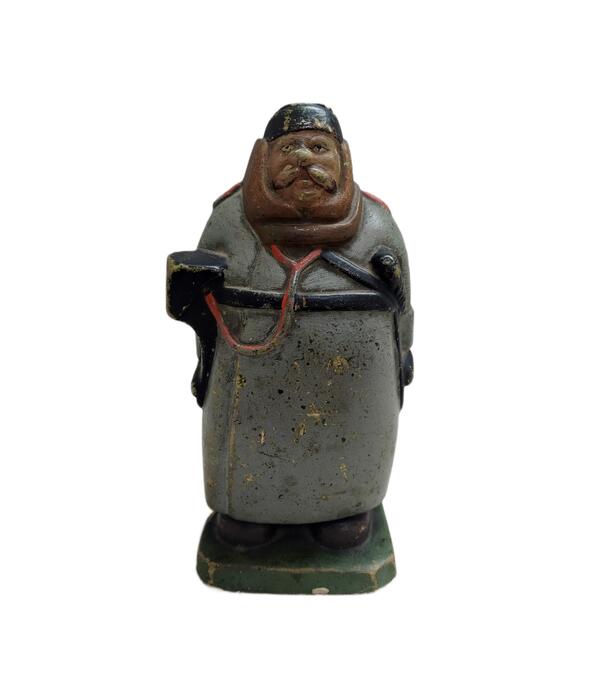
The collection of decorative and applied arts of the Zheleznodorozhny Local Lore Museum presents the money box called “Policeman”, created by the Russian artist Nikolay Dmitriyevich Bartram.
Nikolay Dmitriyevich Bartram was born in the Kursk Governorate in 1873. His grandfather Ernest Ivanovich Bartram, a native of Scotland, rose to the rank of colonel in the Russian army and later retired and bought two villages in the Lgovsky Uyezd — Semyonovka and Anastasyevka. His son Dmitry Ernestovich Bartram developed a penchant for painting at an early age and entered the Academy of Arts, going expressly against his father’s wishes.
Many Russian writers and artists dedicated their works to the image of a policeman, including Nikolay Dmitriyevich Bartram — a talented artist, inquisitive researcher, teacher, enthusiast and energetic organizer, who devoted his entire life to studying, preserving and popularizing Russian folk crafts.
The title of policeman was approved in the Russian Empire in 1862. Russian Empire policemen were recruited as civilian employees from retired soldiers and non-commissioned officers. Their salaries were paid from the city budget. According to the “Table of Ranks, ” the policeman corresponded to the lowest, 14th class. Thus, in wartime, a policeman could be summoned as a michman in the navy, a cornet in the cavalry, a standard bearer in a Cossack unit, and an ensign in the infantry. The policemen wore gray uniforms, as well as special shoulder insignia. In summer, policemen were dressed in a light linen tunic with a drawstring belt and no pockets or a long double-breasted white jacket. In winter, they wore cloth tunics or double-breasted dress jackets, black long-wool papakha hats, bashlyk headdress hoods, and sometimes sheepskin coats. The headdress featured the city coat of arms with the policeman’s assigned number. In the 1880s, the policemen began to be armed with revolvers, but since there were not enough revolvers for everybody, many apparently wore only empty holsters with red cords.
The “Policeman” money box, presented in the
museum’s exhibition, was created by craftsmen of the First Moscow Artel based
on the designs of Nikolay Dmitriyevich Bartram.