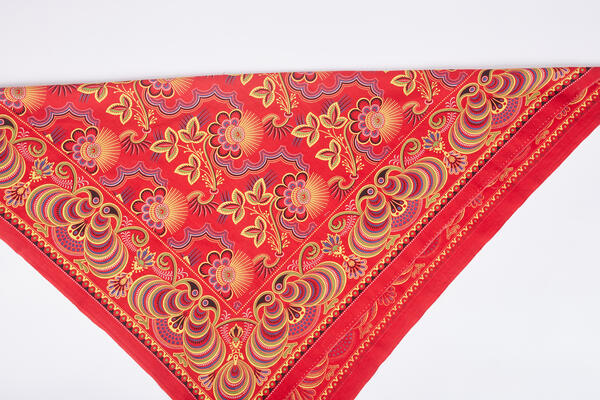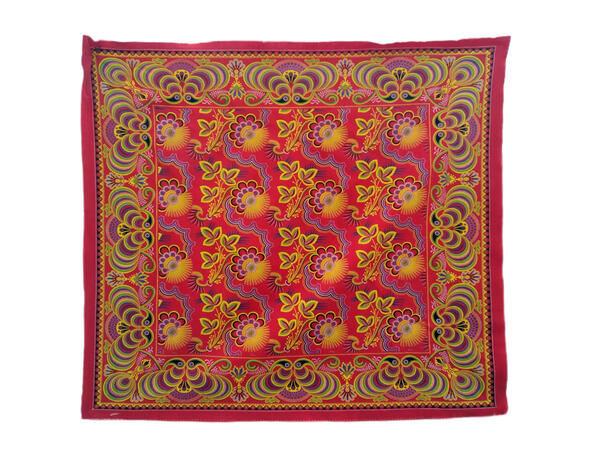
The exhibition of the Zheleznodorozhny Local Lore Museum presents two printed chintz scarves of the late 19th century, made by the Baranov Manufactory Partnership.
The Baranov merchant family became known among industrialists in the mid-19th century and continued its activities until the beginning of the 20th century. The Baranovs made a significant contribution to the development of textile production not only in the Alexandrovsky Uyezd but throughout the entire Russia. The family’s wealth originally began to accumulate thanks to trade: Tikhon Petrovich Baranov received the right to it in the Alexandrovskaya Sloboda back in the 18th century. Baranov’s business was continued by his son, the Alexandrov merchant Nikolay Tikhonovich Baranov, and Nikolay’s son Fyodor brought the trading business to a new, grander level. He significantly increased the fortune acquired by his grandfather and father.
After Fyodor Baranov’s death, his son Ivan (1807–1848) remained the full and independent owner and manager of his father’s entire estate. In a short time, he managed to transform the dyeing production into one of the best factories of its kind. In 1845, Ivan Baranov launched the construction of a new factory on the banks of the Seraya River near the settlement of Karabanovo, Aleksandrovsky Uyezd. In 1846 (the same year that the production of Baranovsky chintz began), the factory, called the Troitsko-Alexandrovskaya manufactory, was put into operation, and it began dyeing chintz, printing headscarves and making red Indian calico. Ivan Baranov received the highest attention and awards for his diligence and success in trade and manufacturing.
One of the most outstanding representatives of the Baranov family was Asaf Ivanovich Baranov (1834–1906). His career in the factory industry began at the age of 17, when, together with his brother Alexander, he took over a factory in the Karabanovo settlement. From that time on, the Troitsko-Alexandrovskaya manufactory began to prosper. In 1874, an enterprise called Partnership on Shares of the Baranov Manufactories was established. The new factory was furnished with high-tech equipment, and the fabric dyeing process reached an industrial scale. In 1878, the joint-stock company “Partnership of Sokolovskaya Manufactory of Asaf Baranov” was formed.
After the revolution, the famous manufactory was
nationalized, and the workers of the Baranovskaya factory were “put under the
banner” of the young Soviet Republic. The exquisite chintzes were branded with
the mark “Combine of the Third International.”