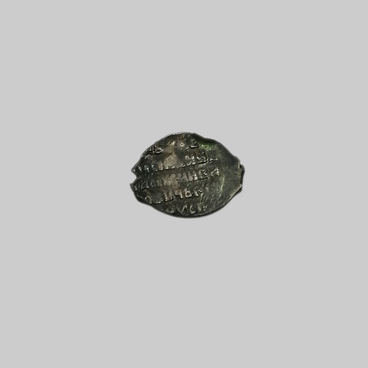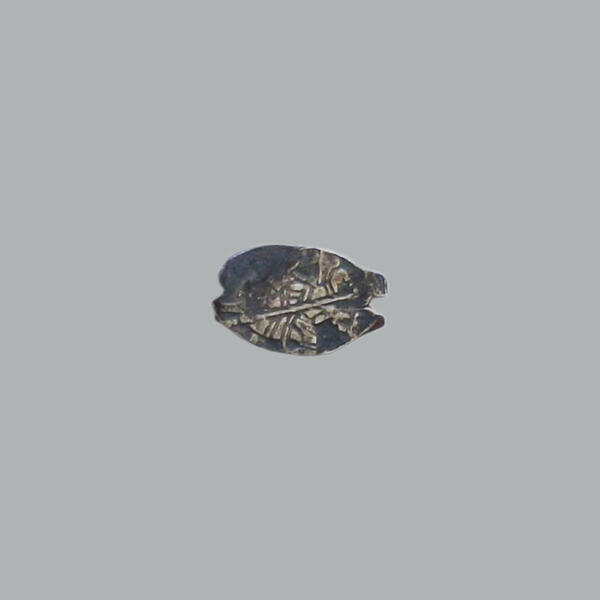
This is an oval-shaped, solid silver coin, with a face value of a kopek, made from 930 silver. It was most likely issued in 1611, under the reign of Polish Tsarevitch Wladyslaw. The coin weighs 0.51 g. The name and title ‘КIНК ЛАДIСЛАВ IГIМО’, or ‘Tsar and Grand Duke of all of Rus’ Wladyslaw Sigismundovich’ are displayed on the coin’s reverse.
On 17 July 1610, a mutiny broke out in Moscow. Vasily Shuysky, who had brought about the death of False Dmitry I, was forcibly made a monk. The power in the country was temporarily transferred into the hands of the Boyar Duma. In September, Moscow swore its allegiance to the fifteen year old Polish Prince Wladyslaw, the eldest son of King Sigismund III. The Moscow and Novgorod mints started to issue coins with his name, Wladyslaw Sigismundovich, keeping the Russian minting tradition intact.
Throughout the prince’s reign, between September 1610 and September 1612, kopeks were minted according to different weight measures. The coins minted at the beginning of his reign were heavy and corresponded with a three ruble coin to silver ratio. 300 hundred kopeks would be minted from a 200-gram silver ingot. Lighter coins started to be minted from September 1611. The new coin ratio was 3.4 rubles to a pound of silver, or 340 kopeks. However, judging by the weight of these coins, this ratio was not used in Moscow. There are coins from a 4-ruble coin to silver ratio, with an average weight of 0.51 grams. The museum’s coin falls into this category. In the final months of Wladyslaw’s reign, the fall in weight continued, with the average weight first dropping to 0.48 grams, before dropping even further to 0.41 grams.
The Novgorod mint operated for a short time under Wladyslaw. In October 1610, residents of Novgorod swore their allegiance to Wladyslaw, but in January 1611, Novgorod revolted and became self-governed.
The museum’s coin has an overly large design for such a small coin meaning that only the central part of the design fits on the obverse, whilst only three lines of a six-line inscription fit on the reverse. As a result of this, it is hard to visually determine what type of stamp was used for the reverse. Stamp No. 2 can be identified on the coin’s obverse through Kleschinov and Grishin’s ‘Catalogue of Russian Medieval Coins 1533-1617’. Other coins in the rest of this catalogue demonstrate that this stamp on the obverse side only ever exists with stamp No. 2 on the reverse. This means that this is a Moscow-minted kopek from 1611 - the most widespread coin under Wladyslaw Sigismundovich.
On 17 July 1610, a mutiny broke out in Moscow. Vasily Shuysky, who had brought about the death of False Dmitry I, was forcibly made a monk. The power in the country was temporarily transferred into the hands of the Boyar Duma. In September, Moscow swore its allegiance to the fifteen year old Polish Prince Wladyslaw, the eldest son of King Sigismund III. The Moscow and Novgorod mints started to issue coins with his name, Wladyslaw Sigismundovich, keeping the Russian minting tradition intact.
Throughout the prince’s reign, between September 1610 and September 1612, kopeks were minted according to different weight measures. The coins minted at the beginning of his reign were heavy and corresponded with a three ruble coin to silver ratio. 300 hundred kopeks would be minted from a 200-gram silver ingot. Lighter coins started to be minted from September 1611. The new coin ratio was 3.4 rubles to a pound of silver, or 340 kopeks. However, judging by the weight of these coins, this ratio was not used in Moscow. There are coins from a 4-ruble coin to silver ratio, with an average weight of 0.51 grams. The museum’s coin falls into this category. In the final months of Wladyslaw’s reign, the fall in weight continued, with the average weight first dropping to 0.48 grams, before dropping even further to 0.41 grams.
The Novgorod mint operated for a short time under Wladyslaw. In October 1610, residents of Novgorod swore their allegiance to Wladyslaw, but in January 1611, Novgorod revolted and became self-governed.
The museum’s coin has an overly large design for such a small coin meaning that only the central part of the design fits on the obverse, whilst only three lines of a six-line inscription fit on the reverse. As a result of this, it is hard to visually determine what type of stamp was used for the reverse. Stamp No. 2 can be identified on the coin’s obverse through Kleschinov and Grishin’s ‘Catalogue of Russian Medieval Coins 1533-1617’. Other coins in the rest of this catalogue demonstrate that this stamp on the obverse side only ever exists with stamp No. 2 on the reverse. This means that this is a Moscow-minted kopek from 1611 - the most widespread coin under Wladyslaw Sigismundovich.