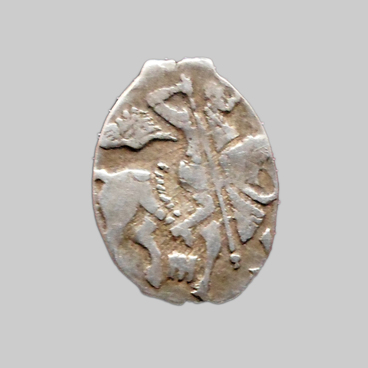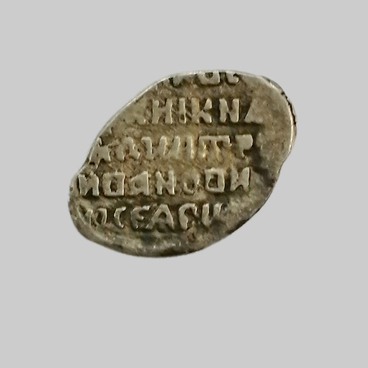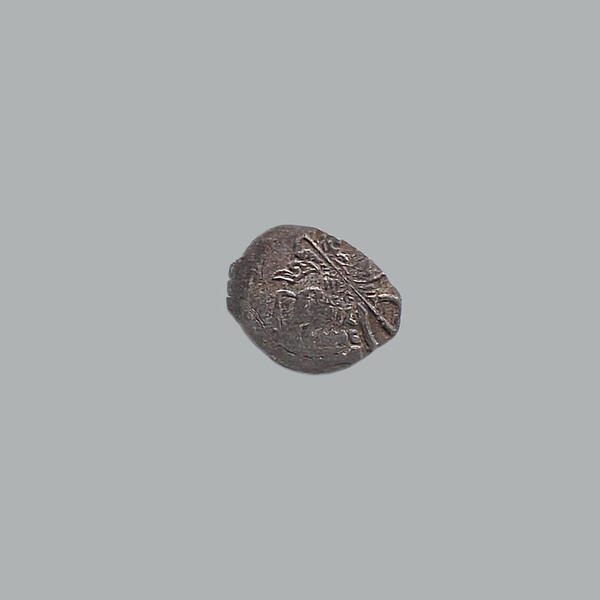
The Karasuksky Regional Museum’s numismatics collection includes an oval-shaped, solid silver kopek coin, which was in circulation under Mikhail I of Russia. It was made from pieces of flattened 930 silver.
The museum’s coin was very common. It is very worn-down - the image and inscriptions are barely legible. The coin’s obverse depicts a righter in a flowing greatcoat, on a moving horse, with a spear pointing down in his right hand. Under the horses legs, the letter ‘S’ is visible. The inscription most likely would have read: ‘Moscow’, in two lines. The coin’s reverse has a six-line inscription, formed of the name and titles of the ruler: ‘Tsar and Grand Prince of all Rus’ Mikhail Feodorovich’. There is a diacritical mark above the first line - a wavy or zigzag line. This is used in Greek, Latin and Cyrillic alphabets to shorten words and to indicate numerical values.
The Moscow Mint which had been captured at the beginning of the 17th century during the Polish-Swedish intervention, re-established its operations in November 1613. From 1613, the coins were minted with a standardized weight of 0.51 grams per kopek. In fact, all of the kopeks minted at this time weighed 0.49 to 0.50 grams. That said, the silver type used at this time was high - 960. In 1617, the Novgorod and Pskov mints started operations, also using 960 silver. After 1618, kopeks from the revived Yaroslavl Mint also entered into circulation.
From 1618, the weight of the coins started to fall. Between 1618 and 1622, this fall amounted to 0.01 grams, but by the end of the period the weight of the coins had fallen even further, ending up at 0.47 grams per coin. The silver type used for the coins remained of a high fineness - 960. In 1627, after ten years of operation, the Novgorod and Pskov mints were shut down.
There was another fall in the weight of the coins - 0.01 grams - in 1626. At the same time, the standard weight of the coin was not the only thing to change. Researchers have discovered that the silver type used for coins after 1626 completely coincides with the silver type used for thalers at the turn of the 16th and 17th centuries, serving as the raw materials for Russian money. As after 1626 all official sources continued to say that the silver type of the kopeks was unchanged, it means that the transition towards minting coins from the thaler silver type was kept a secret by the government. By the end of Tsar Mikhail I’s rule, almost all kopeks weighed 0.45 grams.
The museum’s coin was very common. It is very worn-down - the image and inscriptions are barely legible. The coin’s obverse depicts a righter in a flowing greatcoat, on a moving horse, with a spear pointing down in his right hand. Under the horses legs, the letter ‘S’ is visible. The inscription most likely would have read: ‘Moscow’, in two lines. The coin’s reverse has a six-line inscription, formed of the name and titles of the ruler: ‘Tsar and Grand Prince of all Rus’ Mikhail Feodorovich’. There is a diacritical mark above the first line - a wavy or zigzag line. This is used in Greek, Latin and Cyrillic alphabets to shorten words and to indicate numerical values.
The Moscow Mint which had been captured at the beginning of the 17th century during the Polish-Swedish intervention, re-established its operations in November 1613. From 1613, the coins were minted with a standardized weight of 0.51 grams per kopek. In fact, all of the kopeks minted at this time weighed 0.49 to 0.50 grams. That said, the silver type used at this time was high - 960. In 1617, the Novgorod and Pskov mints started operations, also using 960 silver. After 1618, kopeks from the revived Yaroslavl Mint also entered into circulation.
From 1618, the weight of the coins started to fall. Between 1618 and 1622, this fall amounted to 0.01 grams, but by the end of the period the weight of the coins had fallen even further, ending up at 0.47 grams per coin. The silver type used for the coins remained of a high fineness - 960. In 1627, after ten years of operation, the Novgorod and Pskov mints were shut down.
There was another fall in the weight of the coins - 0.01 grams - in 1626. At the same time, the standard weight of the coin was not the only thing to change. Researchers have discovered that the silver type used for coins after 1626 completely coincides with the silver type used for thalers at the turn of the 16th and 17th centuries, serving as the raw materials for Russian money. As after 1626 all official sources continued to say that the silver type of the kopeks was unchanged, it means that the transition towards minting coins from the thaler silver type was kept a secret by the government. By the end of Tsar Mikhail I’s rule, almost all kopeks weighed 0.45 grams.