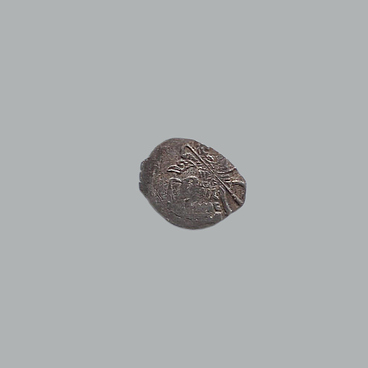
The numismatic collection of the Karasuksky Regional Museum includes an oval-shaped solid silver coin, with a face value of a kopek. A crowned rider facing to the right with a flowing greatcoat and a downward facing spear in his right hand are depicted on the coin’s obverse. The rider’s horse is walking rather than galloping. The coin’s reverse has a five-line inscription, formed of the ruler’s name and title ‘КИIКNА ДМIТР ИВАNОВИ ИСЕѦРУ’: meaning ‘His Majesty the Grand Prince Dmitry Ivanovich of all Rus’’ The first line is not legible on the museum’s coin.
False Dmitry I ruled from 1605 until 1606, until he was killed in a coup lead by Vasily Shuysky, who took his place. There are two versions of the story. According to the first version of events, Prince Dmitry, who was killed in Uglich, first passed himself off as a nobleman from Galich, and later as a dedicated monk, Grigory Otrepyev. He was elevated to the throne as a result of an agreement between Russian and Polish nobility. According to the second version of events, Dmitry was a genuine Prince from Uglich, who had been saved from death by the skin of his teeth - the youngest son of Ivan the Terrible.
A substantial number of silver kopeks made in the Moscow mint remain, which speaks to the intensity of the operations there under False Dmitry I. Kopeks were also stamped with the name of Dmitry Ivanovich in the Novgorod and Pskov mints. There are silver and gold medals from the reign of False Dmitry I. There are no records of denga coins with Dmitry’s name stamped on them.
The museum’s coin was most likely minted in Pskov in 1606. It is not possible to be more specific as the lower half of the design is not visible on the coin’s obverse, where the mint’s designation was generally positioned. However, the design is very similar to obverse stamp No. 2, as demonstrated in Kleschinov and Grishin’s ‘Catalogue of Russian Medieval Coins 1533-1717’, in particular the rider’s crown and the greatcoat flowing behind him. This feature corresponds with the Moscow design. But this means that they used the design from the previous ruler for the obverse. That design was prepared under Boris Godunov in 1604. On stamp No. 1, the crown and flowing greatcoat are drawn less precisely and the horse is galloping rather than walking. These attributes correspond to an older coin design.
Coins with the Moscow design were minted in Pskov in 1606. The reverse’s stamp is No. 1 (according to Kleschinov and Grishin). In other words, the reverse stamp was remade with the name of the new Tsar, Dmitry Ivanovich. The style of the letters differs from all of the other stamps used in Pskov before Dmitry’s reign. It is clear that the stamp’s designer is well-versed with latin letters. It is possible that the stamp was prepared by a foreign designer, perhaps in Poland.
False Dmitry I ruled from 1605 until 1606, until he was killed in a coup lead by Vasily Shuysky, who took his place. There are two versions of the story. According to the first version of events, Prince Dmitry, who was killed in Uglich, first passed himself off as a nobleman from Galich, and later as a dedicated monk, Grigory Otrepyev. He was elevated to the throne as a result of an agreement between Russian and Polish nobility. According to the second version of events, Dmitry was a genuine Prince from Uglich, who had been saved from death by the skin of his teeth - the youngest son of Ivan the Terrible.
A substantial number of silver kopeks made in the Moscow mint remain, which speaks to the intensity of the operations there under False Dmitry I. Kopeks were also stamped with the name of Dmitry Ivanovich in the Novgorod and Pskov mints. There are silver and gold medals from the reign of False Dmitry I. There are no records of denga coins with Dmitry’s name stamped on them.
The museum’s coin was most likely minted in Pskov in 1606. It is not possible to be more specific as the lower half of the design is not visible on the coin’s obverse, where the mint’s designation was generally positioned. However, the design is very similar to obverse stamp No. 2, as demonstrated in Kleschinov and Grishin’s ‘Catalogue of Russian Medieval Coins 1533-1717’, in particular the rider’s crown and the greatcoat flowing behind him. This feature corresponds with the Moscow design. But this means that they used the design from the previous ruler for the obverse. That design was prepared under Boris Godunov in 1604. On stamp No. 1, the crown and flowing greatcoat are drawn less precisely and the horse is galloping rather than walking. These attributes correspond to an older coin design.
Coins with the Moscow design were minted in Pskov in 1606. The reverse’s stamp is No. 1 (according to Kleschinov and Grishin). In other words, the reverse stamp was remade with the name of the new Tsar, Dmitry Ivanovich. The style of the letters differs from all of the other stamps used in Pskov before Dmitry’s reign. It is clear that the stamp’s designer is well-versed with latin letters. It is possible that the stamp was prepared by a foreign designer, perhaps in Poland.