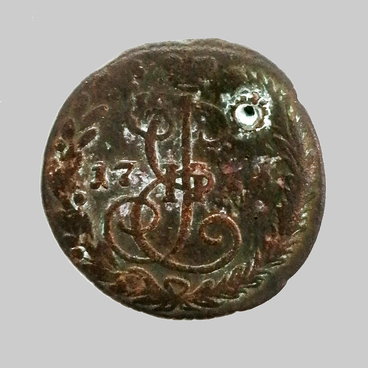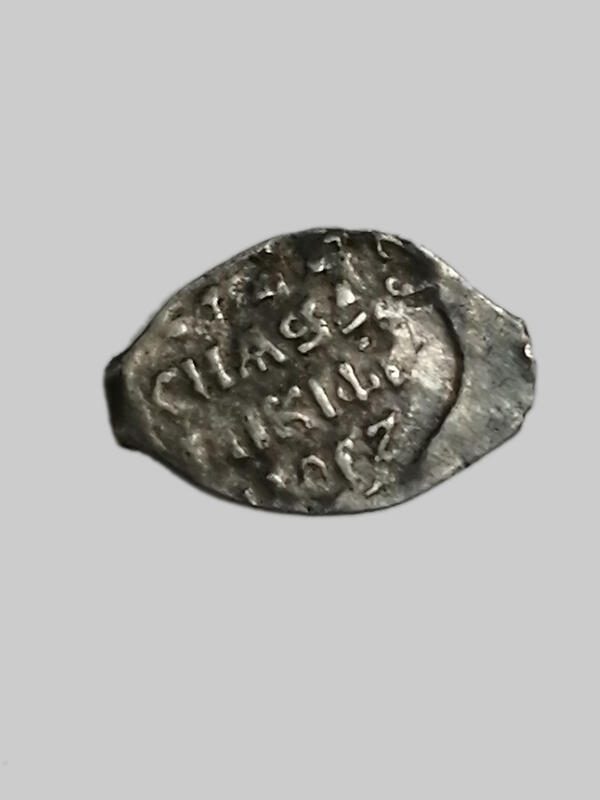
This Denga Coin from the time of Feodor Ivanovich’s reign is a solid 950 silver coin, shaped like a teardrop, with a weight of 0.34 g. A denga both weighed and was worth half a kopek. The coin, held by the Numismatics collection of the Karasuksky Regional Museum has uneven edges and worn-down surfaces. The date of issuance is between 1584 and 1594.
The raised sections of these coins are very slight. The coin’s obverse depicts a horseman riding to the right, with a saber raised above his head in his right hand. The letters ‘НС’ (NS) are written under the horse’s legs. Despite the fact that this denga was in circulation for a long period of time, it is well preserved. A section of the inscription on the coin’s reverse is legible. This four-line inscription displaying the name and title of the ruler: the first line is illegible (one would expect to see the word Tsar there, however), then: СНѦS МКIФ ОРЪ.
This denga coin was the most widely used coin from the early period of minting at the Moscow Mint. These coins made up a great proportion of the money used under Feodor Ivanovich.
Feodor’s government, which took charge of the country in 1584, inherited a terrible financial system from Ivan the Terrible. Monetary production had fallen sharply at every mint. A drop in interior and exterior trade had placed the Russian government in a very difficult situation. From 1584 until 1595, the number of coins minted had been small, but everything changed in May 1595, after the Treaty of Teusina was signed as a result of the end of the Russo-Swedish War. The revival of trade after 1595 increased the influx of silver, which led to increased production at the mints.
A monetary decree was created in 1595 and 1596, whose functions were carried out by the Moscow Mint. From 1595, kopeks with the date and sign of the Novgorod court entered into circulation, and the sign of the mint also appeared on Pskovian coins for the first time in Russian monetary history. Kopeks started to be produced at the Moscow mint, whilst the silver denga became fractional currency. This period also saw the inclusion of the Tsar’s patronymic name on Russian coinage for the first time (1535). This gradually became the norm.
The raised sections of these coins are very slight. The coin’s obverse depicts a horseman riding to the right, with a saber raised above his head in his right hand. The letters ‘НС’ (NS) are written under the horse’s legs. Despite the fact that this denga was in circulation for a long period of time, it is well preserved. A section of the inscription on the coin’s reverse is legible. This four-line inscription displaying the name and title of the ruler: the first line is illegible (one would expect to see the word Tsar there, however), then: СНѦS МКIФ ОРЪ.
This denga coin was the most widely used coin from the early period of minting at the Moscow Mint. These coins made up a great proportion of the money used under Feodor Ivanovich.
Feodor’s government, which took charge of the country in 1584, inherited a terrible financial system from Ivan the Terrible. Monetary production had fallen sharply at every mint. A drop in interior and exterior trade had placed the Russian government in a very difficult situation. From 1584 until 1595, the number of coins minted had been small, but everything changed in May 1595, after the Treaty of Teusina was signed as a result of the end of the Russo-Swedish War. The revival of trade after 1595 increased the influx of silver, which led to increased production at the mints.
A monetary decree was created in 1595 and 1596, whose functions were carried out by the Moscow Mint. From 1595, kopeks with the date and sign of the Novgorod court entered into circulation, and the sign of the mint also appeared on Pskovian coins for the first time in Russian monetary history. Kopeks started to be produced at the Moscow mint, whilst the silver denga became fractional currency. This period also saw the inclusion of the Tsar’s patronymic name on Russian coinage for the first time (1535). This gradually became the norm.