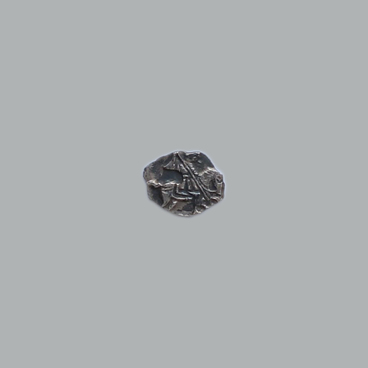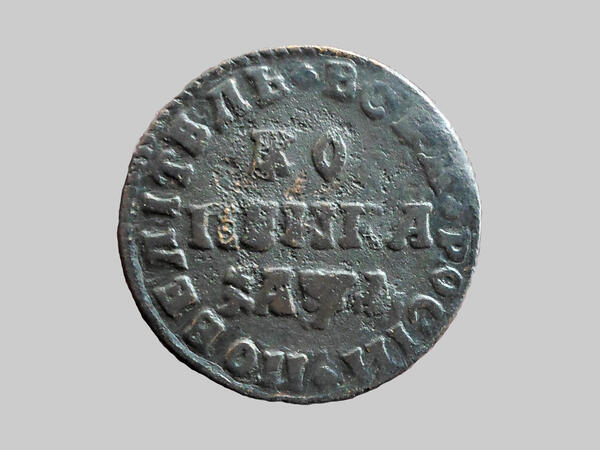
The Karasuksky Regional Museum’s Numismatics collection includes two-kopek coins minted under Peter the Great. One is a pre-reform stretched ‘cheshuyka’ (fish-scale), made from silver wire, whilst the other is a traditional, round, solid copper coin. It was minted in 1710.
The reforms carried out between 1698 and 1704 were some of the first measures undertaken by Peter the Great in order to regulate the country’s economy. The overall goal was to increase revenue from monetary regalia. Furthermore it was necessary to standardize and unify the system of the internal circulation of money.
Until the end of the 17th century, the Moscow mint (the only mint in the country), continued to mint silver kopeks, dengas and polushkas. Face values of less than a kopek were expensive to produce, and so on the whole they were in demand. By the end of the 17th century, the kopek had become very small indeed, but it remained a heavily used coin.
That coin production was greatly reduced and local initiatives received compensation accounts for the fact that they didn’t change the coin. People would either cut kopeks into smaller pieces or created local money from other materials, such as ‘leather lots’, which were stamped square pieces of hard leather. In these circumstances, the only way forward was to create a new monetary system. It was based on a silver ruble with a reduced weight, which corresponded to the European thaler, and also a copper kopek and its derivatives.
There were thorough preparations ahead of the reforms. Several minting machines were purchased from abroad. From 1696, dated kopeks started to be issued. These dates would have sent a message to the population about the forthcoming changes to the monetary system.
The reforms took six years. In 1698, the weight of the silver kopek was reduced to 0.28 grams, due to the weight of the ruble being equal to the weight of a thaler - 28 grams. From this scheme, the government received 35 kopeks in profit for every ruble. At the same time, new mints were being built and existing mints were being refurbished, where coins could be minted on round blanks.
On 11 March 1700, a decree was issued ‘About the introduction of copper coins’. Copper coins were necessary due to a lack of coins being available in cities. Copper coins were initially issued with face values of a denga (½ kopek), polushka (¼ kopek) and polupolushka (1/8 kopek). The government recognized that they were directly equivalent to the silver wire kopeks. When there was a critical lack of coins, they were fairly easily introduced into circulation. Coins were minted from imported copper, which came in ingots or plates.
In 1701, the following new silver coins were minted: poltinas, polupoltinniks, grivenniks (10 kopeks) and five kopeks (10 dengas). At the same time, up until 1718, the previous style of silver wire kopeks were made as collateral for the solid copper kopeks and their derivatives. In 1701, gold coins started to be produced, with a weight of 3.47 grams. They were equivalent to the Western European Ducat. The final stage of the reforms took place in 1704, with the silver ruble and copper kopek entering into circulation.
The reforms carried out between 1698 and 1704 were some of the first measures undertaken by Peter the Great in order to regulate the country’s economy. The overall goal was to increase revenue from monetary regalia. Furthermore it was necessary to standardize and unify the system of the internal circulation of money.
Until the end of the 17th century, the Moscow mint (the only mint in the country), continued to mint silver kopeks, dengas and polushkas. Face values of less than a kopek were expensive to produce, and so on the whole they were in demand. By the end of the 17th century, the kopek had become very small indeed, but it remained a heavily used coin.
That coin production was greatly reduced and local initiatives received compensation accounts for the fact that they didn’t change the coin. People would either cut kopeks into smaller pieces or created local money from other materials, such as ‘leather lots’, which were stamped square pieces of hard leather. In these circumstances, the only way forward was to create a new monetary system. It was based on a silver ruble with a reduced weight, which corresponded to the European thaler, and also a copper kopek and its derivatives.
There were thorough preparations ahead of the reforms. Several minting machines were purchased from abroad. From 1696, dated kopeks started to be issued. These dates would have sent a message to the population about the forthcoming changes to the monetary system.
The reforms took six years. In 1698, the weight of the silver kopek was reduced to 0.28 grams, due to the weight of the ruble being equal to the weight of a thaler - 28 grams. From this scheme, the government received 35 kopeks in profit for every ruble. At the same time, new mints were being built and existing mints were being refurbished, where coins could be minted on round blanks.
On 11 March 1700, a decree was issued ‘About the introduction of copper coins’. Copper coins were necessary due to a lack of coins being available in cities. Copper coins were initially issued with face values of a denga (½ kopek), polushka (¼ kopek) and polupolushka (1/8 kopek). The government recognized that they were directly equivalent to the silver wire kopeks. When there was a critical lack of coins, they were fairly easily introduced into circulation. Coins were minted from imported copper, which came in ingots or plates.
In 1701, the following new silver coins were minted: poltinas, polupoltinniks, grivenniks (10 kopeks) and five kopeks (10 dengas). At the same time, up until 1718, the previous style of silver wire kopeks were made as collateral for the solid copper kopeks and their derivatives. In 1701, gold coins started to be produced, with a weight of 3.47 grams. They were equivalent to the Western European Ducat. The final stage of the reforms took place in 1704, with the silver ruble and copper kopek entering into circulation.