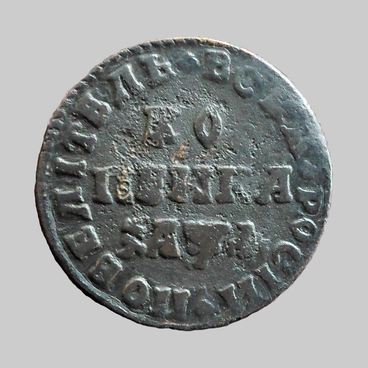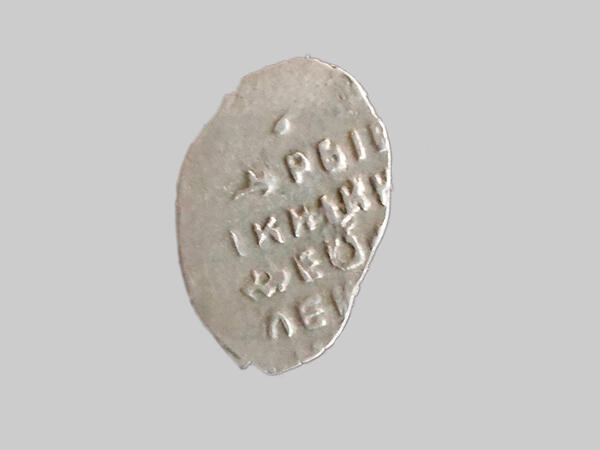
The Karasuksky Regional Museum’s Numismatics collection includes a solid silver coin, with a face value of one kopek. It is oval-shaped and weighs 0.40 grams, 0.36 grams of which is pure silver. It was in circulation under Feodor III.
Feodor Alekseyevich was the son of Alexei Mikhailovich, and ruled for a short time - between 1676 and 1682. Under him, the government tried to centralize all financial affairs within the Order of the Grand Treasury. Kopeks were minted under Feodor III until 1680 at a standard weight of 0.48 grams, whilst in 1681 and 1682 they were minted at a standard weight of 0.42 grams. It is hard to say whether the lower weight is linked to financial difficulties or as a way to replenish the Treasury’s coffers. The obverse side of the ‘fish-scale’ kopeks produced under Feodor III traditionally depicted a rider on horseback, and carried the designation of the Moscow Mint: ‘o/M’. The following inscription was positioned on the reverse: ‘Tsar and Grand Prince of all Rus’ Feodor Alekseyevich’.
These small silver kopeks were nicknamed ‘fish-scales’ due to their similarity to fish scales. They were made from flattened pieces of silver wire. It is fairly hard to find two identical coins, and even rarer to find a coin with the whole image. More often, it is possible to find only fragments of the stamp, with part of the inscription of design missing. Sometimes the fish-scale coin was smaller than the stamp, which meant that the drawing was initially not completely stamped. Some stamps continued to be used even after they became damaged.
On the coin’s obverse, the rider on horseback wears a crown, with a spear in his right hand a flowing greatcoat. The coin’s reverse has a four-line inscription, formed of the name and titles of the ruler: ‘ЦРЬIВ IКНIКН ФЕО ЛЕ’. The words ‘all of Rus’’ would have been on the missing fifth line.
Some elements of the rider and horse (the flattened ears and the cloak) make it clear that the obverse side was stamped by stamp No. 13, according to Grishin and Kleschinov’s ‘Catalogue of Russian Medieval Coins 1533-1717’. This stamp had also been used under Alexey Mikhailovich. The reverse side was stamped by stamp No. 21, which allows researchers to establish that the coin was minted during the final years of Feodor III’s reign, when the standard weight dropped - between 1681 and 1682.
Feodor Alekseyevich was the son of Alexei Mikhailovich, and ruled for a short time - between 1676 and 1682. Under him, the government tried to centralize all financial affairs within the Order of the Grand Treasury. Kopeks were minted under Feodor III until 1680 at a standard weight of 0.48 grams, whilst in 1681 and 1682 they were minted at a standard weight of 0.42 grams. It is hard to say whether the lower weight is linked to financial difficulties or as a way to replenish the Treasury’s coffers. The obverse side of the ‘fish-scale’ kopeks produced under Feodor III traditionally depicted a rider on horseback, and carried the designation of the Moscow Mint: ‘o/M’. The following inscription was positioned on the reverse: ‘Tsar and Grand Prince of all Rus’ Feodor Alekseyevich’.
These small silver kopeks were nicknamed ‘fish-scales’ due to their similarity to fish scales. They were made from flattened pieces of silver wire. It is fairly hard to find two identical coins, and even rarer to find a coin with the whole image. More often, it is possible to find only fragments of the stamp, with part of the inscription of design missing. Sometimes the fish-scale coin was smaller than the stamp, which meant that the drawing was initially not completely stamped. Some stamps continued to be used even after they became damaged.
On the coin’s obverse, the rider on horseback wears a crown, with a spear in his right hand a flowing greatcoat. The coin’s reverse has a four-line inscription, formed of the name and titles of the ruler: ‘ЦРЬIВ IКНIКН ФЕО ЛЕ’. The words ‘all of Rus’’ would have been on the missing fifth line.
Some elements of the rider and horse (the flattened ears and the cloak) make it clear that the obverse side was stamped by stamp No. 13, according to Grishin and Kleschinov’s ‘Catalogue of Russian Medieval Coins 1533-1717’. This stamp had also been used under Alexey Mikhailovich. The reverse side was stamped by stamp No. 21, which allows researchers to establish that the coin was minted during the final years of Feodor III’s reign, when the standard weight dropped - between 1681 and 1682.