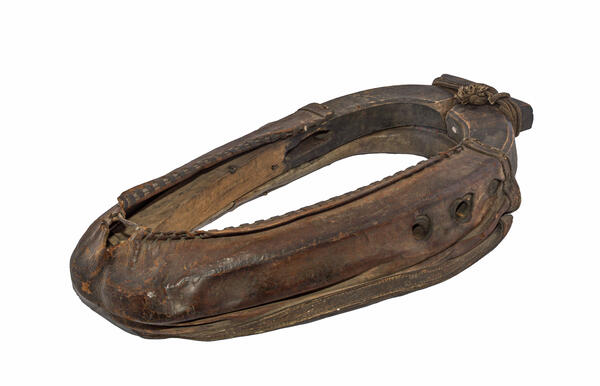
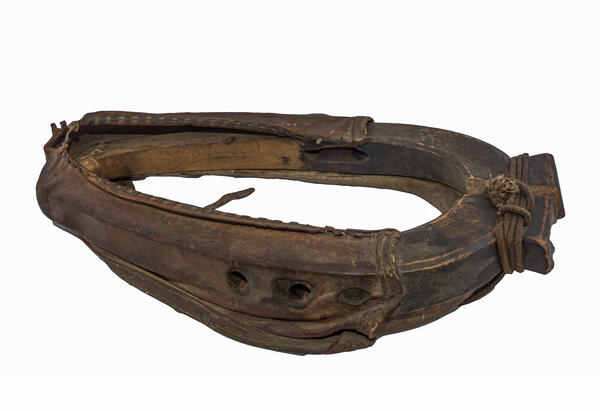
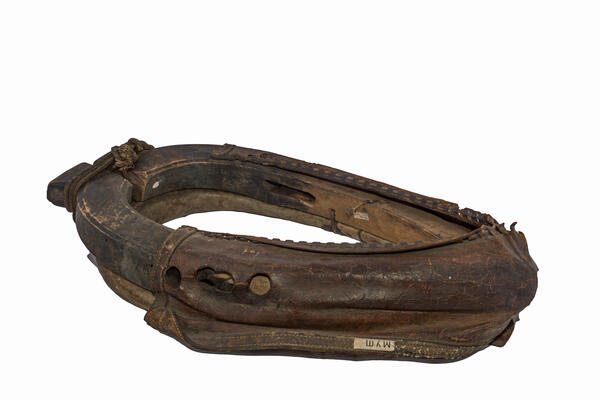
According to the characteristic features of horse equipment, the development of Shor horse-riding transport was influenced by the culture of Central Asian nomads. As for horse-drawn transport, it was influenced by Russian settlers. In the mountain taiga region of Siberia, the main means of transport were wooden sleds with two runners, to which the horse was harnessed using a Russian shaft bow and a “koop” horse collar.
Thanks to this part of the harness, the load was evenly distributed on the horse’s neck and shoulder girdle, and the efforts to move the cart or plow were directed in the desired direction.
Before the horse collar, a soft yoke was placed around the animal’s neck. The heavier the load required to be pulled, the more pressure was placed on the chest, which made it difficult for the horse to breathe and led to rapid exhaustion. This approach significantly limited the use of horse traction.
An improved rigid model of a “collar” appeared in the 7th century in the East; in the second half of the 10th –11th centuries, Europeans became acquainted with it, and then it appeared in Rus.
Unlike the yoke, the horse collar has an advantage — it does not compress the animal’s trachea and allows it to push the weight with the back of the body and legs, rather than pull it on the shoulders.
This device consists of a lining (“khomutina”) and a pair of curved wooden parts to which traces are attached — rope or leather loops that are necessary to hitch the horse to the shaft. To allow the animal’s head to pass freely through the horse collar, they are slightly moved apart. After the horse collar is put on the horse, the lower ends are tightened with a narrow and durable belt made of rawhide. This provides a closer and more comfortable fit to the animal’s body.
The oval shape of the clamp also contributes to a
tight fit. In places where the collar touches the skin, the rigidity of the
structure is softened by an elastic soft lining. It looks like a roller and is
made of leather or fabric and stuffed with sponge, hair, straw, or other
shock-absorbing filler, sometimes even wool or felt is used. When the harness
is adjusted correctly, a small gap no bigger than the width of a palm remains
between the horse’s throat and the collar. Two fingers should fit freely between
the top of the collar and the animal’s neck.