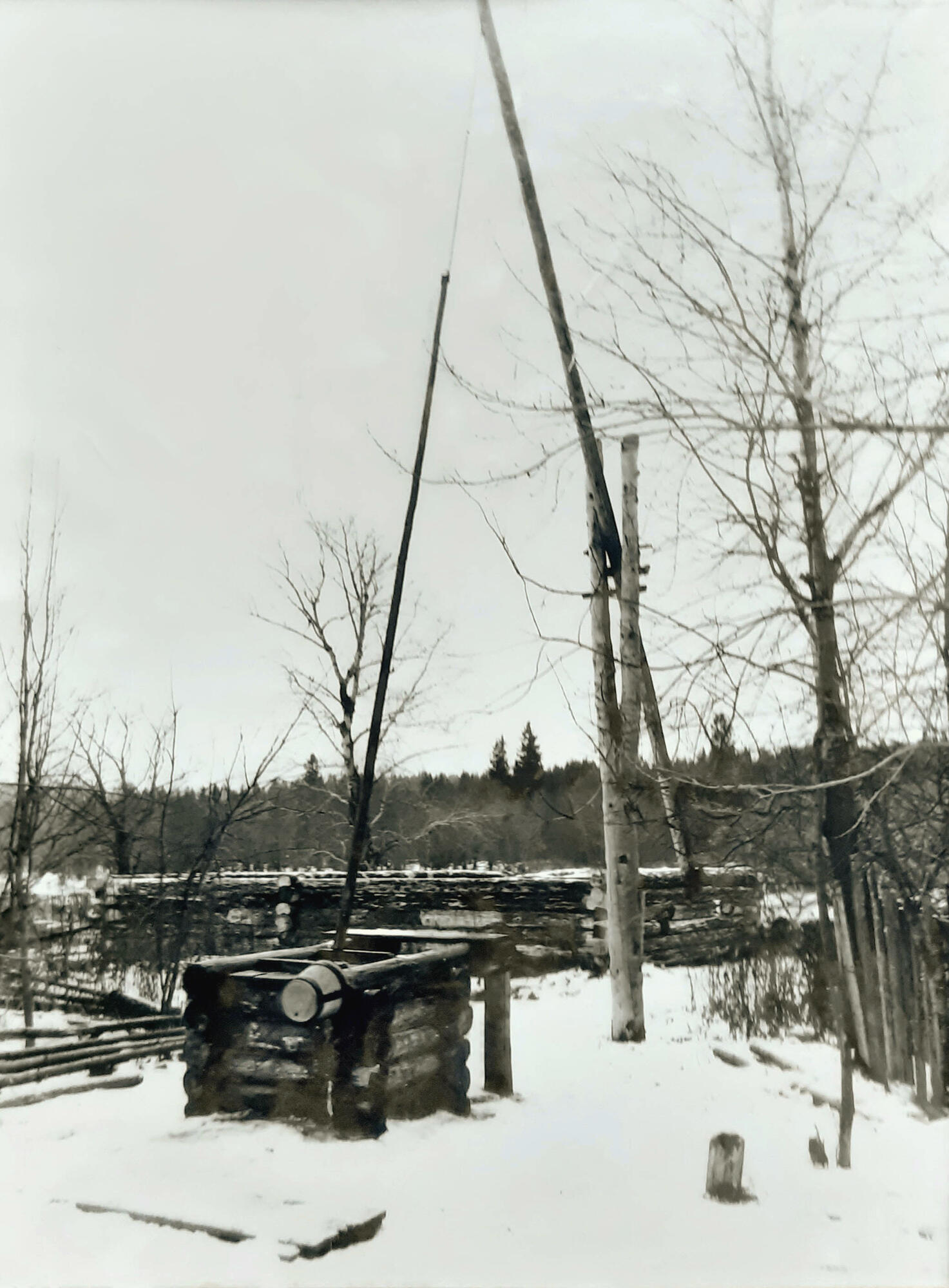


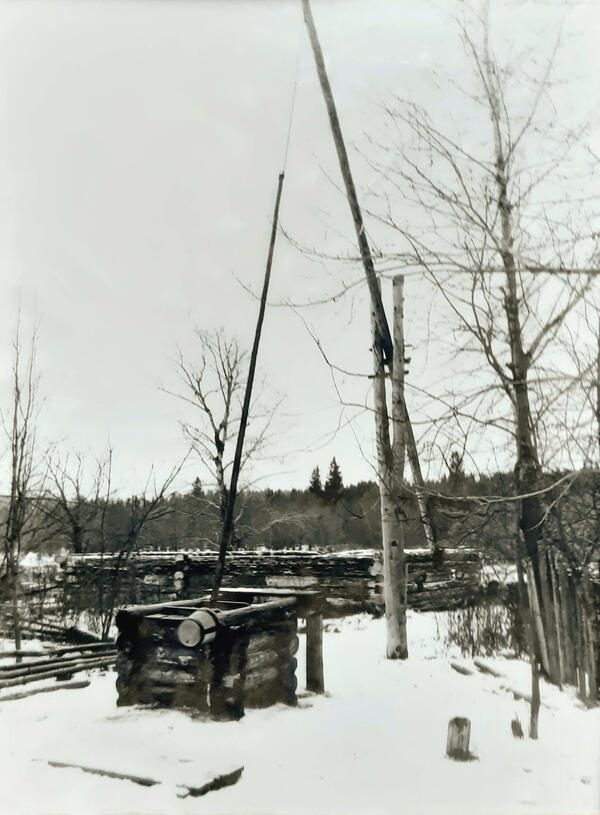
The crane well is a well with a special lifting mechanism called ‘a crane.’ The mechanism consists of a thick pole on a post with a fork; a bucket, or a chain is on one end of the pole and a load is on the other end. This type of a well was known even in the 16th century.
The name was given as the well structure reminded of a crane. The crane was a lever with a counterweight on the one end and a bucket for water on the one end. The structure allowed easily taking out water from a well. If a well was deep, a chain was used. A 1.5-meter-long chain was attached to a bucket handle for the bucket not to flow on the water surface but to submerge and collect water. A permanent bucket was used on the pole in order to maintain a proper sanitary state of the well. At present, one can seldom find a crane well. There are more draw-wells with handles.
Our ancestors believed that wells were connected with supernatural power. They thought that the devilry may slip into our world through a well. For the same reason, a person should not bend over a well and look at well water. According to a superstition, one could see devilry in well water.
People believed that a well and water appeared in a definite place due to Makosh, a goddess in the Slavic mythology. Later presence of water in some place was connected with Paraskeva-Pyatnitsa (a saint personifying Friday), or Mary, the mother of Jesus. However, the well holiday had a male name, Konstantinov’s Circles. On this day, on March 19, a special ritual was performed: circles were trodden out around wells in order to protect wells from dirty melted snow. People believed that this measure could preserve water purity and taste.
Springs with healing water were found in many villages and rural areas. There were many superstitions connected with wells. On Yury’s Day (November, 26) it has prohibited to take water from a well. Moreover, it was not recommended to approach a well on this day. If you agreed upon something with a neighbor, it was prohibited to drink water from his well, because well water could ‘wash down’ the agreement. Another popular belief stated that a woman should not sit on the edge of the well, otherwise dough for bread would not rise. Taking money for well water was prohibited, otherwise the spring would dry up.
The name was given as the well structure reminded of a crane. The crane was a lever with a counterweight on the one end and a bucket for water on the one end. The structure allowed easily taking out water from a well. If a well was deep, a chain was used. A 1.5-meter-long chain was attached to a bucket handle for the bucket not to flow on the water surface but to submerge and collect water. A permanent bucket was used on the pole in order to maintain a proper sanitary state of the well. At present, one can seldom find a crane well. There are more draw-wells with handles.
Our ancestors believed that wells were connected with supernatural power. They thought that the devilry may slip into our world through a well. For the same reason, a person should not bend over a well and look at well water. According to a superstition, one could see devilry in well water.
People believed that a well and water appeared in a definite place due to Makosh, a goddess in the Slavic mythology. Later presence of water in some place was connected with Paraskeva-Pyatnitsa (a saint personifying Friday), or Mary, the mother of Jesus. However, the well holiday had a male name, Konstantinov’s Circles. On this day, on March 19, a special ritual was performed: circles were trodden out around wells in order to protect wells from dirty melted snow. People believed that this measure could preserve water purity and taste.
Springs with healing water were found in many villages and rural areas. There were many superstitions connected with wells. On Yury’s Day (November, 26) it has prohibited to take water from a well. Moreover, it was not recommended to approach a well on this day. If you agreed upon something with a neighbor, it was prohibited to drink water from his well, because well water could ‘wash down’ the agreement. Another popular belief stated that a woman should not sit on the edge of the well, otherwise dough for bread would not rise. Taking money for well water was prohibited, otherwise the spring would dry up.