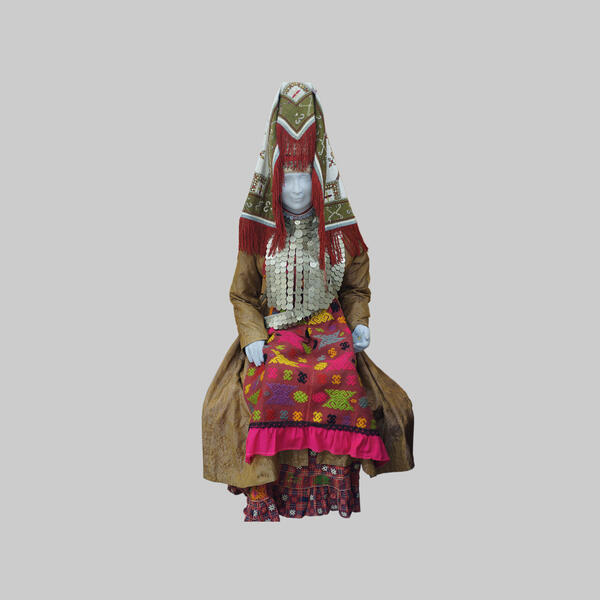
This national costume was typical of the group of Udmurts living in the Bavlinsky District of the Republic of Tatarstan and the Yermekeyevsky District of the Republic of Bashkortostan. The bridal gown consisted of a female shirt, a caftan, and an apron. The shirt’s lower hem was decorated with a ruffle. The upper part of the apron was made of a checked homespun cloth with loom weaving designs. The lower part of the apron was also decorated with a ruffle. The apron was part of a dowry.
In the groom’s house, the bride was wearing a female headdress: a head towel fixed with a headband. Over them, the bride wore an aishon, a tall headdress made of birch-bark covered with a cloth and silver coins. The aishon was layered with a wedding syulyk, a head blanket with a fringe decoration on the edges. Symbolic trees of life were embroidered at the corners of the blanket. These embodied procreation.
A young woman wore this sophisticated and heavy headdress before her first child was born. After the birth of a child, the embroidered blanket was replaced with a red headscarf. A byrttos, an additional trapezoidal detail covered with linen and silver coins, was sewn onto the aishon. After the childbearing period was over, a woman changed her headdress again.
A female necklace was called a chyrtyves; a shoulder decoration was called a butmar and kalobutmar. The breast was decorated with a monIsto. The jewelry was passed down the generations. Silver coins, imperial rubles, and small silver details were used for jewelry manufacturing. They were sewn in rows onto the fabric. As a result, it looked like a solid silver cascade fringed with chains of copper coins. The piece used to be a good luck charm protecting the wearer from the evil eye.
Metal jewelry was very typical of the Udmurts' costumes in the 19th century and the first quarter of the 20th century. It even replaced beads and cowrie shells. Very often, jewelry, including silver pieces, indicated the wealth of a family. A bride’s status was determined by the value of her jewelry. The exposition of the National Museum of the Udmurt Republic features modern replicas of an aishon and necklaces. They are decorated with coins made in the 1980s.
In the groom’s house, the bride was wearing a female headdress: a head towel fixed with a headband. Over them, the bride wore an aishon, a tall headdress made of birch-bark covered with a cloth and silver coins. The aishon was layered with a wedding syulyk, a head blanket with a fringe decoration on the edges. Symbolic trees of life were embroidered at the corners of the blanket. These embodied procreation.
A young woman wore this sophisticated and heavy headdress before her first child was born. After the birth of a child, the embroidered blanket was replaced with a red headscarf. A byrttos, an additional trapezoidal detail covered with linen and silver coins, was sewn onto the aishon. After the childbearing period was over, a woman changed her headdress again.
A female necklace was called a chyrtyves; a shoulder decoration was called a butmar and kalobutmar. The breast was decorated with a monIsto. The jewelry was passed down the generations. Silver coins, imperial rubles, and small silver details were used for jewelry manufacturing. They were sewn in rows onto the fabric. As a result, it looked like a solid silver cascade fringed with chains of copper coins. The piece used to be a good luck charm protecting the wearer from the evil eye.
Metal jewelry was very typical of the Udmurts' costumes in the 19th century and the first quarter of the 20th century. It even replaced beads and cowrie shells. Very often, jewelry, including silver pieces, indicated the wealth of a family. A bride’s status was determined by the value of her jewelry. The exposition of the National Museum of the Udmurt Republic features modern replicas of an aishon and necklaces. They are decorated with coins made in the 1980s.