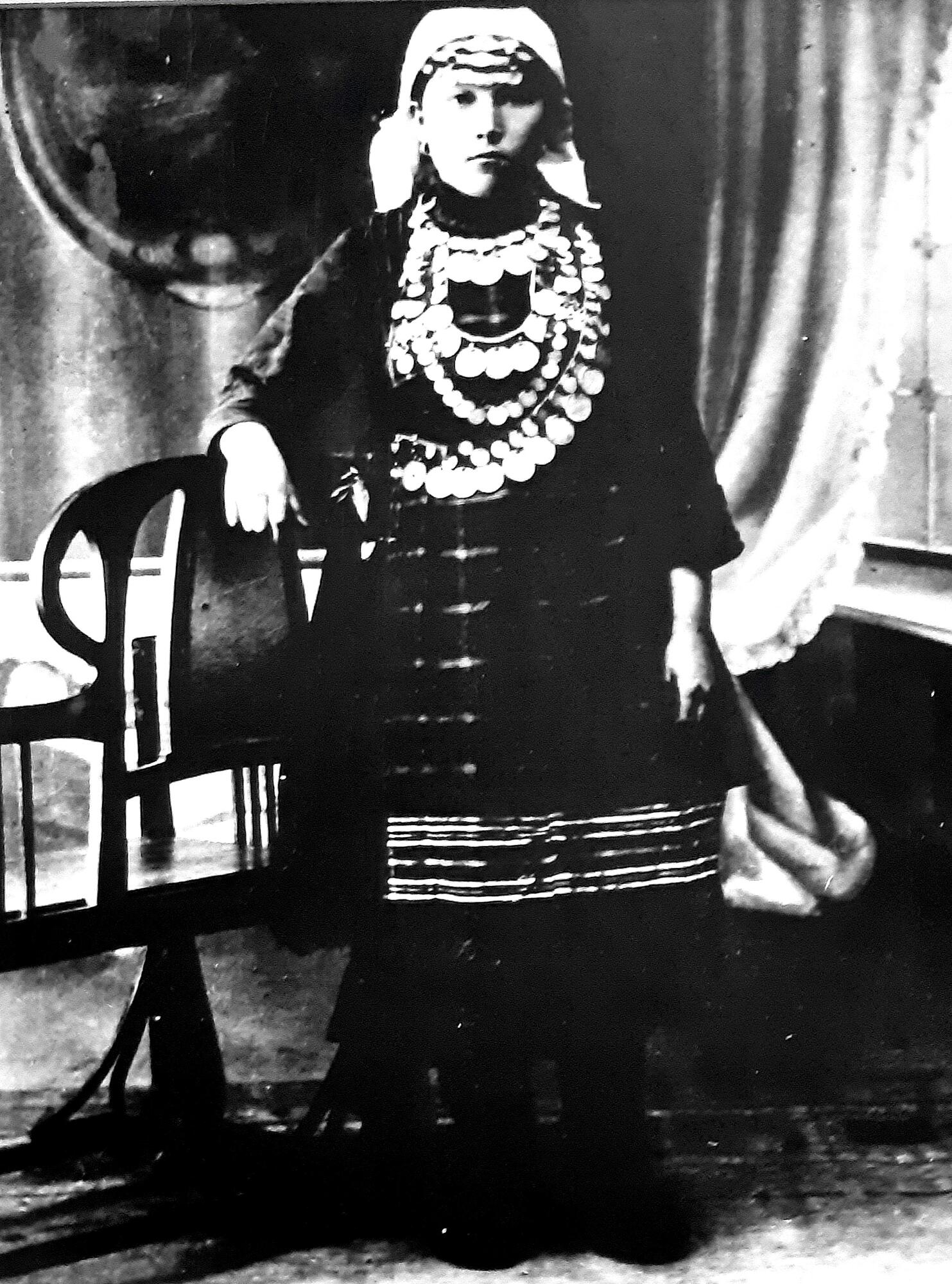


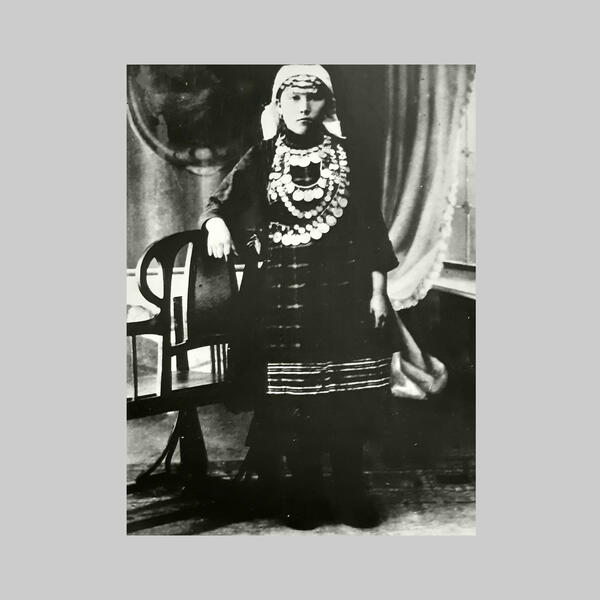
The national female costume of a Trans-Vyatka Udmurt consisted of a shirt, an apron, and a head towel in the late 19th – early 20th centuries. The shirt was tunica-shaped, with a small standing collar and three-quarter sleeves. The sleeve ends were covered with a wide strip of a factory fabric. The shirt’s lower hem was decorated with a 15–20cm wide ruffle made of a red or wine-colored factory fabric. The upper part of the apron was made of a checked homespun. The lower part of the apron was decorated with factory-made bands. However, the number of strips on the apron should be the same as on the shirt.
A girl’s costume differed from a woman’s costume by a headdress. Girls wore a cap called a takya. It was a round-shaped cap made of a factory-made or homespun fabric and decorated with small silver coins, or details imitating coins. Teenage girls wore round takyas. As they grew up, they changed it to an elongated one. On holidays, women wore necklaces called a chertykysh and a shoulder decoration called a kamali; both were made of silver coins.
The shoulder decoration was put over the left shoulder under the right hand. The decoration was a looped strip of linen. The back part was narrower than the front one. Silver coins were sewn onto the front side. Women wore decorations for weddings, seeing the soldiers off, and other solemn occasions. Expensive silver jewelry was kept for centuries as a family jewel and was passed down the generations. Many peoples believed that silver was a metal with magic powers. It symbolized beauty, wealth, and health.
The Zavyatsk national costume was typical of the following areas: the Mari-Tureksky District of the Mari El Republic, some areas of the Malmyzhsky District of the Kirov region, the Mamadyshsky and Baltasinsky Districts of the Republic of Tatarstan (the former territory of the Mamadyshsky Uyezd of the Kazan Governorate and the Malmyzhsky and Urzhumsky Uyezds of the Vyatka Governorate). The Turkic concepts affected the South Udmurt national costume. The southern Udmurts sewed clothes of homespun fabrics made of threads of different colors. The clothes cut remained unchanged for almost three centuries.
A girl’s costume differed from a woman’s costume by a headdress. Girls wore a cap called a takya. It was a round-shaped cap made of a factory-made or homespun fabric and decorated with small silver coins, or details imitating coins. Teenage girls wore round takyas. As they grew up, they changed it to an elongated one. On holidays, women wore necklaces called a chertykysh and a shoulder decoration called a kamali; both were made of silver coins.
The shoulder decoration was put over the left shoulder under the right hand. The decoration was a looped strip of linen. The back part was narrower than the front one. Silver coins were sewn onto the front side. Women wore decorations for weddings, seeing the soldiers off, and other solemn occasions. Expensive silver jewelry was kept for centuries as a family jewel and was passed down the generations. Many peoples believed that silver was a metal with magic powers. It symbolized beauty, wealth, and health.
The Zavyatsk national costume was typical of the following areas: the Mari-Tureksky District of the Mari El Republic, some areas of the Malmyzhsky District of the Kirov region, the Mamadyshsky and Baltasinsky Districts of the Republic of Tatarstan (the former territory of the Mamadyshsky Uyezd of the Kazan Governorate and the Malmyzhsky and Urzhumsky Uyezds of the Vyatka Governorate). The Turkic concepts affected the South Udmurt national costume. The southern Udmurts sewed clothes of homespun fabrics made of threads of different colors. The clothes cut remained unchanged for almost three centuries.