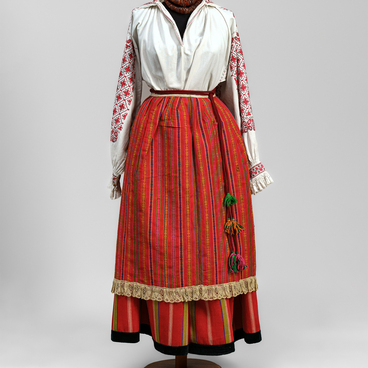
One of the most eye-catching types of Russian women’s headwear is the kokoshnik. It was the central accessory of the traditional costume and became one of Russia’s national symbols. Kokoshniks were worn not only by peasants but also by wives of boyars and citizens. Even members of the royal family wore luxurious kokoshniks decorated with precious stones and expensive fabrics.
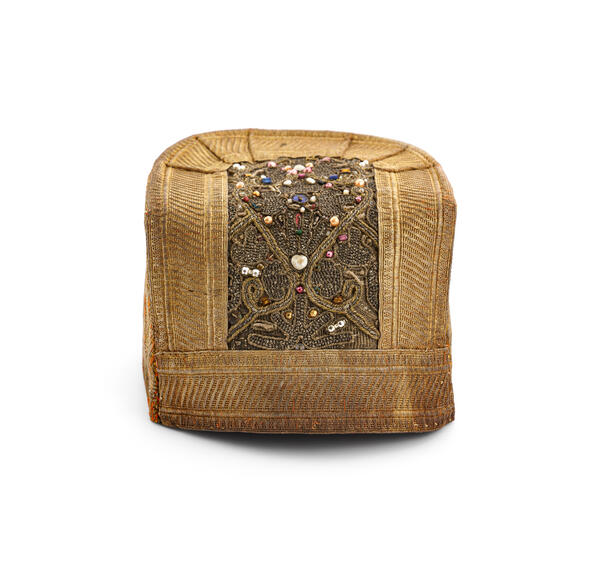
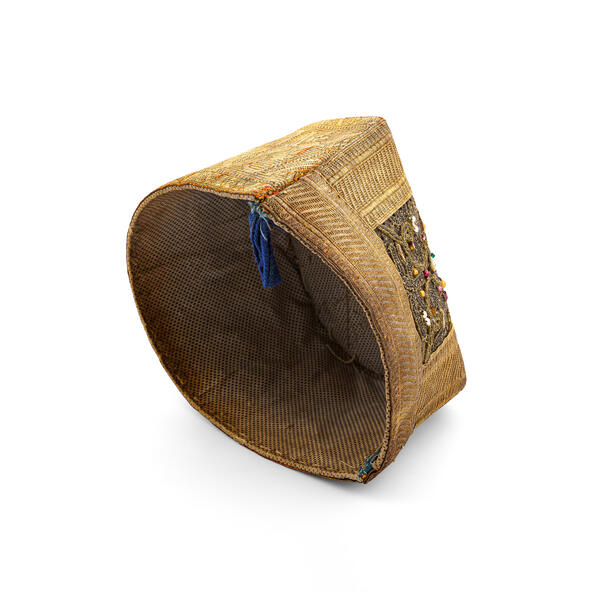
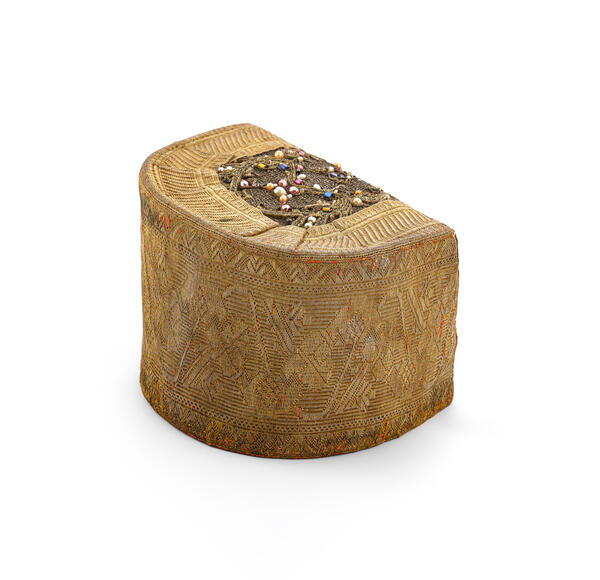
The Lipetsk Regional Museum of Local Lore houses kokoshniks made in the villages of the Tambov, Voronezh, and Ryazan Governorates. They are shaped like cylindrical hats with a flat top. Such headdresses were typically decorated with a colorful headscarf on top and were worn on special occasions. The kokoshnik from the museum collection originated from the village of Novonikolskoye, Dankovsky Uyezd, Ryazan Governorate. The solid base of the headdress is covered with passementerie featuring a floral pattern. At the top and in the back, there is a narrow galloon with a geometric pattern. The back side of the kokoshnik is decorated with woven metallic thread embroidery, glass beads, pearls, and sequins.
The history of the kokoshnik can be traced back to ancient times. However, they were first mentioned in written sources in the 17th century. In Russia, women were traditionally expected to cover their heads, hiding their hair under headdresses in order to protect their families from trouble and misfortune. According to superstitions, women’s hair attracted evil forces, so it was important to cover it. In the governorates of the Russian Empire, there were various versions of this festive headdress. The kokoshnik came in different shapes and sizes. To this day, one-horned kokoshniks with netting covering the forehead have been preserved. This was the most common version among women in Central Russia. Even more peculiar were wider two-horned kokoshniks with a crescent-shaped ochelye (band covering the forehead). These were worn in the Nizhny Novgorod Governorate. The saddle-shaped “shelomok” was worn in Kharkov, Oryol, and Kursk Governorates. In the old days, kokoshniks were purchased at fairs or tailor-made. As they were expensive, they were treasured as family heirlooms and passed down from generation to generation.