In the Southern Great Russian Governorates of the second half of the 19th century and the early 20th century, men’s peasant clothing was made mainly from homespun materials such as linen, striped cotton, woolen cloth, and sheepskin. Sometimes, factory-produced materials were used, such as calico, chintz, sateen, cotton velvet, and cheap woolen fabric. The traditional casual clothing consisted of a shirt and pants. The shirt was worn untucked, tied at the waist with a belt. On their feet, men wore bast shoes (with cloth wrapped around their feet) or boots. Festive clothes, particularly shirts, were usually made of a thinner fabric and were decorated with woven and embroidered designs. Wedding shirts were especially richly adorned.
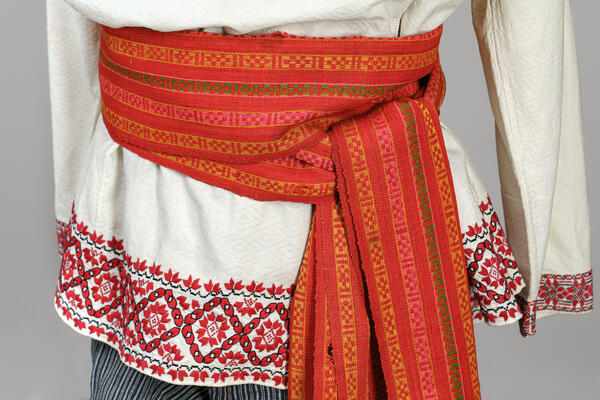
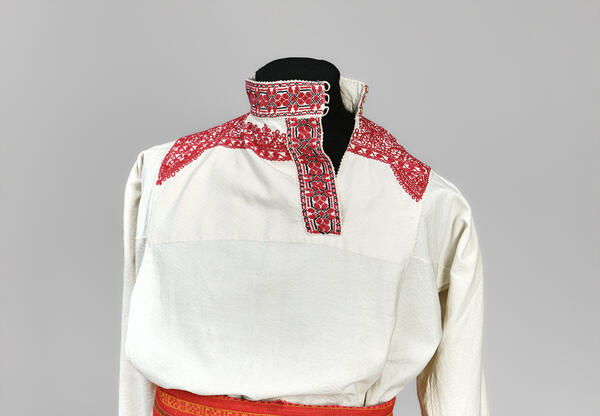
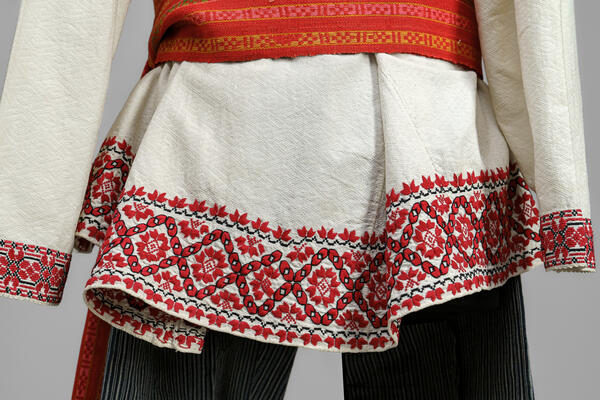
The collection of the Lipetsk Regional Museum of Local Lore includes men’s festive clothes which originated from the village of Syrskoye, in the Lipetsk Uyezd of the Tambov Governorate. The outfit is dated to approximately the middle of the 19th century. The pants are dark blue, a color typical of the Lipetsk region, and have thin, vertical white stripes. They have a traditional cut, similar to that used in Russia in the 14th century. They are made up of two pants that are folded in half and a diamond-shaped gusset. The festive kosovorotka shirt is richly embroidered. It was designed for the wedding, made of white linen, and decorated with a woven pattern that forms a rhombus grid. It is tunic-shaped and has oblique sides and a rectangular lining. The shirt has a stand-up collar. It is buttoned up on the left side with three glass buttons and thread loops. The sleeves are wide, gathered at the top, and tapered at the wrist. The collar, front, and cuffs are decorated with rick rack trim and red and black cross stitching. The red tambour embroidery imitates a yoke. The pattern features pots with trees. The hem is decorated with red and black stitchwork, cross-stitch embroidery, and counted-thread embroidery. A belt was an integral part of a traditional men’s outfit. It was considered indecent to go out without wearing a belt. It served as a talisman and even an identification sign because the patterns on the kushak belt differed depending on the place of origin. The red, striped belt from the museum collection was made from homespun materials, using the plain weave technique. There are alternating ornate stripes of geometric patterns formed by yellow, pink, and green threads. The ends are sewn with triangular pieces of cotton velvet outlined with green and pink rick rack trimming. A colorful wool fringe made of thick, twisted threads is attached to the ends of the belt.