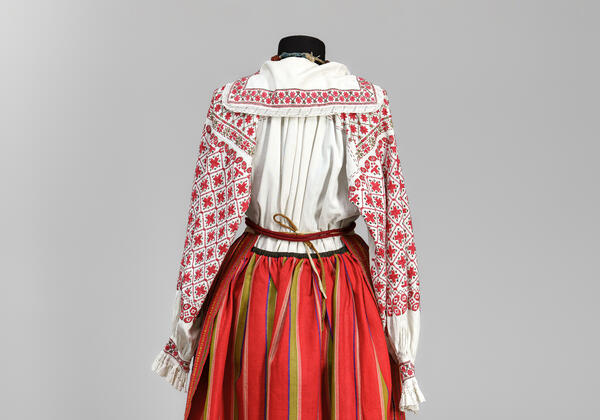
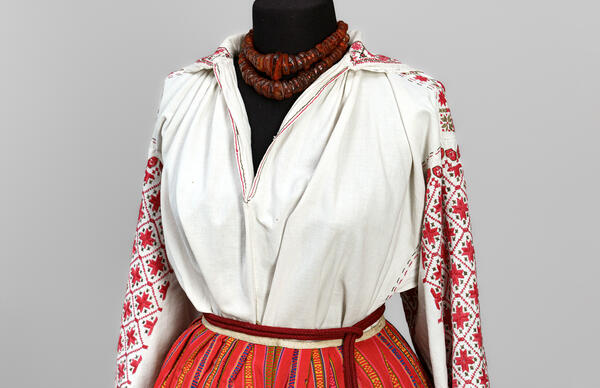
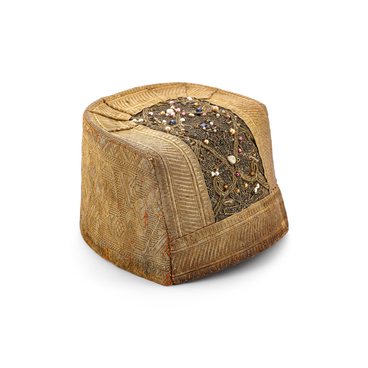
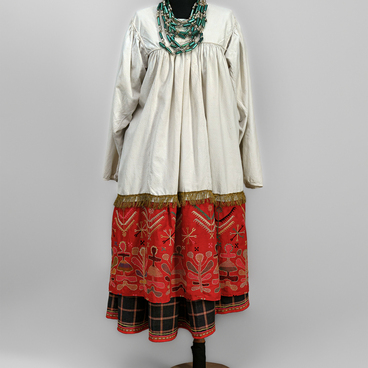
In the Southern Great Russian Governorates, the festive women’s outfit consisted of a shirt made of homespun fabric and decorated with red pattern weaving and embroidery, a skirt (ponyova), an apron, a belt, and various necklaces. The Lipetsk Regional Museum of Local Lore houses an example of a festive costume worn by peasant women in the Tambov Governorate. It can be described as a collective image, as the elements were used in villages in the Usman and Lipetsk Districts of the present-day Lipetsk Oblast.
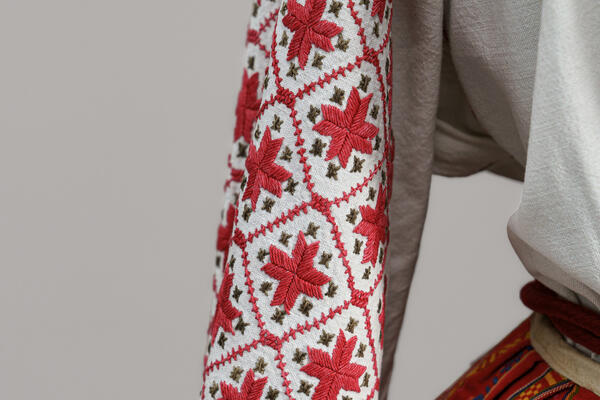
An essential element of the traditional costume was a shirt. The one presented in the museum collection is made of white and smooth homespun linen with straight shoulder elements. It has a deep V-cut neckline with a button at the neck. The shirt is richly decorated, with the fluffy sleeves featuring counted-thread embroidery up to the cuffs. There is also an embroidered strip along the edge of the turn-down collar. The cuffs and collar edges are trimmed with handmade white lace. This shirt was used in the village of Golovshchino in the Lipetsk Uyezd of the Tambov Governorate in 1917.
The shirt was traditionally complemented by a skirt. This one catches the eye with its bright colors and colorful woven strips. The skirt was sewn from seven woolen panels woven at home. The decorative strips are created by introducing colorful threads, such as green, white, purple, and pink. At the top, the skirt is gathered with a gashnik — a special cord made from hemp threads. It is hidden inside a narrow piece of black cotton fabric. The hem is edged with a strip of black cotton velvet. This skirt was worn in the early 20th century. It belonged to a resident of the village of Demshino, in the Usman Uyezd of the Tambov Governorate.
The outfit is made even more festive and spectacular by the red apron woven at home and decorated with a geometric pattern, which features alternating yellow, pink, and purple threads. The hem is trimmed with factory-made lace. This apron was made in the village of Podgornoye in the Lipetsk Uyezd of the Tambov Governorate in the second half of the 19th century.
Another essential element of a woman’s costume was a belt. This particular outfit includes a long, braided cord made of maroon wool. The belt is folded in half, forming a loop on one side. At the end of the cord, there are decorative elements — lush and colorful tassels made of woolen threads. A festive outfit was usually accompanied by a necklace made of beads, including glass and amber ones.