The history of coffee started in the Middle East in about 850 AD. Initially, it was not the decoction of roasted beans that was used as a tonic, but the raw coffee berries. People started to use the beans to make the drink only in the 12th century. A few centuries later, they began to dry, roast, grind them and pour hot water over the resulting powder.
Coffee appeared in Europe in the first half of the 16th century. In 1615, Venetian merchants brought it to Italy. In 1646, the first coffee house opened in Venice, then they appeared in Marseille and other French cities.
Coffee was brought to Russia during the reign of tsar Aleksey Mikhaylovich (1645–1676). It was used to cure some diseases, including migraines. The tradition of drinking coffee originated in the times of Peter the Great (1682–1725). The emperor forced his entourage to drink the new beverage that they called bitter swill. In 1703, the first coffee house was opened in Russia.
When drinking coffee became fashionable in Europe, the first coffee pots appeared. Before the invention of the coffee maker, the drink was served in special porcelain or semi-porcelain ware, similar to a teapot but smaller. The first coffee pot is considered to be invented in 1685, in France during the reign of Louis XV. It was a small jug. There was a metal plate at its bottom, and it was heated with an ordinary alcohol burner.
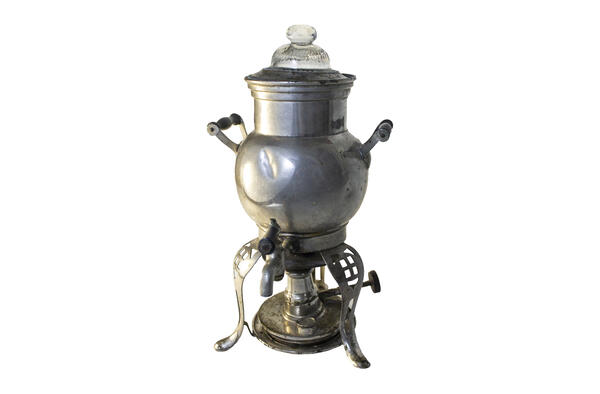
In Russia, a coffee pot on an alcohol burner became popular at the end of the 19th century, especially in Saint Petersburg, the capital of Russia at that time. Its construction allowed to make coffee right at the table in a living or dining room since the burning of alcohol produced no smell, soot, or smoke. Such coffee pots were produced at Saint Petersburg and Warsaw factories.
The coffee pot at the exhibition was purchased for the museum’s collection in 1977, from a resident of the city of Oryol, K. Nikolskaya.
In about 1800, Jean-Baptiste de Belloy, an Archbishop of Paris, improved the coffee pot construction. He equipped it with a sieve at the top, on which a cloth bag of ground coffee was put. Boiling water was poured on top. It seeped through the bag and sieve, and as a result, ready-to-drink coffee flowed to the bottom of the vessel.
Coffee appeared in Europe in the first half of the 16th century. In 1615, Venetian merchants brought it to Italy. In 1646, the first coffee house opened in Venice, then they appeared in Marseille and other French cities.
Coffee was brought to Russia during the reign of tsar Aleksey Mikhaylovich (1645–1676). It was used to cure some diseases, including migraines. The tradition of drinking coffee originated in the times of Peter the Great (1682–1725). The emperor forced his entourage to drink the new beverage that they called bitter swill. In 1703, the first coffee house was opened in Russia.
When drinking coffee became fashionable in Europe, the first coffee pots appeared. Before the invention of the coffee maker, the drink was served in special porcelain or semi-porcelain ware, similar to a teapot but smaller. The first coffee pot is considered to be invented in 1685, in France during the reign of Louis XV. It was a small jug. There was a metal plate at its bottom, and it was heated with an ordinary alcohol burner.
In Russia, a coffee pot on an alcohol burner became popular at the end of the 19th century, especially in Saint Petersburg, the capital of Russia at that time. Its construction allowed to make coffee right at the table in a living or dining room since the burning of alcohol produced no smell, soot, or smoke. Such coffee pots were produced at Saint Petersburg and Warsaw factories.
The coffee pot at the exhibition was purchased for the museum’s collection in 1977, from a resident of the city of Oryol, K. Nikolskaya.
In about 1800, Jean-Baptiste de Belloy, an Archbishop of Paris, improved the coffee pot construction. He equipped it with a sieve at the top, on which a cloth bag of ground coffee was put. Boiling water was poured on top. It seeped through the bag and sieve, and as a result, ready-to-drink coffee flowed to the bottom of the vessel.