In 1943, Lev Tolkunov, the war correspondent for the “Pravda” [“Truth”] newspaper, wrote:
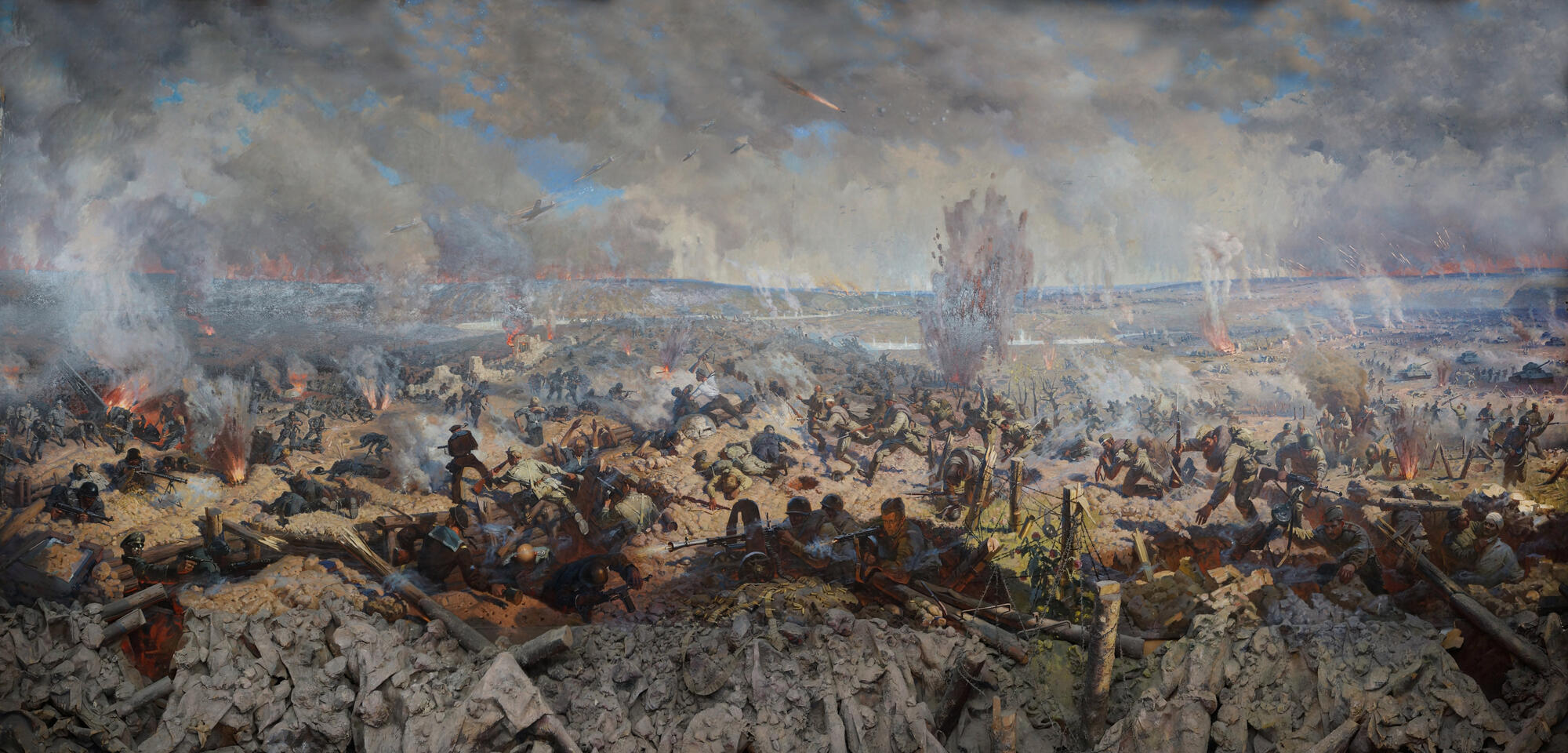


Diorama
Creation period
the 1960s
Place of сreation
Oryol
Dimensions
300x1000 cm
Technique
oil, canvas
Collection
Exhibition
1
Open in app#1
Diorama
#4
#5
The Battle for Oryol became one of the largest battles in the war history. It was unparalleled in the simultaneous concentration of huge masses of troops and all types of the most modern military equipment in narrow areas.
#2
The battle events are displayed in the diorama located in the Oryol Museum of Local History on Gostinaya Street. It is called “The Breakthrough of the Nazi Troops Defense in the Vicinity of the Village of Vyazhi, Novosilsky district. 1943.”
Three authors worked on the creation of the diorama: brothers Andrey and Leonid Kurnakov and Georgy Dyshlenko. All three fought on the fronts of World War II, and Dyshlenko personally participated in the liberation of the Oryol city.
The diorama is made in the oil on canvas technique. It is nine meters long and four meters high. It took about two years to create this masterpiece; the canvas was completed in 1960.
The diorama depicts the beginning of the enemy’s defense breakthrough by the strike forces of the Bryansk Front on July 11 and 12, 1934. The 3rd Army under the command of Lieutenant General Alexander Gorbatov and the 63rd Army under the command of Lieutenant General Vladimir Kolpakchi participated in the offensive. The breakthrough was carried out on the Zusha River near the village of Vyazhi, 90 kilometers to the east of Oryol.
The authors of the diorama showed the climax of the battle when Soviet troops had already stormed the first fortifications of the Nazis and hand-to-hand fighting began in the trench lines. The compositional center of the picture is the storming of the height, which was called the “Collective Farm Stable”.
Three authors worked on the creation of the diorama: brothers Andrey and Leonid Kurnakov and Georgy Dyshlenko. All three fought on the fronts of World War II, and Dyshlenko personally participated in the liberation of the Oryol city.
The diorama is made in the oil on canvas technique. It is nine meters long and four meters high. It took about two years to create this masterpiece; the canvas was completed in 1960.
The diorama depicts the beginning of the enemy’s defense breakthrough by the strike forces of the Bryansk Front on July 11 and 12, 1934. The 3rd Army under the command of Lieutenant General Alexander Gorbatov and the 63rd Army under the command of Lieutenant General Vladimir Kolpakchi participated in the offensive. The breakthrough was carried out on the Zusha River near the village of Vyazhi, 90 kilometers to the east of Oryol.
The authors of the diorama showed the climax of the battle when Soviet troops had already stormed the first fortifications of the Nazis and hand-to-hand fighting began in the trench lines. The compositional center of the picture is the storming of the height, which was called the “Collective Farm Stable”.
#7
The most important defensive post of the enemies were two dilapidated stone buildings of the collective farm stable. They were situated on the north-western outskirts of the Vyazhi village on a rocky hill at the mouth of the Panikovets river… a small hill with two stone buildings on its top dominated the entire bridgehead and the district within a radius of 4-5 kilometers. The Germans turned the higher ground with the stables into a powerful stronghold of their defense. Two lines of full-profile trenches with a lot of communications were built on the high slopes facing in our direction.
One of the battle participants, the captain Vasily Pozdeev recalled.
#6
The historical consultant of the painters was retired Major General Alexey Kustov. He took part in the battle and commanded a division that began to break through the Nazi defense near the village of Vyazhi on the Zusha River, fought to Oryol, and was one of the first to enter the city, liberating it from enemy forces.
#3
Ministry of Culture of the Russian Federation
read morehide
00:00
00:00
1x
Diorama
Creation period
the 1960s
Place of сreation
Oryol
Dimensions
300x1000 cm
Technique
oil, canvas
Collection
Exhibition
1
 Point your smartphone camera to open in the app
Open in app
Share