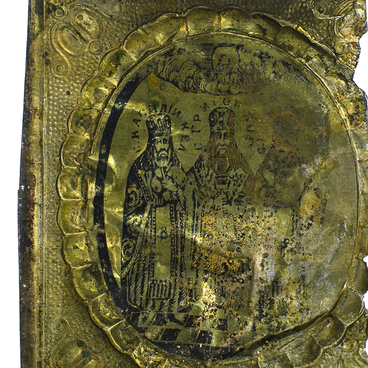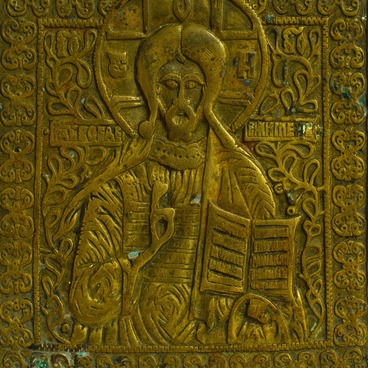
Inexpensive icons, which became widespread among the common people in the late 19th century, were printed. They were decorated with revetments made of tin, which were often reduced-in-size copies of images of saints and their hagiographies.
To save money, at the beginning of the 20th century, tin plates began to be replaced with revetments made of cheaper material — foil. It was embossed with images of icons dedicated to biblical subjects and holidays, as well as faces of saints and venerable Christians.
The Museum Complex of Kuybyshev houses a fragment of an icon’s revetment, depicting the scene (“kleimo” — literally “mark, branding”) “Resurrection of Christ”. Presumably, it is part of a lectern icon — a small image of a saint or a holiday. On the appropriate day, such an icon is placed on a special table, a lectern, and believers at the entrance to the church bow before the image and kiss it.
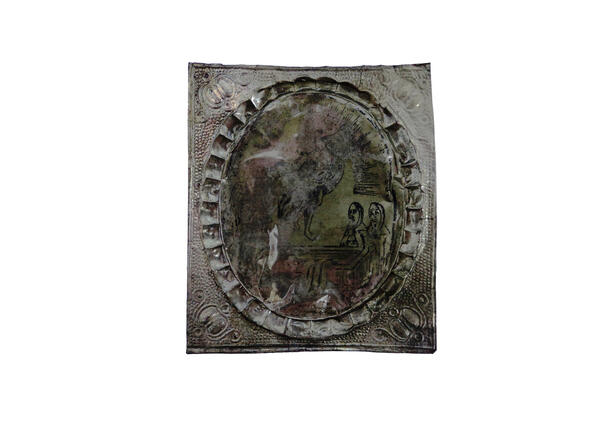
The displayed fragment is a plate made of metal foil, close to a square in shape. It was printed at the beginning of the 20th century. In the center of the plate is a flat depressed oval, bordered by a relief frame with a “blade” pattern. The ornament is made by stamping.
On the surface of the oval is a drawing in black paint made using a metal printing technique — chromolithography. In the scene, in the lower right corner, two female figures are visible — these are the myrrh-bearers. They stand by a rectangular coffin, from which burial sheets hang.
In the center of the scene is the lower left part of the floating figure of Jesus Christ with fluttering ribbons surrounded by rays. Due to the remnants of the paint layer, the right hand is still visible, it is pulled back. The image of the left part is completely lost.
In the upper central part, along the edge of the oval, the name of the copy is indicated — its iconographic type. The outer field of the plate features convex dots, and the corners — relief patterns. There is a simple geometric frame at the edges of the fragment.
The image of the Resurrection of Jesus Christ came into Russian culture in this form in the second half of the 18th century with engravings by Western artists which began to be brought into the country. Until that time, in Rus, depictions of the Resurrection of Christ corresponded to the canons of the plot “Descent into Hell”.
To save money, at the beginning of the 20th century, tin plates began to be replaced with revetments made of cheaper material — foil. It was embossed with images of icons dedicated to biblical subjects and holidays, as well as faces of saints and venerable Christians.
The Museum Complex of Kuybyshev houses a fragment of an icon’s revetment, depicting the scene (“kleimo” — literally “mark, branding”) “Resurrection of Christ”. Presumably, it is part of a lectern icon — a small image of a saint or a holiday. On the appropriate day, such an icon is placed on a special table, a lectern, and believers at the entrance to the church bow before the image and kiss it.
The displayed fragment is a plate made of metal foil, close to a square in shape. It was printed at the beginning of the 20th century. In the center of the plate is a flat depressed oval, bordered by a relief frame with a “blade” pattern. The ornament is made by stamping.
On the surface of the oval is a drawing in black paint made using a metal printing technique — chromolithography. In the scene, in the lower right corner, two female figures are visible — these are the myrrh-bearers. They stand by a rectangular coffin, from which burial sheets hang.
In the center of the scene is the lower left part of the floating figure of Jesus Christ with fluttering ribbons surrounded by rays. Due to the remnants of the paint layer, the right hand is still visible, it is pulled back. The image of the left part is completely lost.
In the upper central part, along the edge of the oval, the name of the copy is indicated — its iconographic type. The outer field of the plate features convex dots, and the corners — relief patterns. There is a simple geometric frame at the edges of the fragment.
The image of the Resurrection of Jesus Christ came into Russian culture in this form in the second half of the 18th century with engravings by Western artists which began to be brought into the country. Until that time, in Rus, depictions of the Resurrection of Christ corresponded to the canons of the plot “Descent into Hell”.