Small folding icons came to Rus from Byzantium around the 10th century. With the development of Russian icon-painting tradition, local craftsmen began to produce folding icons of their own. In general, they were two- or three-part images which were called “diptych” or “triptych”, respectively.
Such folding icons were cast from a copper alloy. The side images were attached to the central one with special pins and usually were half the size of the main, middle icon. The side images could be closed completely and sometimes fastened with a lock.
One of the most popular type of triptychs was “Deesis” — an image in which Jesus Christ is depicted in the center according to the canons of a specific iconographic type. Generally, it was the image Savior Not Made by Hands (the image of the Savior’s face) or Christ Pantocrator — most often the figure of Christ depicted in half-length holding the Gospel in one hand and making a gesture of blessing with the other. On both sides of him were the Mother of God and saints who pray to Jesus for the human race.
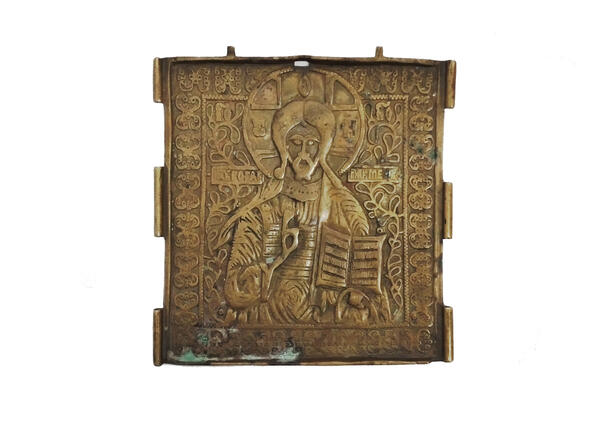
The central panel of the folding icon is a cast metal plate in the shape of a square. On the left and right sides of the main panels, one can see loops for mounting pins, to which the side panels were previously attached. On the upper edge to the left and right of the center are two protruding rectangular pins for fixing the icon. There is a hole in the center of the icon. Probably, it was made in order to pull a thread or a thin belt into it and fasten it onto something.
The middle part of the icon contains a relief half-length image of the Savior Almighty. The Lord blesses this world with His right hand, and in His left hand is an open Gospel.
The relief of the face and attire is meticulously worked out. The name of the icon is written in the center. Around the figure of the Savior is an ornament with the image of a bindweed around the perimeter of the main part of the panel. In the margins behind the central part is a pattern of curls.
Folding icons were especially appreciated among all copper icons. They could replace entire iconostases and menologies. People brought the icons with them on journeys, pilgrimages and campaigns, as they were reliable and convenient for transportation.
Such folding icons were cast from a copper alloy. The side images were attached to the central one with special pins and usually were half the size of the main, middle icon. The side images could be closed completely and sometimes fastened with a lock.
One of the most popular type of triptychs was “Deesis” — an image in which Jesus Christ is depicted in the center according to the canons of a specific iconographic type. Generally, it was the image Savior Not Made by Hands (the image of the Savior’s face) or Christ Pantocrator — most often the figure of Christ depicted in half-length holding the Gospel in one hand and making a gesture of blessing with the other. On both sides of him were the Mother of God and saints who pray to Jesus for the human race.
The Museum Complex of Kuybyshev houses the central part of the triptych “Deesis”, which, according to all canons, depicts the image Christ Pantocrator.
The central panel of the folding icon is a cast metal plate in the shape of a square. On the left and right sides of the main panels, one can see loops for mounting pins, to which the side panels were previously attached. On the upper edge to the left and right of the center are two protruding rectangular pins for fixing the icon. There is a hole in the center of the icon. Probably, it was made in order to pull a thread or a thin belt into it and fasten it onto something.
The middle part of the icon contains a relief half-length image of the Savior Almighty. The Lord blesses this world with His right hand, and in His left hand is an open Gospel.
The relief of the face and attire is meticulously worked out. The name of the icon is written in the center. Around the figure of the Savior is an ornament with the image of a bindweed around the perimeter of the main part of the panel. In the margins behind the central part is a pattern of curls.
Folding icons were especially appreciated among all copper icons. They could replace entire iconostases and menologies. People brought the icons with them on journeys, pilgrimages and campaigns, as they were reliable and convenient for transportation.