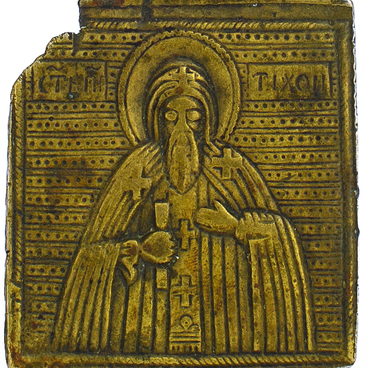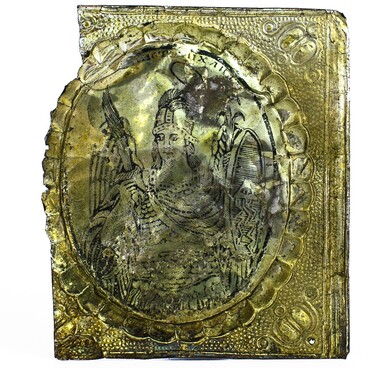
In the late 19th century, icons that were printed on cardboard and tin and decorated with tin revetments became a major part of the religious life of ordinary Orthodox Christians. Such icons were cheap and in great demand, as they were the most accessible to all segments of the population. Soon, such images, produced on an industrial scale and using industrial equipment, displaced church art works handmade at icon painting workshops. The process of creating an icon according to all the canons at monasteries and churches was extremely laborious and time-consuming. The master could work on one image for months or even years. Naturally, the price of the icon in this case was quite high. In addition, the production volume of hand-painted icons did not meet the ever-increasing demand for objects of worship. Hence printed icons became quite popular.
At the beginning of the 20th century, tin revetments began to be replaced with foil ones, as foil was cheaper. Images of saints were printed on these thin sheets of metal covering the icons. Most popular were icons of those who were quick helpers and saints to whom one could turn for help. One of these saints was Saint Paraskeva, called Friday.
For common people, Saint Paraskeva occupied as prominent a place among the holy wives, similar to the status of Nicholas the Wonderworker among all the saints: both were considered helpers in troubles and intercessors in misfortunes.
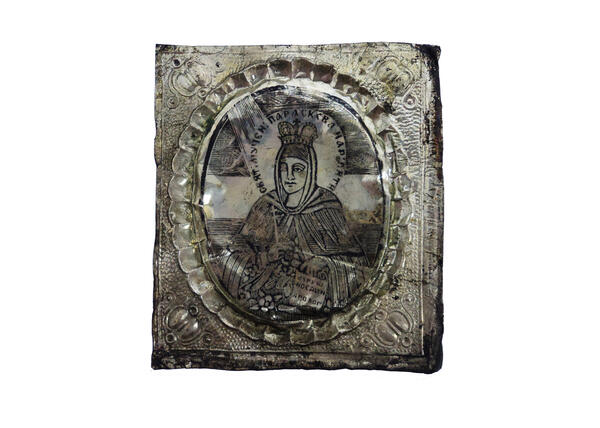
The Museum Complex of Kuybyshev houses a fragment of an icon’s revetment, depicting the printed scene (“kleimo” — literally “mark, branding”) “Holy Martyr Paraskeva called Friday”. It was stamped at the beginning of the 20th century; the exact date and place of printing are unknown.
The displayed fragment is a thin plate of metal foil, with a depressed flat oval in the center. It is bordered by a relief frame with a stamped “blade” pattern.
The oval features a half-length image of the holy martyr Paraskeva called Friday. It was made using printed plates and black paint. Her head is covered with a maphorion, with a crown on top. In her right hand, Friday holds a cross — a symbol of martyrdom, in her left — a scroll with a text.
Paraskeva Friday was considered the patroness of weddings, home, women’s work, travelers and trade.
At the beginning of the 20th century, tin revetments began to be replaced with foil ones, as foil was cheaper. Images of saints were printed on these thin sheets of metal covering the icons. Most popular were icons of those who were quick helpers and saints to whom one could turn for help. One of these saints was Saint Paraskeva, called Friday.
For common people, Saint Paraskeva occupied as prominent a place among the holy wives, similar to the status of Nicholas the Wonderworker among all the saints: both were considered helpers in troubles and intercessors in misfortunes.
The Museum Complex of Kuybyshev houses a fragment of an icon’s revetment, depicting the printed scene (“kleimo” — literally “mark, branding”) “Holy Martyr Paraskeva called Friday”. It was stamped at the beginning of the 20th century; the exact date and place of printing are unknown.
The displayed fragment is a thin plate of metal foil, with a depressed flat oval in the center. It is bordered by a relief frame with a stamped “blade” pattern.
The oval features a half-length image of the holy martyr Paraskeva called Friday. It was made using printed plates and black paint. Her head is covered with a maphorion, with a crown on top. In her right hand, Friday holds a cross — a symbol of martyrdom, in her left — a scroll with a text.
Paraskeva Friday was considered the patroness of weddings, home, women’s work, travelers and trade.