

Cast icons appeared in Rus at the time when Christianity was adopted as the official religion — in the 10th century. Such icons were the most convenient for everyday wear around the neck and frequent use. They were durable and cheap. Therefore, they have always been in great demand among the common people.
Cast icons were loved and revered by the Schismatics, they are also called Old Believers, who thought that these icons had been purified by fire.
The most common were one-sided icons worn over clothes so that the image was visible. Initially, cast images had removable projections on top with a hole for a lace. Later, these fastening loops became fixed.
One of these images is the one-sided icon “Holy Monk Tikhon”, which is in kept the collection of the Museum Complex of Kuybyshev.
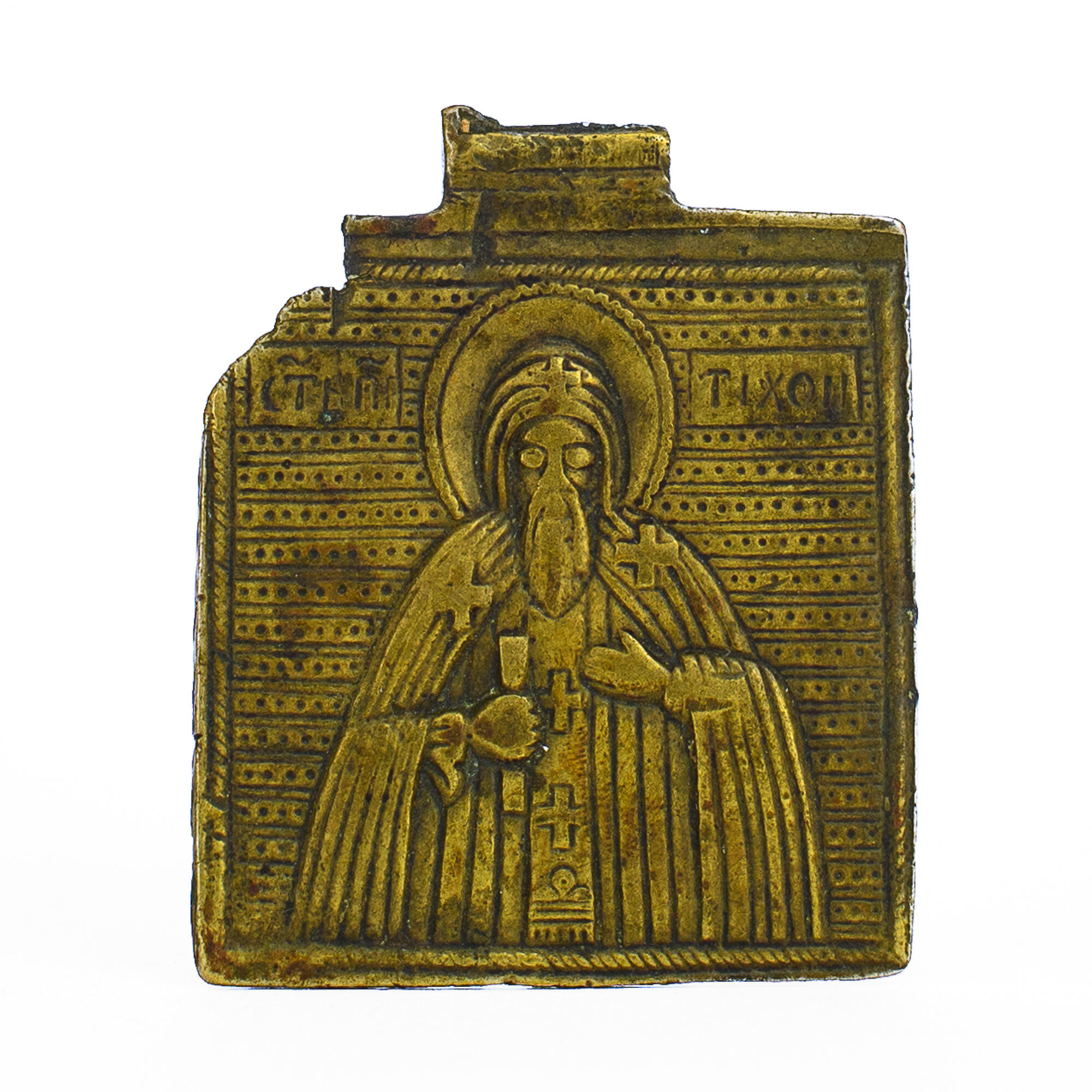
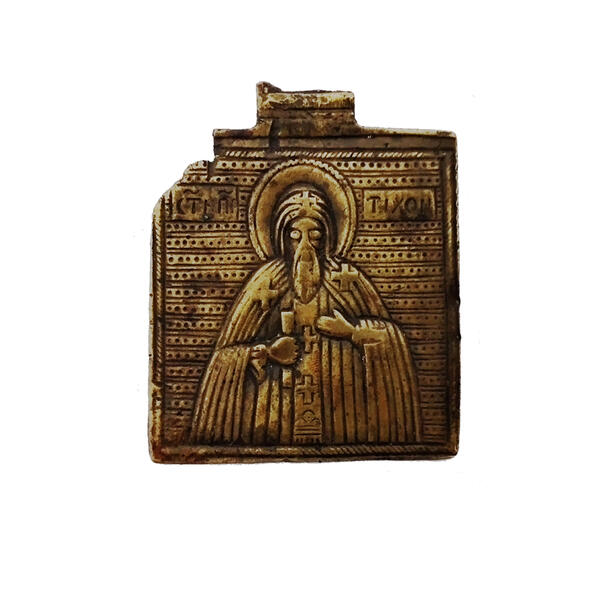
The icon is a thin cast metal plate close to a square in shape. The center of the upper side was supposed to feature a fixed loop, designed for a string or rope. Only a small part of it has been preserved.
In the center of the icon is a relief frontal half-length image of the Holy Monk Tikhon. The elder is depicted in the vestments of a schemamonk with a halo around his head. In his right hand, the saint holds a rolled-up scroll, and his left hand is pressed to his chest.
To the right and left of the halo, the saint’s name is cast in smooth rectangles. The background of the icon is made up of narrow horizontal stripes with a pattern of dots. The relief of the image is low with fine details and clear casting.
There were three most famous saints with the name Tikhon: Monk Tikhon of Lukh and Kostroma, Monk Tikhon of Medyn and Kaluga, and Monk Tikhon Sokolovsky.
Monk Tikhon of Lukh and Kostroma led an ascetic life and worked with his hands to feed himself. A monastery was established on the site of his exploits.
Monk Tikhon of Medyn and Kaluga took monastic vows in his youth and went into the dense forests as a hermit; later he also founded an Orthodox monastery.
Monk Tikhon Sokolovsky and his brothers lived in the vicinity of the village of Sokolovo separately from each other as ascetics.
Although some data was obtained during the examination of the icon, it is still difficult to determine which of the venerable ones is depicted in the icon.
Cast icons were loved and revered by the Schismatics, they are also called Old Believers, who thought that these icons had been purified by fire.
The most common were one-sided icons worn over clothes so that the image was visible. Initially, cast images had removable projections on top with a hole for a lace. Later, these fastening loops became fixed.
One of these images is the one-sided icon “Holy Monk Tikhon”, which is in kept the collection of the Museum Complex of Kuybyshev.
The icon is a thin cast metal plate close to a square in shape. The center of the upper side was supposed to feature a fixed loop, designed for a string or rope. Only a small part of it has been preserved.
In the center of the icon is a relief frontal half-length image of the Holy Monk Tikhon. The elder is depicted in the vestments of a schemamonk with a halo around his head. In his right hand, the saint holds a rolled-up scroll, and his left hand is pressed to his chest.
To the right and left of the halo, the saint’s name is cast in smooth rectangles. The background of the icon is made up of narrow horizontal stripes with a pattern of dots. The relief of the image is low with fine details and clear casting.
There were three most famous saints with the name Tikhon: Monk Tikhon of Lukh and Kostroma, Monk Tikhon of Medyn and Kaluga, and Monk Tikhon Sokolovsky.
Monk Tikhon of Lukh and Kostroma led an ascetic life and worked with his hands to feed himself. A monastery was established on the site of his exploits.
Monk Tikhon of Medyn and Kaluga took monastic vows in his youth and went into the dense forests as a hermit; later he also founded an Orthodox monastery.
Monk Tikhon Sokolovsky and his brothers lived in the vicinity of the village of Sokolovo separately from each other as ascetics.
Although some data was obtained during the examination of the icon, it is still difficult to determine which of the venerable ones is depicted in the icon.